
IE · vat
How to add and remove Irish VAT: net, VAT and total
Add VAT to a confirmed taxable amount, or extract VAT already included in a total. Follow the EUR examples, check the arithmetic and keep rate eligibility separate from the calculation.
EUR · Illustrative 23% assumption
See the VAT calculation
One amount, assumed 23% treatment. This example does not determine the rate applicable to your transaction.
- Before VAT
- EUR 100.00
- VAT amount
- EUR 23.00
- Including VAT
- EUR 123.00
EUR 100.00 + EUR 23.00 = EUR 123.00
VAT is rounded first to cents, exact half-cents up. The chart shows shares of the total, not the percentage applied to the before-tax amount.
This is the Irish calculator's display convention, not a verified mandatory Irish invoice rule. Cash-payment rounding is separate and is not applied here.
Establish the amount before choosing a calculation
Net or exclusive means the amount before VAT. Gross or inclusive means the total with VAT included. The tax amount connects the two: amount before VAT plus VAT equals the inclusive total.
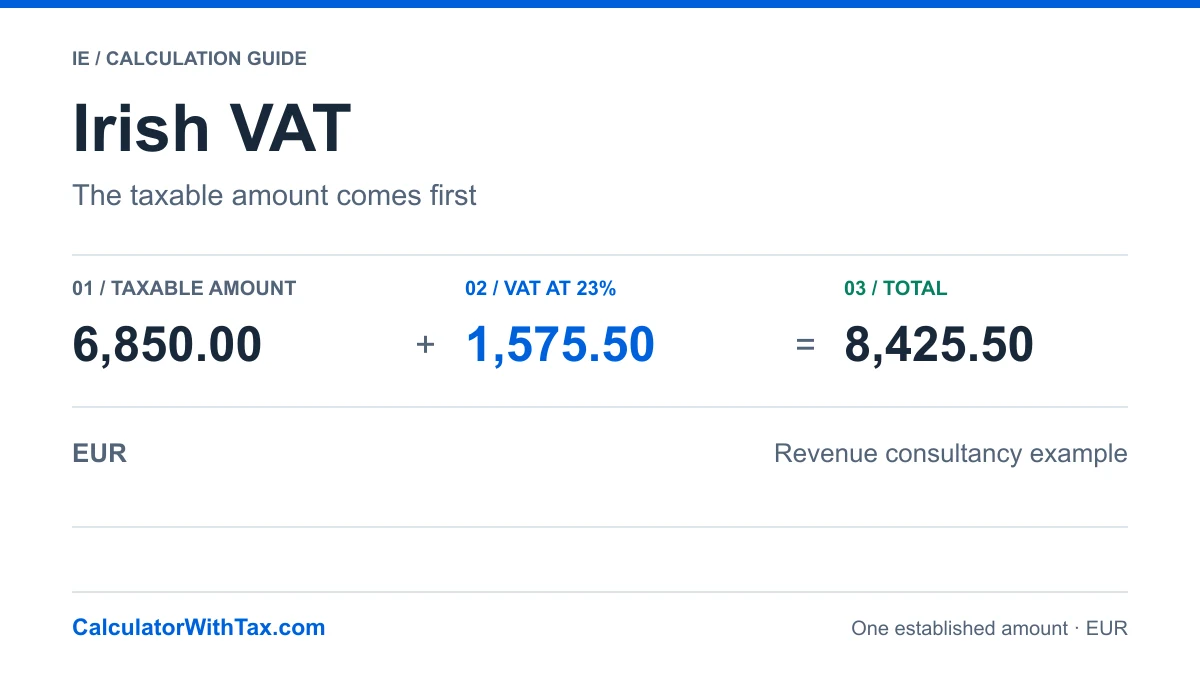
The taxable amount is not always the headline fee alone. Revenue’s taxable-amount guidance includes a consultancy example with additional charges. Establish the taxable amount first; this calculator does not decide which charges belong in it.
The Irish VAT calculator uses EUR and requires an explicit treatment choice. It covers Irish VAT arithmetic, not UK or Northern Ireland VAT, registration or place-of-supply decisions.
Add VAT to an exclusive amount
For an explicitly assumed rate, multiply the exclusive amount by that percentage divided by 100. The Irish calculator rounds the VAT component to cents, exact half-cents up, then adds it to the exclusive amount. This is a disclosed display convention, not a verified mandatory Irish invoice rule.
VAT = round(exclusive × rate ÷ 100)
Inclusive = exclusive + VAT
For a simple assumed 23% example, EUR 100 before VAT produces EUR 23 VAT and EUR 123 total. Confirm that treatment independently before using the percentage for a transaction.
Revenue’s published consultancy example uses EUR 6,850 exclusive, EUR 1,575.50 VAT and EUR 8,425.50 total. It is the independent addition row below, not a determination that every consultancy or reimbursement has identical treatment.
Extract VAT from an inclusive total
Use the inclusive fraction rather than subtracting the nominal percentage directly from the total:
VAT = round(inclusive × rate ÷ (100 + rate))
Exclusive = inclusive − VAT
At an assumed 23%, the VAT inside EUR 123 is EUR 123 multiplied by 23 and divided by 123: EUR 23. The remaining EUR 100 is the amount before VAT. Subtracting 23% of the inclusive total would instead leave EUR 94.71, which uses the wrong base for this example.
Reversing Revenue’s published total is a derived check of our arithmetic. Revenue’s cited example is an addition example; the reverse row is not a separately published official fixture. Removing VAT is also different from deciding reverse-charge liability.
Worked examples from the Irish engine
VAT rounded first to cents, half-cents up as a display convention, not a verified mandatory Irish rule. Each row uses this country's calculator engine. The percentages are explicit example assumptions, not a determination of treatment.
| Case and evidence | Input / mode / rate | Excluding VAT | VAT | Including VAT |
|---|---|---|---|---|
| Revenue consultancy exampleIndependent Revenue addition example; taxable amount already established | EUR 6,850.00Add · 23% | EUR 6,850.00 | EUR 1,575.50 | EUR 8,425.50 |
| Reverse the published totalDerived reverse check, not a separate official reverse example | EUR 8,425.50Remove · 23% | EUR 6,850.00 | EUR 1,575.50 | EUR 8,425.50 |
| Reduced-reference arithmeticSynthetic example; no reduced-rate eligibility decision | EUR 100.00Add · 13.5% | EUR 100.00 | EUR 13.50 | EUR 113.50 |
| Half-cent display boundarySynthetic half-up display policy, not a verified statutory requirement | EUR 0.50Add · 23% | EUR 0.50 | EUR 0.12 | EUR 0.62 |
The reduced-reference row assumes eligibility; it does not establish it. The exact half-cent row deliberately tests this engine’s display convention and is not an official midpoint example.
Confirm category and tax-point conditions separately
The current rate table, standard, reduced and second-reduced guidance have distinct purposes. A rate-table row date is not a complete effective window for every category. This calculator has no transaction-date lookup.
The category pages also contain date-specific changes, including changes effective from 1 July 2026. Do not use an old category example or assume the table’s date settles the treatment of your transaction. Check the relevant Revenue guidance before selecting a rate.
Zero-rating and exemption are not interchangeable. Exempt, outside-scope and unsupported scheme choices return no numerical result; they are not silently treated as zero-rated supplies.
Distinguish cent display from cash rounding
Half-up VAT-first rounding is a disclosed display policy, not a verified mandatory Irish invoice or return rule. The Central Bank’s cash-rounding guidance separates voluntary rounding of a cash payment from VAT charged on the unrounded amount. Card payments are not subject to that cash-rounding process. This calculator does not round the payment to five-cent increments.
The synthetic EUR 0.50 exclusive example produces EUR 0.115 VAT before rounding at an assumed 23%. Under this tool’s convention it displays EUR 0.12 VAT and EUR 0.62 total. It tests the display boundary; it is not an official statutory midpoint example.
Multi-line aggregation, return preparation, reverse-charge liability, special schemes, property rules, refunds and cross-border cases are excluded. Exact add/remove inversion is not promised after cent rounding. Other tools may use a different rounding convention at boundaries.
Check your result before using it
Confirm that the starting amount includes or excludes VAT, select the independently established treatment and check that the two components add to the total. A calculator with tax can explain those numbers without classifying the underlying transaction.
Do not combine several rates or invoice lines and assume the single-amount result is equivalent. Rounding the VAT component, the exclusive amount or individual lines can produce different cent boundaries. Compare the stated method, and seek appropriately qualified advice for transaction-specific obligations.
Sources and calculation limits
Revenue provides the rate, category and taxable-amount references; the Central Bank explains the separate cash-payment process. These links support the distinctions above, not a determination of your tax obligations. The independent consultancy example and synthetic test cases are labelled separately in the table.
Use the Irish VAT calculator, browse Ireland’s official tax references or read our calculation methodology. This guide is informational and does not replace professional tax advice.
Frequently asked questions
How do I add 23% Irish VAT?
For an amount already confirmed as subject to 23% VAT, multiply the amount before VAT by 23 and divide by 100. Under this tool's display convention, round the VAT to cents and add it to the original amount. EUR 100 before VAT becomes EUR 123 including EUR 23 VAT.
How do I remove 23% VAT from a total?
Calculate the included VAT as total multiplied by 23 divided by 123. This tool rounds that VAT component to cents and subtracts it from the total. With an assumed 23% treatment, EUR 123 includes EUR 23 VAT and EUR 100 before VAT.
Is Irish VAT always 23%?
No. Revenue lists several rates and separate category conditions. Check the applicable category and transaction date; selecting a rate in the calculator does not establish eligibility.
Does Irish cash rounding change the VAT amount?
The Central Bank distinguishes voluntary cash-payment rounding from VAT charged on the unrounded amount. The calculator does not round the final payment to five-cent increments.
Is reverse VAT the same as the reverse charge?
No. Removing VAT means extracting an included tax amount. Reverse-charge obligations concern who accounts for VAT and are outside this tool's scope.
Can I use this calculation to prepare a VAT return or certify an invoice?
No. The tool calculates one established amount under a stated display convention. It does not determine taxable charges, invoice aggregation, registration, deductions, special schemes or return obligations.
Use the same country engine
Add tax or extract the included amount with the calculation method used in these examples. Select the treatment applicable to your transaction separately.
Ireland VAT calculator