
NZ · gst
How to add and remove New Zealand GST: 15% and the 3/23 fraction
Add GST to an exclusive price, or extract GST already included in a total. Follow IRD's NZD examples and use the exact 3/23 fraction, while keeping tax eligibility and rounding requirements separate.
NZD · Illustrative 15% assumption
See the GST calculation
One amount, assumed 15% treatment. This example does not determine the rate applicable to your transaction.
- Before GST
- NZD 100.00
- GST amount
- NZD 15.00
- Including GST
- NZD 115.00
NZD 100.00 + NZD 15.00 = NZD 115.00
GST is rounded first to cents, exact half-cents down under a provisional display policy. The chart shows shares of the total, not the percentage applied to the before-tax amount.
This one-amount example does not establish whether section 19O applies, aggregate invoice lines or enforce consistency over a taxable period. Current-law applicability and professional review remain incomplete.
Establish the treatment before doing arithmetic
Exclusive means the price before GST. Inclusive means the total with GST already included. Decide which starting amount you have before adding or extracting tax.
IRD’s overview and charging guidance describe the GST context. The New Zealand GST calculator starts with its treatment blank. Selecting NZD does not decide registration, eligibility or the time of supply.
This guide assumes one ordinary monetary price already confirmed as standard-rated. It is not a GST return, registration service or product-classification engine.
Add GST to an exclusive price
For an amount already confirmed as subject to 15% GST, calculate the tax from the price before GST. The New Zealand engine rounds the GST component first under its disclosed provisional cent-display policy, then adds it to the original price.
GST = roundGST(exclusive × 15 ÷ 100)
Inclusive = exclusive + GST
IRD’s calculation examples reconcile NZD 100 exclusive, NZD 15 GST and NZD 115 inclusive. Those published figures do not resolve how every possible half-cent should be displayed.
Extract GST with the exact inclusive fraction
For that standard reference, included GST is the inclusive price multiplied by 3 and divided by 23. Do not use a truncated decimal substitute for the fraction, or subtract 15% directly from the total.
GST = roundGST(inclusive × 3 ÷ 23)
Exclusive = inclusive − GST
IRD separately publishes the reverse NZD 115 example. Its charging guidance also states NZD 13.04 GST inside NZD 100 inclusive; the corresponding exclusive amount in our table is derived by subtraction.
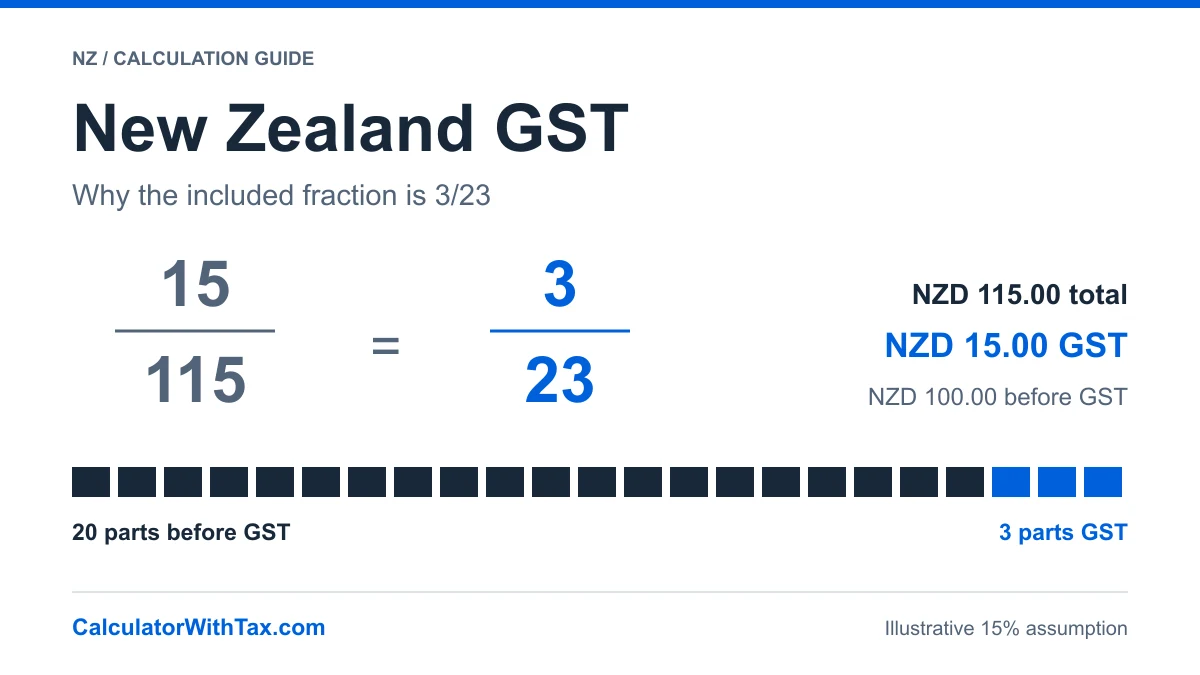
The fraction follows from the tax base: 15 parts GST divided by 115 parts inclusive price simplifies to 3/23. It is not 15/100 of the inclusive total. At NZD 115 including GST, subtracting 15% would leave NZD 97.75 rather than the NZD 100 before GST in IRD’s example.
Worked examples from the New Zealand engine
Provisional GST-first cent display, half-cents down; current-law verification and human approval pending. Each row uses this country's calculator engine. The percentages are explicit example assumptions, not a determination of treatment.
| Case and evidence | Input / mode / rate | Excluding GST | GST | Including GST |
|---|---|---|---|---|
| IRD addition exampleIndependent IRD calculating-GST example | NZD 100.00Add · 15% | NZD 100.00 | NZD 15.00 | NZD 115.00 |
| IRD extraction exampleIndependent IRD calculating-GST reverse example | NZD 115.00Remove · 15% | NZD 100.00 | NZD 15.00 | NZD 115.00 |
| GST within an inclusive priceIRD states GST of 13.04; exclusive amount is derived | NZD 100.00Remove · 15% | NZD 86.96 | NZD 13.04 | NZD 100.00 |
| Provisional half-cent boundarySynthetic half-down candidate; current-law verification pending | NZD 0.10Add · 15% | NZD 0.10 | NZD 0.01 | NZD 0.11 |
The last row is synthetic: NZD 0.10 exclusive produces exact GST of NZD 0.015, displayed by this tool as NZD 0.01. That provisional half-down boundary is intentionally different from the Australian and Irish engines’ half-up displays. The chart and table use the New Zealand engine, not the global manual calculator.
Why the rounding policy remains provisional
GST Act section 19O describes an optional approach for fractional cents in amounts of tax shown in taxable supply information or supply correction information. It distinguishes fractions no greater than half a cent from larger fractions; it also provides individual-amount and supply-total alternatives and requires consistency within a taxable period when relying on that approach.
The consolidated text viewed on 18 October 2026 is dated 30 June 2026 and carries an unincorporated-amendments notice. Do not treat the displayed version date or this one-amount implementation as a complete assessment of which requirements apply to your transaction or document. Amendment applicability and professional review remain incomplete; no universal mandatory half-down rule is claimed.
In this guide, roundGST means the calculator’s provisional GST-first, nearest-cent display with exact half-cents down. The tool neither aggregates invoice lines nor enforces period-wide consistency. Its arithmetic is not proof of invoice or filing compliance. Other tools may round a different component or use another convention, producing different boundary results.
Keep classifications and unsupported cases separate
Zero-rated supplies have conditions; a zero selection does not establish them. Exempt supplies are distinct. Exempt and outside-scope selections clear numerical results instead of being relabelled as zero-rated.
Mixed baskets, special supplies, cash payments, multi-line invoices, credit adjustments, discounts, imports, exports, GST credits and returns are outside this guide’s implemented scope. Confirm treatment independently before using arithmetic results.
Check your result before using it
Check the starting price, the independently established treatment and whether the price before GST plus the displayed tax equals the inclusive total. A calculator with tax can explain that arithmetic without deciding the legal treatment of the supply.
Keep mixed rates and individual invoice lines separate from a one-amount example. Seek appropriately qualified advice when eligibility, document requirements or filing obligations are uncertain. Cash-payment rounding and GST credits are not implemented here.
Sources and calculation limits
IRD supplies the independent addition and extraction examples and the distinction between zero-rated and exempt supplies. Section 19O provides the limited rounding context discussed above, not a universal compliance certification. The examples are calculations, not customer testimonials.
Use the New Zealand GST calculator, browse official New Zealand tax references or read our calculation methodology. This guide is informational and does not replace professional tax advice.
Frequently asked questions
How do I add 15% GST in New Zealand?
For a price already confirmed as subject to 15% GST, multiply the price before GST by 15 and divide by 100. Add the rounded GST component to that price. IRD's example adds NZD 15 GST to NZD 100, giving NZD 115 total.
Why is the included-GST fraction 3/23?
At an assumed 15% rate, an inclusive price contains 100 parts before GST and 15 parts GST. The GST share is 15/115, which simplifies exactly to 3/23. Keep that fraction exact until rounding the tax component.
Can I remove GST by subtracting 15% of the total?
No. The percentage was applied to the price before GST, not to the inclusive total. For NZD 115 including GST, the included tax is NZD 15 using 3/23, leaving NZD 100. Subtracting 15% of NZD 115 would leave NZD 97.75 instead.
Must every New Zealand calculation round exact half-cents down?
No universal mandatory rule is established here. Section 19O describes an optional approach for specified tax information, with amount-versus-total alternatives and taxable-period consistency requirements. This calculator's half-down display remains provisional and does not determine legal applicability.
Is zero-rated the same as exempt?
No. The classifications have different conditions. Selecting zero-rated does not establish eligibility or entitlement to recover GST. Exempt and outside-scope choices return no calculation in this tool.
Can I use this as a GST return or invoice-compliance check?
No. The calculator handles one price. It does not aggregate invoices, enforce period-wide consistency, classify supplies or calculate filing adjustments and GST credits.
Use the same country engine
Add tax or extract the included amount with the calculation method used in these examples. Select the treatment applicable to your transaction separately.
New Zealand GST calculator