
AE · business-workflows
UAE VAT-inclusive discount calculator: final-price examples
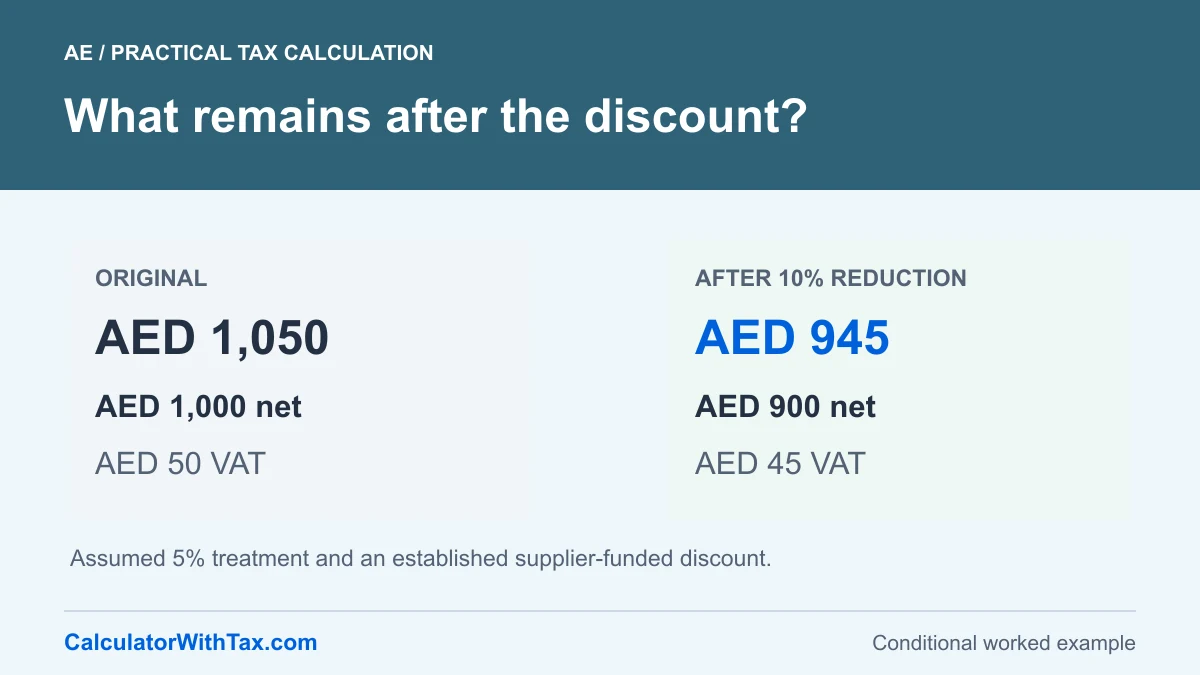
For an established 5% VAT-inclusive price of AED 1,050 and an eligible supplier-funded 10% price reduction, the final amount is AED 945. Its before-VAT portion is AED 900 and VAT is AED 45. The calculation does not determine discount eligibility or create a compliant credit note.
Identify the final inclusive price first
A UAE VAT-inclusive discount calculator is useful once the reduction and tax treatment have already been established. For an assumed ordinary 5% VAT-inclusive price of AED 1,050, an eligible supplier-funded 10% reduction removes AED 105. The remaining AED 945 contains AED 900 before VAT and AED 45 VAT.
The discount percentage is not a VAT percentage. One measures a commercial reduction from the agreed price; the other describes the tax treatment of the resulting consideration. Keeping those roles separate avoids adding tax again to an amount that already contains it.
The UAE government VAT overview supplies the 5% standard-rate context. This illustration does not classify goods or services, determine registration or establish eligibility for zero rating or exemption.
Establish the discount conditions before using the formula
Article 28 of the Executive Regulation linked through the FTA’s VAT legislation listing addresses discounts and vouchers. The September 2026 English text describes a discount benefiting the customer and funded by the supplier.
This article assumes the relevant conditions are met. It does not infer them merely because a checkout displays “sale,” “cashback” or “coupon.” A third-party contribution, voucher or later reimbursement can raise different questions. Establish the arrangement before treating a lower customer payment as a straightforward reduction of taxable consideration.
The calculation below is deliberately narrower than a promotions engine. It uses one known inclusive price and one established supplier-funded reduction, with no mixed treatment or additional fees.
Follow the AED 1,050 example
The original inclusive price is AED 1,050. Ten percent of that amount is AED 105, so the agreed reduction leaves AED 945 payable. Extracting the established 5% VAT from that remainder gives AED 45. Subtracting it leaves AED 900 before VAT.
Originally, the assumed AED 1,050 contained AED 1,000 before VAT and AED 50 VAT. The reduction therefore changes the before-VAT amount by AED 100 and the VAT component by AED 5. Those components sum to the AED 105 inclusive reduction.
Check an agreed VAT-inclusive discount
One established UAE 5% taxable price and supplier-funded price reduction benefiting the customer. Voucher, third-party funding, credit-note and filing decisions excluded.
Included VAT = final established inclusive price x 1/21 before cent rounding.
- Final inclusive price
- AED 945.00
Original inclusive price: AED 1050.00; Established discount: AED 105.00; Final before VAT: AED 900.00; Included VAT: AED 45.00; Final inclusive price: AED 945.00
| Starting assumptions | Tax in the stated amount | Scenario result |
|---|---|---|
| Established percentage price reduction: AED 1,050.00; 10% | AED 45.00 | Final inclusive price: AED 945.00 |
| Established percentage price reduction: AED 2,100.00; 25% | AED 75.00 | Final inclusive price: AED 1,575.00 |
| Established percentage price reduction: AED 1,050.00; 0% | AED 50.00 | Final inclusive price: AED 1,050.00 |
The before-and-after receipts are synthetic educational examples, not FTA invoice samples or reports of customer purchases. Their values are checked with the same decimal helper as the adjustable comparison, so the cover, table and result use one numerical basis.
Why included VAT is one twenty-first
At an established 5% treatment, an inclusive price represents 105 parts: 100 before VAT and 5 VAT. The included VAT fraction is 5 over 105, simplifying to 1 over 21. For AED 945, dividing by 21 gives AED 45 VAT.
Multiplying AED 945 by 5% would instead give AED 47.25. That calculates 5% of an amount already containing VAT and therefore overstates its included component. It is not an alternative rounding method.
The fraction only applies when the full input has the assumed treatment. A receipt containing exempt items, differently treated supplies or unrelated fees cannot generally be reversed as one 5% amount. The UAE inclusive-price VAT guide explains that starting-basis distinction in more detail.
Compare another discount without changing the treatment
Assume AED 2,100 inclusive and an established 25% supplier-funded price reduction. The reduction is AED 525, leaving AED 1,575. At the same assumed 5% treatment, the final before-VAT portion is AED 1,500 and VAT is AED 75.
With no reduction on the original AED 1,050 price, the final price remains AED 1,050 and its included VAT remains AED 50. A zero discount is not a zero-rated supply. Likewise, a large discount percentage does not change the underlying VAT rate by itself.
The worked table demonstrates these separate assumptions, rather than suggesting that a buyer can select whichever discount produces a preferred tax result. The discount must reflect the actual agreed arrangement.
Fixed-amount offers need inclusive or exclusive wording
A fixed AED 100 reduction from an AED 1,050 inclusive price leaves AED 950. Reducing the corresponding AED 1,000 before-VAT price by AED 100 instead leaves AED 900 before VAT and AED 945 inclusive under the assumed 5% treatment.
The two final prices differ because the agreement applies the same numeric reduction to different starting bases. Neither method should be selected simply because it looks more generous. Read whether the offer changes the final consumer price or the before-VAT consideration.
For a percentage reduction uniformly applied to the same single-treatment price, the exact proportional relationships are simpler. Fixed inclusive and exclusive amounts do not share that convenience, and cent rounding can introduce additional small differences.
A lower payment is not always a lower taxable price
A customer might pay less because another party contributes, because a voucher is redeemed, or because a separate credit is used in settlement. Those facts do not automatically match the supplier-funded discount assumed here.
The calculator does not ask who funds every promotion or trace the seller’s reimbursement. It therefore cannot certify the VAT value for those arrangements. Article 28’s voucher provisions and other applicable rules need their own review rather than being collapsed into a percentage reduction.
Keep the original sale terms, promotion funding and final invoice together. If the commercial arrangement is unclear, the most useful next step is to establish it, not to apply a more elaborate reverse-tax formula to the amount charged to a bank card.
Handle later changes and records separately
A price established at checkout and a later reduction after an invoice has been issued can require different record handling. This illustration does not prepare a tax credit note, determine the relevant reporting period or assign adjustments between supplier and customer.
The two-decimal display is a transparent single-amount calculation convention. Multi-line allocation, invoice reconciliation and statutory record requirements are not implemented by the chart. Do not infer document compliance from a total that adds up correctly.
When reviewing a one-cent discrepancy, compare the exact price basis and rounding scope before changing the rate or discount. A rounded component from an earlier invoice may not match an independently recalculated component from a newly rounded final price.
A practical final-price checklist
- Establish what the quoted amount includes and the actual VAT treatment.
- Confirm the commercial reduction, who funds it and the relevant conditions.
- Identify whether the reduction applies to an inclusive or exclusive amount.
- Calculate the established final consideration.
- Extract its known VAT component and reconcile the total.
- Complete required records and any later adjustment process separately.
This sequence keeps the calculator useful without overstating its authority. It provides reproducible final-price arithmetic while leaving eligibility, special promotions and legally required documents to the facts and rules that actually govern them.
Frequently asked questions
How do I calculate a 10% discount on AED 1,050 including VAT?
If the established discount reduces the full inclusive price by 10%, subtract AED 105 to get AED 945. At an already confirmed 5% treatment, that contains AED 45 VAT and AED 900 before VAT.
Why is included UAE VAT divided by 21?
For an amount wholly inclusive of an established 5% treatment, the tax fraction is 5 over 105, which simplifies to 1 over 21. It is not 5% of the inclusive amount.
Does every promotion reduce the VAT value?
No. The relevant conditions must be established. Article 28 of the cited Executive Regulation addresses a customer-benefiting discount funded by the supplier; third-party funding and vouchers cannot automatically be treated as the same case.
Is a fixed AED 100 reduction the same before and after VAT?
No. A reduction of AED 100 from the inclusive total differs from reducing the before-VAT price by AED 100. Establish the offer's actual price basis.
Does this prepare a credit note or VAT return?
No. It only illustrates one established final-price reduction at a single treatment. Documentation, timing, return adjustments and customer eligibility are outside the calculator's completed scope.
Check a separately established amount
Use one confirmed taxable amount and the applicable percentage. The manual calculator does not select a rate or classify the transaction.
Open the manual calculator