
CA · gst
How to calculate Canadian GST/HST: province, price and reverse tax
Choose the independently established place of supply, identify whether the price includes GST/HST, and calculate the GST/HST component. Keep separate PST/QST out of a GST-only reverse calculation.
Choose the independently determined place of supply and treatment. No rate is selected automatically.
Supported reference window: 1 April 2025–18 October 2026. Earlier/future dates and transitional transactions are not calculated. The date does not determine when tax becomes payable.
One CAD amount; up to two decimals and CAD 1,000,000,000,000. PST/QST, cash-payment rounding, rebates and filing calculations are excluded.
GST/HST only · separate PST/QST excluded
- Before GST/HST
- GST/HST component
- Subtotal + GST/HST only
Select a province or territory and a treatment to see the formula.
Tax-first nearest-cent display, exact half-cents up. One established amount only; not a complete invoice or tax-compliance check.
Source check: · CRA rate table · CRA rounding guidance. Professional tax review is pending.
Start with the place of supply
The correct starting question is not simply where the seller lives. Identify where the supply is considered to occur, then establish its GST/HST treatment. CRA’s place-of-supply guidance explains why a delivery destination can change the relevant province.
This guide covers ordinary, already-classified single amounts within the supported reference window, 1 April 2025–18 October 2026. It does not decide the place of supply, registration or tax eligibility. The date window is a software scope limit, not a claim that each rate was introduced on its first day or expires on its last day.
The Canada GST/HST calculator starts with province and treatment unselected. Its inputs and worked examples use the same decimal engine.
Separate GST/HST from provincial sales taxes
HST is a combined tax: do not add a second GST charge on top of the HST amount. Separate PST or QST is different. In this version, those components are not calculated; the result is labelled subtotal + GST/HST only, not a promise of the final amount payable.
In particular, a receipt that includes both GST and a separate provincial tax cannot be reversed with a GST-only denominator. Remove or separately establish the provincial component first using appropriate official guidance. The reverse control requires explicit confirmation for the four separate-tax jurisdictions.
CRA’s charging guidance says to calculate GST on the price excluding PST. This tool does not determine the provincial tax base or exemptions. A complete Canadian sales-tax calculator needs more than adding a province label to one national percentage.
Add GST/HST to a before-tax amount
For one established taxable base, calculate the GST/HST component, round it to cents, and add that component to the base:
GST/HST = round(before-tax amount × rate ÷ 100)
Subtotal plus GST/HST = before-tax amount + GST/HST
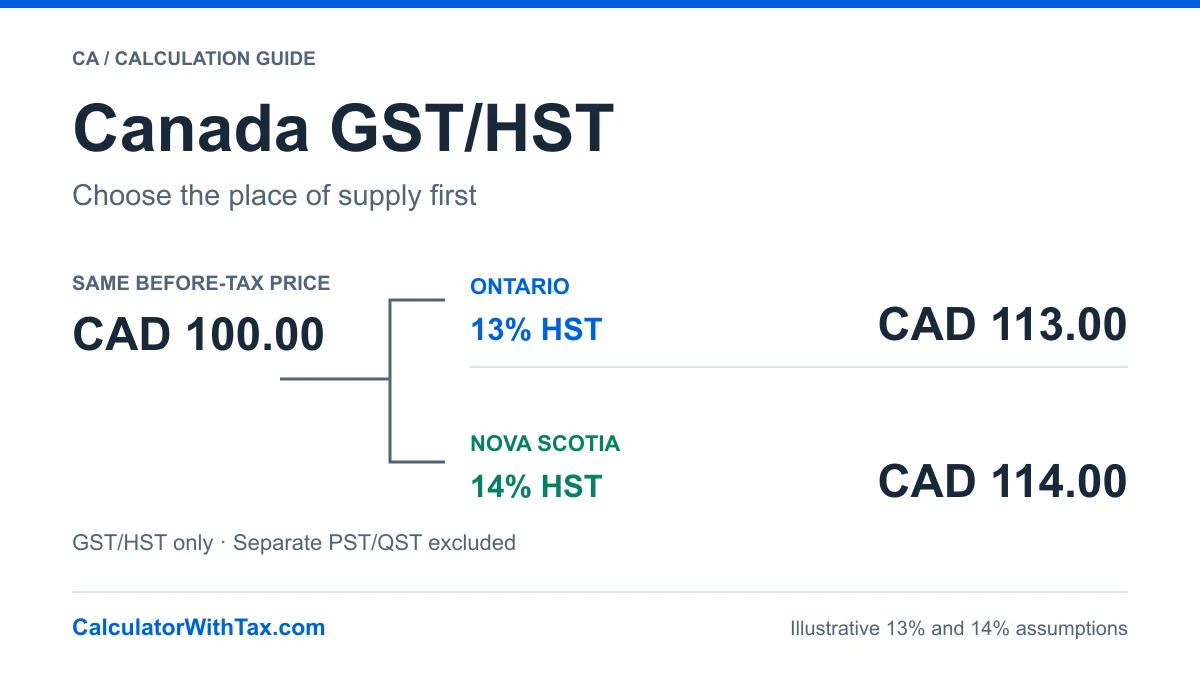
For an assumed Ontario supply at the 13% reference, CAD 100 before HST gives CAD 13 HST and CAD 113 including HST. Under Nova Scotia’s 14% reference, the same base produces CAD 14 HST and CAD 114. These amounts are derived illustrations, not a decision that either rate applies to your sale.
Extract tax with the inclusive fraction
The tax percentage is based on the price before tax. That is why removing included tax is not the same as subtracting the rate directly from the total.
GST/HST = round(GST/HST-only total × rate ÷ (100 + rate))
Before-tax amount = GST/HST-only total − rounded GST/HST
For an Ontario price containing only 13% HST, use 13/113 of the inclusive amount. CAD 113 contains CAD 13 HST, leaving CAD 100. Subtracting 13% of CAD 113 instead would leave CAD 98.31, which is not the original base. That is a common reverse-tax error.
The corresponding GST fraction at 5% is 5/105, or 1/21. At Nova Scotia’s 14% reference, it is 14/114, or 7/57. Preserve the exact denominator until rounding; do not replace it with a shortened decimal.
Compare worked examples and provincial references
| Case | Place / input / mode | Before GST/HST | GST/HST | Subtotal + GST/HST |
|---|---|---|---|---|
| CRA RC4022 discounted subtotalIndependent published subtotal, GST and total; discount calculation not implemented. | AlbertaCAD 3,225.00 · add · 5% | CAD 3,225.00 | CAD 161.25 | CAD 3,386.25 |
| Ontario included HSTDerived arithmetic, not a separate official reverse example. | OntarioCAD 113.00 · remove · 13% | CAD 100.00 | CAD 13.00 | CAD 113.00 |
| Nova Scotia laptop scenarioDerived amounts from CRA's CAD 1,000 scenario and 14% rate; not transition eligibility. | Nova ScotiaCAD 1,000.00 · add · 14% | CAD 1,000.00 | CAD 140.00 | CAD 1,140.00 |
| Exact half-cent boundarySynthetic single-amount rounding check. | AlbertaCAD 0.10 · add · 5% | CAD 0.10 | CAD 0.01 | CAD 0.11 |
GST/HST reference by province and territory
CRA table for the reference period beginning 1 April 2025; source checked 18 October 2026. Establish place of supply and tax treatment separately.
| Place of supply | GST/HST reference | Separate tax excluded |
|---|---|---|
| Alberta | GST · 5% | No separate PST/QST component in this reference |
| British Columbia | GST · 5% | PST not calculated |
| Manitoba | GST · 5% | PST not calculated |
| New Brunswick | HST · 15% | No separate PST/QST component in this reference |
| Newfoundland and Labrador | HST · 15% | No separate PST/QST component in this reference |
| Northwest Territories | GST · 5% | No separate PST/QST component in this reference |
| Nova Scotia | HST · 14% | No separate PST/QST component in this reference |
| Nunavut | GST · 5% | No separate PST/QST component in this reference |
| Ontario | HST · 13% | No separate PST/QST component in this reference |
| Quebec | GST · 5% | QST not calculated |
| Prince Edward Island | HST · 15% | No separate PST/QST component in this reference |
| Saskatchewan | GST · 5% | PST not calculated |
| Yukon | GST · 5% | No separate PST/QST component in this reference |
The first row reproduces the already-established CAD 3,225 discounted subtotal, CAD 161.25 GST and CAD 3,386.25 total in CRA RC4022’s volume-discount example. Its discount mechanics are not implemented here. The Ontario reverse example is derived arithmetic, the Nova Scotia row derives amounts from CRA’s laptop scenario, and the half-cent row is synthetic.
Check the reference date and Nova Scotia transition
CRA’s rate table identifies the Nova Scotia HST change to 14% from 1 April 2025. A date alone does not settle every transitional transaction: payment timing, the supply and special rules can matter. Those determinations are outside this calculator.
The calculator’s date control rejects dates before the supported table period and after the source-check date. This is deliberately narrower than a historical or future tax engine. Do not use a current reference to overwrite an older invoice’s treatment.
Round the tax component, not a cash payment
CRA RC4022 discusses nearest-cent GST/HST rounding, with half-cents rounded up. We apply that convention to the single tax component first, then derive the other amount so the displayed parts reconcile.
For the synthetic CAD 0.10 example at 5%, exact GST is CAD 0.005. The engine displays CAD 0.01 tax and CAD 0.11 subtotal plus GST. This is a boundary test, not an independent official worked example. It does not establish a universal invoice-aggregation method or implement rounding a cash payment to a nickel.
Keep zero-rated and exempt classifications distinct
CRA distinguishes taxable, zero-rated and exempt supplies. A zero-rated selection performs 0% GST/HST arithmetic only after you establish that classification. It does not settle separate provincial taxes or tax-credit eligibility.
Exempt and outside-scope choices show no numerical calculation. They are not silently treated as zero-rated. Point-of-sale rebates, special supplies, imports, credits, returns, mixed baskets and line-item invoice calculations also need a different, verified scope.
Use the result with its assumptions
Check the place of supply, date, input price and treatment. Confirm that before-tax amount plus GST/HST equals the displayed subtotal-plus-tax, and that no separate PST or QST has been smuggled into a GST-only reverse input.
A calculator with tax should make those assumptions inspectable. Copy and print retain the reference version, engine version, source links and exclusions; financial inputs are processed locally, not sent automatically.
Use the Canadian GST/HST calculator, browse Canada’s official-source directory or read the calculation methodology. This guide is informational, not a tax-compliance certification or personalized advice. Independent professional tax review remains pending.
Frequently asked questions
Which GST/HST rate should I use?
The rate depends on the place of supply and tax treatment, not simply your home address. The calculator requires a province or territory and a treatment; it does not classify the transaction for you.
How do I remove Ontario HST from a price?
For an ordinary supply already confirmed as subject to 13% HST, the included HST fraction is 13/113. For CAD 113 including only HST, the tax is CAD 13 and the before-tax amount is CAD 100. This is a derived arithmetic example.
Does this calculator include PST or QST?
No. Separate PST and QST are excluded. In British Columbia, Manitoba, Saskatchewan and Quebec, the displayed subtotal plus GST is not a full sales-tax-inclusive amount. A reverse GST calculation requires confirming that the entered amount excludes the separate provincial tax.
Is Nova Scotia HST still 15%?
CRA's current reference table uses 14% from 1 April 2025. Transitional timing and special cases require separate assessment. This tool does not calculate earlier dates or determine when tax becomes payable.
How are half-cents rounded?
The GST/HST component is rounded to the nearest cent, with exact half-cents rounded up, following the fractional-amount discussion in CRA RC4022. The other displayed amount is reconciled after rounding. Cash-payment rounding is separate and not applied.
Can this calculate a GST/HST return or a multi-tax receipt?
No. This is one GST/HST component on one established amount. It does not determine registration, credits, point-of-sale rebates, provincial tax, mixed supplies, invoice-line aggregation or return filing.
Use the same country engine
Add tax or extract the included amount with the calculation method used in these examples. Select the treatment applicable to your transaction separately.
Canada GST/HST calculator