
IN · reverse-tax
Reverse GST calculator India: inclusive price and tax components
To reverse one known combined GST rate, divide the inclusive amount by 1 plus that rate divided by 100. Our 18% examples are assumed arithmetic inputs, not a universal Indian rate or a product classification.
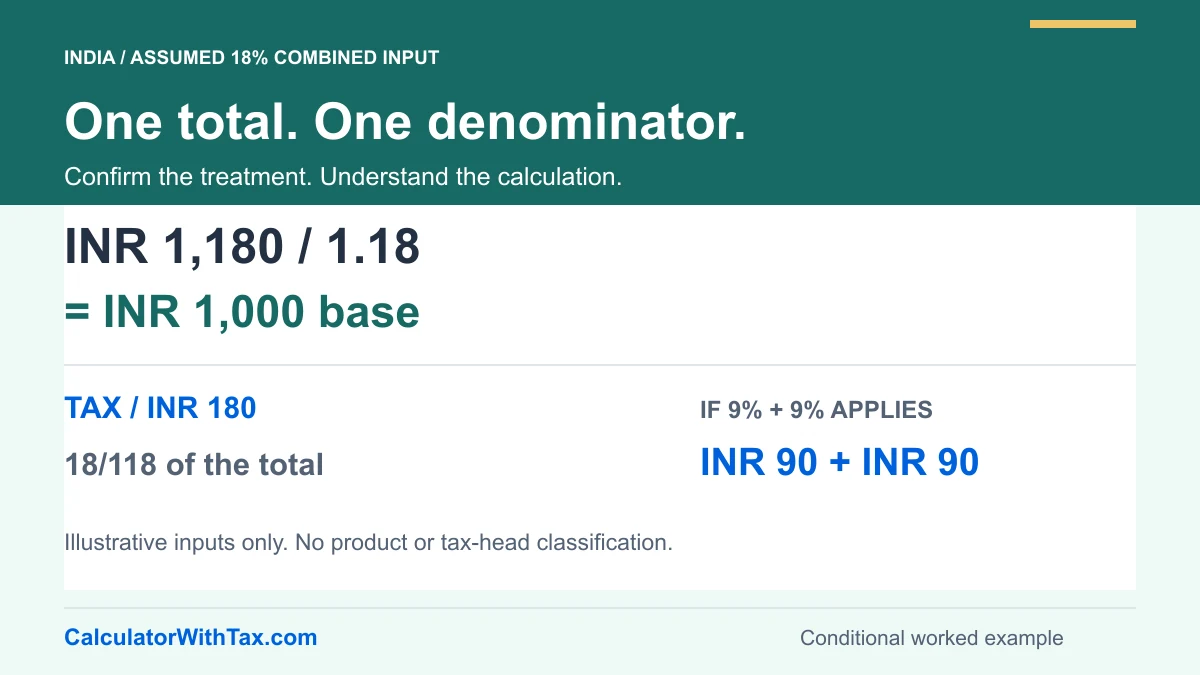
Reverse the price, not the tax obligation
A reverse GST calculator answers a mathematical question: how much of an inclusive payment belongs to the before-tax base when the applicable percentage is already known? It does not decide who must pay GST or whether a supply belongs under IGST, CGST, SGST or UTGST.
CBIC’s 24 September 2021 consolidation of the CGST Rules contains the inclusive-value relationship in Rule 35. We consulted that dated official text on 19 October 2026 for the formula, not as a complete current rate or classification source. Current-law applicability and subsequent amendments require separate checking before operational use.
The examples assume 18% combined tax on one established base, without cess or unrelated charges. This is not a claim that 18% applies to your purchase. Use the rate established for the product, transaction and relevant date.
Divide the inclusive amount by the right multiplier
For an assumed 18% combined treatment, INR 1,180 represents 100 base parts plus 18 tax parts. Recover the base by dividing by 1.18:
Before GST = 1,180 / 1.18 = INR 1,000.00
Included GST = 1,180 - 1,000 = INR 180.00
Enter 1180, 18 and Extract tax in the adjustable example. The calculator with tax accepts manual inputs; selecting India does not select an official rate or component split.
The exact unrounded tax fraction is 18/118, equivalent to 9/59 of the inclusive total. Multiplying INR 1,180 by 18% instead gives INR 212.40 because it uses the larger total as the base. That is not the included GST in this example.
| Scenario | Input | Rate | Before tax | Tax | Total |
|---|---|---|---|---|---|
| Illustrative 18% combined rate, tax included | INR 1,180.00 | 18% | INR 1,000.00 | INR 180.00 | INR 1,180.00 |
| Rebuild the same established base | INR 1,000.00 | 18% | INR 1,000.00 | INR 180.00 | INR 1,180.00 |
| Smaller inclusive amount at the assumed rate | INR 590.00 | 18% | INR 500.00 | INR 90.00 | INR 590.00 |
Use the combined denominator for separate components
Suppose the independently established treatment is two 9% components on the same INR 1,000 base. Each component is INR 90 and their sum is INR 180. These are alternative descriptions of this assumed combined-rate case, not a decision about the correct tax head for a real transaction.
Working directly from INR 1,180, each unrounded component uses 9/118. The denominator contains the sum of the applicable component rates, not just the individual component being calculated.
Using 9/109 separately for each component would treat the total as though it contained only that one 9% tax. Adding an 18% IGST assumption on top of the two 9% components would also double-count tax rather than clarify the example.
Check the result by adding tax back
The recovered INR 1,000 base multiplied by the assumed 18% gives INR 180. Adding that tax reconstructs INR 1,180. The smaller INR 590 inclusive case similarly separates into INR 500 base and INR 90 tax.
This round-trip checks internal arithmetic, not legal eligibility. If a receipt includes a non-taxable amount, several treatments, a separate charge or cess, one combined percentage on the full payment may not reconstruct the original calculation.
Keep cents, tax heads and return rounding separate
The manual engine rounds the recovered base to two decimal places and obtains tax as the remaining difference. Added tax is rounded half-up. It does not implement Indian return-rounding rules or decide how component rounding must be reconciled on an invoice.
Only whole-cent component illustrations are shown here. Do not assume that independently rounding two fractional components must always reproduce an aggregate calculation. Establish the required rounding scope separately, retain your original records privately, and consult our methodology for the tool’s arithmetic limits.
Frequently asked questions
How do I reverse GST from an inclusive amount?
For one established combined rate, divide the inclusive amount by 1 plus the rate divided by 100. Subtract the recovered base from the total to find included tax under the stated rounding convention.
Is 18% the rate for every Indian purchase?
No. It is an assumed input in this worked example, not a national default, current rate catalogue or HSN/SAC classification. Confirm the actual treatment and date separately.
How do two 9% components fit an 18% inclusive example?
If two such components have independently been established on the same base, INR 1,180 contains INR 1,000 base plus INR 90 for each component. Each unrounded component uses the total multiplied by 9/118, not 9/109.
Is a reverse GST calculation the reverse charge mechanism?
No. Extracting tax is arithmetic. Reverse-charge liability is a separate legal question that this calculator does not determine.
Does this produce compliant GST invoices or returns?
No. It does not establish taxability, place of supply, component eligibility, cess, invoice requirements, return rounding or filing obligations. It is a manual price-breakdown tool.
Manual example
Illustrative arithmetic only. Not an official tax rate.
- Amount before tax
- Tax amount
- Total
1000.00 + 180.00 = 1180.00
Open the full calculator