
SG · gst
Singapore GST calculator: add 9% or extract GST with 9/109
For a supply independently confirmed as standard-rated at 9%, add 9% to the before-GST price or divide an inclusive total by 1.09. The included GST fraction is 9/109, not 9% of the final price.
Identify whether your starting price includes GST
A Singapore GST calculator needs two decisions before the numbers: whether the transaction is standard-rated and whether the starting amount already includes tax. A label such as “SGD 100” does not answer both questions.
IRAS’s retail guidance uses 9% calculations and the prevailing 9/109 tax fraction. Its absorbing GST explanation shows how a fixed customer payment can remain GST-inclusive. These sources were checked on 19 October 2026.
The examples below assume one supply independently confirmed as standard-rated at 9%. They do not determine registration, exempt or zero-rated treatment, special schemes, imports or a supplier’s invoice obligations. For an older transaction, establish the treatment and rate relevant to its date first.
Add GST to a before-tax price
If SGD 100 is the established amount before GST, calculate 9% of that smaller base:
GST = 100 x (9 / 100) = SGD 9.00
GST-inclusive total = 100 + 9 = SGD 109.00
Enter 100, 9 and Add tax in the adjustable example. The calculator with tax also supports manual inputs; selecting Singapore does not independently establish the tax treatment of your transaction.
Write “before GST” or “including GST” beside a price in your own comparison. Two amounts that both say SGD 100 can describe different economic values if their tax basis differs.
Extract GST using the fraction 9/109
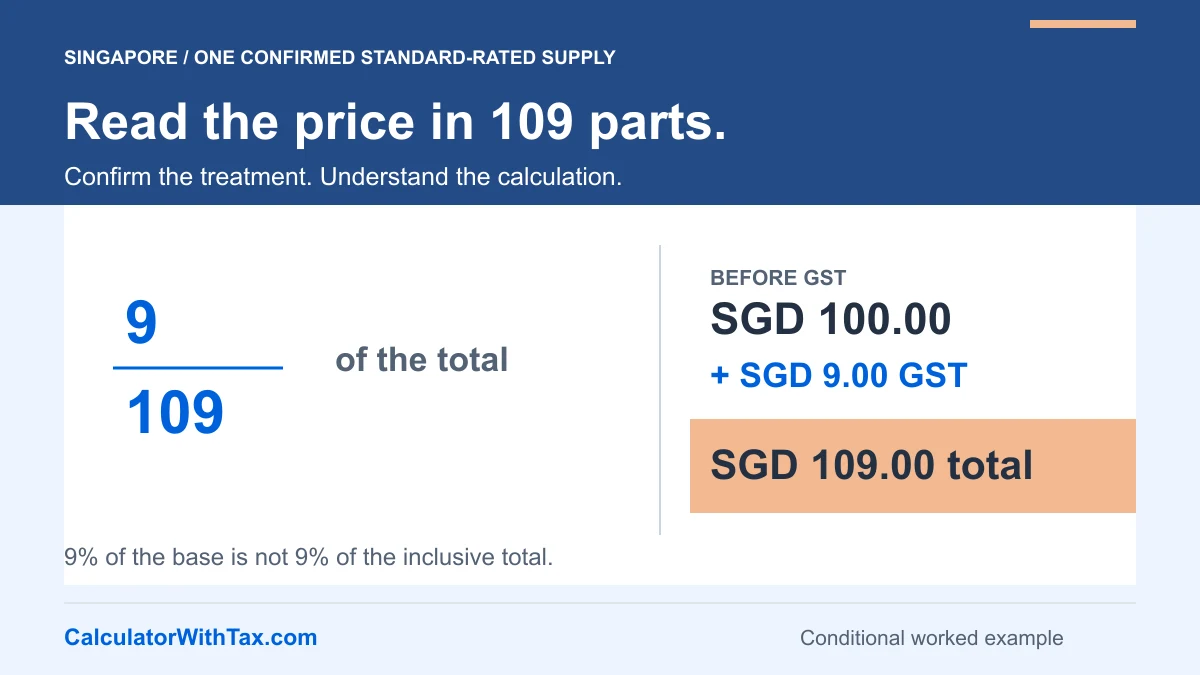
When SGD 109 already includes this one 9% tax, the final amount represents 109 parts: 100 base parts and 9 tax parts. Consequently, the exact unrounded included-tax fraction is 9/109.
Before GST = 109 / 1.09 = SGD 100.00
Included GST = 109 - 100 = SGD 9.00
Multiplying SGD 109 directly by 9% gives SGD 9.81. That calculation uses the inclusive total as though it were the before-tax base. Subtracting it would remove SGD 0.81 too much.
| Scenario | Input | Rate | Before tax | Tax | Total |
|---|---|---|---|---|---|
| If one standard-rated supply at 9% applies | SGD 100.00 | 9% | SGD 100.00 | SGD 9.00 | SGD 109.00 |
| Same example, GST included | SGD 109.00 | 9% | SGD 100.00 | SGD 9.00 | SGD 109.00 |
| Smaller inclusive price, manual cents convention | SGD 40.00 | 9% | SGD 36.70 | SGD 3.30 | SGD 40.00 |
The chart’s blue portion is approximately 8.26% of the total. That does not replace the 9% rate: the two percentages have different denominators. The chart and table share the same decimal calculation engine as the adjustable example.
Understand a fixed GST-inclusive selling price
Suppose SGD 40 is an established final price for one supply at 9%. Divide 40 by 1.09 to obtain the unrounded base. Under this tool’s net-first cents convention, the base displays as SGD 36.70 and included GST as SGD 3.30.
If instead SGD 40 is a before-GST price, adding 9% produces SGD 3.60 GST and SGD 43.60 total. The difference between SGD 40 and SGD 43.60 is caused by the starting-price definition, not a change in the rate.
IRAS’s absorbing-GST guidance is useful when a seller keeps a final amount unchanged. “Absorbed” should not be interpreted as evidence that the supply is exempt or that the tax component is zero.
Reconcile rounding and mixed receipts carefully
This manual tool rounds added tax half-up to two decimal places. On extraction it rounds the recovered base, then obtains tax by subtraction. That disclosed convention is not a certification of every invoice, line-item or reporting method.
For a receipt containing different treatments, separate the relevant amounts before using a single rate. Fees, discounts and service charges require their own established treatment; this article does not decide their tax base.
Compare the quoted basis, confirmed rate, base and rounding scope before treating a difference as an error. Use our calculation methodology to understand the arithmetic. The calculation stays on your device and does not require an address, customer identity or receipt upload.
Frequently asked questions
How do I add Singapore GST at 9%?
For one supply confirmed as subject to 9% on its whole base, multiply the before-GST amount by 0.09 and add that tax. SGD 100 gives SGD 9 GST and SGD 109 total.
How do I remove 9% GST from an inclusive price?
Divide the inclusive amount by 1.09 to recover the unrounded base. Included GST is the difference; its exact unrounded fraction of the total is 9/109.
Why not subtract 9% from the total?
The 9% rate applies to the smaller before-GST amount. Subtracting 9% of the larger inclusive total removes too much. SGD 109 contains SGD 9 GST, not SGD 9.81.
Is absorbing GST the same as there being no GST?
No. IRAS explains that absorbing GST can leave the customer-facing amount inclusive of GST. A fixed final price must still be separated into its base and included tax under the applicable treatment.
Does this determine whether a business should charge GST?
No. Registration, supply classification, exemptions, zero-rating and special schemes must be checked separately. This article and its adjustable manual tool explain arithmetic only.
Manual example
Illustrative arithmetic only. Not an official tax rate.
- Amount before tax
- Tax amount
- Total
100.00 + 9.00 = 109.00
Open the full calculator