
ZA · vat
South Africa VAT calculator: add 15% or remove VAT with 3/23
For a supply independently confirmed as standard-rated at 15%, add VAT to the before-tax price or divide an inclusive total by 1.15. Included VAT is 15/115 of the unrounded total, equivalent to 3/23.
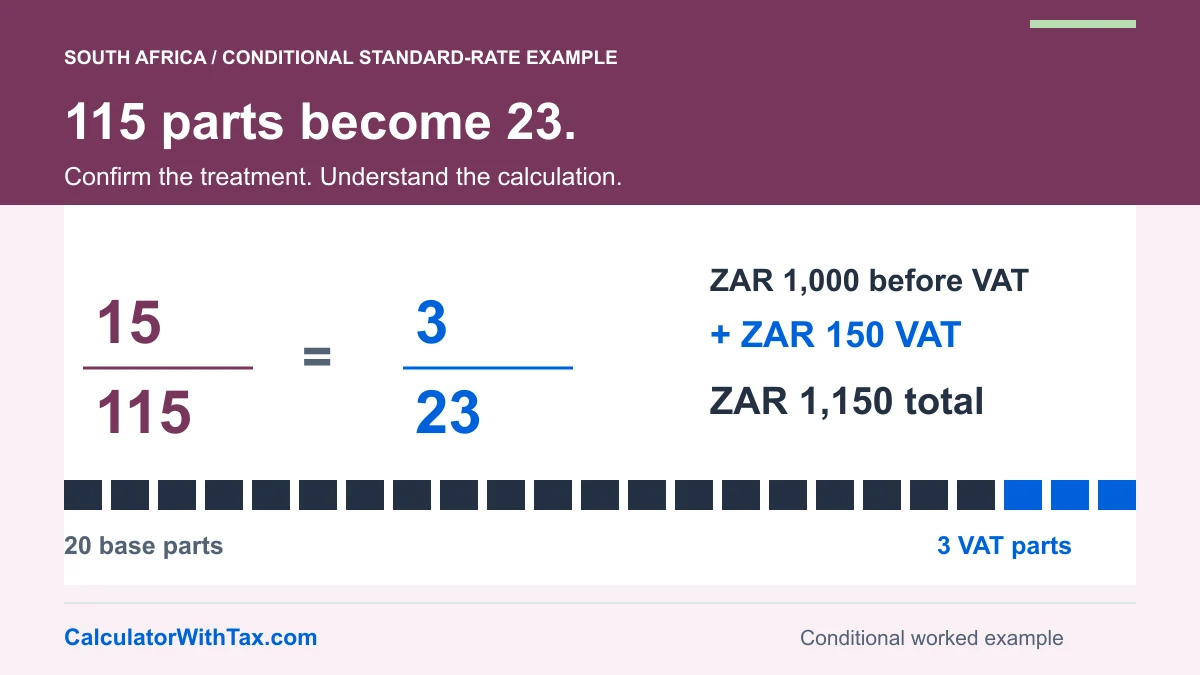
Start with the confirmed treatment and price basis
A South Africa VAT calculator can turn a before-tax amount into a total or separate VAT already included in a payment. It cannot establish whether a particular supplier or transaction should use the standard rate.
The South African Revenue Service VAT page describes the current 15% standard rate, with separate zero-rated and exempt treatments. The page also records the reversal of the previously proposed rate increase. We checked that official source on 19 October 2026 rather than treating an older announcement as a current rate.
The examples assume one supply independently confirmed as standard-rated at 15%. Registration, product classification, import VAT bases, input-tax eligibility, special schemes and return preparation are outside their scope. For a historical sale, establish the rate and treatment relevant to that date.
Add 15% VAT to a rand amount before tax
Assume ZAR 1,000 before VAT is the whole established taxable base. Convert the percentage into a decimal multiplier, then add the calculated tax:
VAT = 1,000 x (15 / 100) = ZAR 150.00
Total including VAT = 1,000 + 150 = ZAR 1,150.00
Enter 1000, 15 and Add tax in the adjustable example. The calculator with tax accepts manual amounts and percentages; choosing South Africa does not create an automatic product-classification or legal VAT engine.
At the same established rate, ZAR 200 before VAT produces ZAR 30 tax and ZAR 230 total. Comparing these two cases confirms that changing the base changes the tax amount even when the rate remains constant.
Extract VAT from an inclusive total
If ZAR 1,150 already includes one tax at 15%, divide the amount by 1.15 to recover ZAR 1,000 before VAT. The difference is ZAR 150 included VAT.
The exact unrounded tax fraction is 15/115, equivalent to 3/23. This follows from 100 before-tax parts plus 15 tax parts, giving 115 total parts. Dividing numerator and denominator by five gives 3 tax parts out of 23 total parts.
| Scenario | Input | Rate | Before tax | Tax | Total |
|---|---|---|---|---|---|
| If one standard-rated supply at 15% applies | ZAR 1,000.00 | 15% | ZAR 1,000.00 | ZAR 150.00 | ZAR 1,150.00 |
| Same example, VAT included | ZAR 1,150.00 | 15% | ZAR 1,000.00 | ZAR 150.00 | ZAR 1,150.00 |
| Smaller before-VAT price at the same rate | ZAR 200.00 | 15% | ZAR 200.00 | ZAR 30.00 | ZAR 230.00 |
The blue chart portion is approximately 13.04% of the inclusive total. It is not a new statutory rate. The 15% rate applies to the smaller before-tax base; the fraction describes a share of the larger total.
Subtracting 15% directly from ZAR 1,150 would remove ZAR 172.50 instead of ZAR 150. This common mistake changes the denominator and understates the recovered base by ZAR 22.50.
Compare inclusive and exclusive quotes consistently
A quote of ZAR 1,000 before VAT and a quote of ZAR 1,150 including VAT can describe the same total under the stated assumptions. A quote of ZAR 1,000 including VAT describes a different base.
For that ZAR 1,000 inclusive amount, dividing by 1.15 gives an unrounded base of approximately ZAR 869.5652. Under this tool’s net-first cents convention, the displayed base is ZAR 869.57 and included VAT ZAR 130.43. The two displayed values still sum to ZAR 1,000.
Record the quoted basis before comparing suppliers. A price difference caused by including tax on one side and excluding it on the other is not a meaningful like-for-like saving.
Keep arithmetic separate from legal VAT obligations
Extracting VAT is sometimes called a reverse calculation, but it is not the domestic reverse charge. Likewise, identifying tax within a payment does not establish an input-tax deduction or a refund entitlement.
Use the SARS vendor FAQs for routes to official vendor information and current updates. Do not infer compliance from a calculator result or from a headline about a proposed change.
Our decimal engine rounds added tax half-up to cents. On extraction, it rounds the recovered base and obtains tax as the remaining difference. This disclosed convention does not certify invoice, reporting or collection compliance. Consult our methodology for implementation details, and separate mixed-treatment receipts before using one percentage on a full payment.
Frequently asked questions
What standard VAT rate is used in these South African examples?
15%, as described on the SARS VAT page checked on 19 October 2026. The examples apply only after the supply has independently been confirmed as standard-rated; they do not classify a purchase.
How much is VAT on ZAR 1,000 before tax?
At a confirmed 15% on the whole base, VAT is ZAR 150 and the inclusive total is ZAR 1,150.
How do I remove 15% VAT from an inclusive amount?
Divide the inclusive amount by 1.15 to recover the unrounded base. The included VAT fraction is 15/115, which simplifies to 3/23. Apply the disclosed rounding method to monetary results.
Is extracting VAT the same as the domestic reverse charge?
No. Extracting included VAT is arithmetic. Domestic reverse-charge rules are a separate legal treatment and are outside this article's calculator scope.
Does a calculated VAT amount establish an input-tax deduction?
No. Recoverability, vendor status, supporting records and other legal conditions require separate assessment. This tool does not prepare a VAT return or establish entitlement to a refund.
Manual example
Illustrative arithmetic only. Not an official tax rate.
- Amount before tax
- Tax amount
- Total
1000.00 + 150.00 = 1150.00
Open the full calculator