
IE · business-workflows
Irish VAT: compare an exclusive fee with an inclusive total
VAT exclusive means before VAT; inclusive means VAT is already included. At an assumed 23%, EUR 500 exclusive becomes EUR 615, above a comparable EUR 600 inclusive fee. Check incidental charges before comparing.
Compare the full fee, not just the VAT label
An exclusive fee leaves VAT to be added; an inclusive fee already contains it. In Ireland, the more useful follow-up question is what amount has been established as taxable? Comparing a fee-only line with an all-in offer can miss relevant costs even when the VAT arithmetic is correct.
This guide focuses on that comparison problem. It assumes an ordinary service with a separately established 23% treatment, not that all professional fees use that rate. Start with the full agreed scope, then normalise the prices.
Start with a fee that has a defined scope
Suppose one supplier quotes EUR 500 before VAT and another quotes EUR 600 including VAT. For this synthetic example, both cover the same ordinary service, all relevant charges are already included in the stated amounts, and a 23% treatment has been independently established.
The first quote becomes EUR 615 including EUR 115 VAT. The second remains EUR 600; the country engine displays EUR 112.20 VAT and EUR 487.80 before VAT. The inclusive second offer is EUR 15 lower on these assumptions. That answer changes if the offers do not cover the same costs.
Compare your two quotes
Established Irish taxable amount, assumed 23% treatment. Synthetic examples, not actual offers or a tax-eligibility decision.
One already-classified amount per quote, assumed 23%; no currency conversion. Maximum 1,000,000,000,000 per input, two decimal places. Inputs stay on this device.
Quote B is lower by EUR 15.00 on the stated tax basis.
Quote A including VATEUR 615.00
Quote B including VATEUR 600.00
Country-engine results. Other charges and tax recovery are not calculated.
| Quote | Before VAT | VAT | Including VAT |
|---|---|---|---|
| A · exclusive input | EUR 500.00 | EUR 115.00 | EUR 615.00 |
| B · inclusive input | EUR 487.80 | EUR 112.20 | EUR 600.00 |
Quote B would match Quote A at an inclusive price of EUR 615.00, with all other terms equal. A lower price is not a recommendation to choose a supplier.
The first pair has a break-even inclusive price of EUR 615. An all-in EUR 600 offer is below it only while both quotes still include the same work and charges.
Establish what belongs in the taxable amount
Revenue’s taxable-amount guidance distinguishes VAT itself from the amount on which it is charged and explains the relevance of incidental charges. Its consultancy example includes several costs before calculating VAT. Do not automatically treat every added expense as outside the taxable amount.
This comparison does not classify expenses, identify disbursements or implement special arrangements. Ask the supplier to clarify what the quote covers, then enter one already-established amount in the Irish VAT calculator.
When a fee-only figure omits a taxable charge
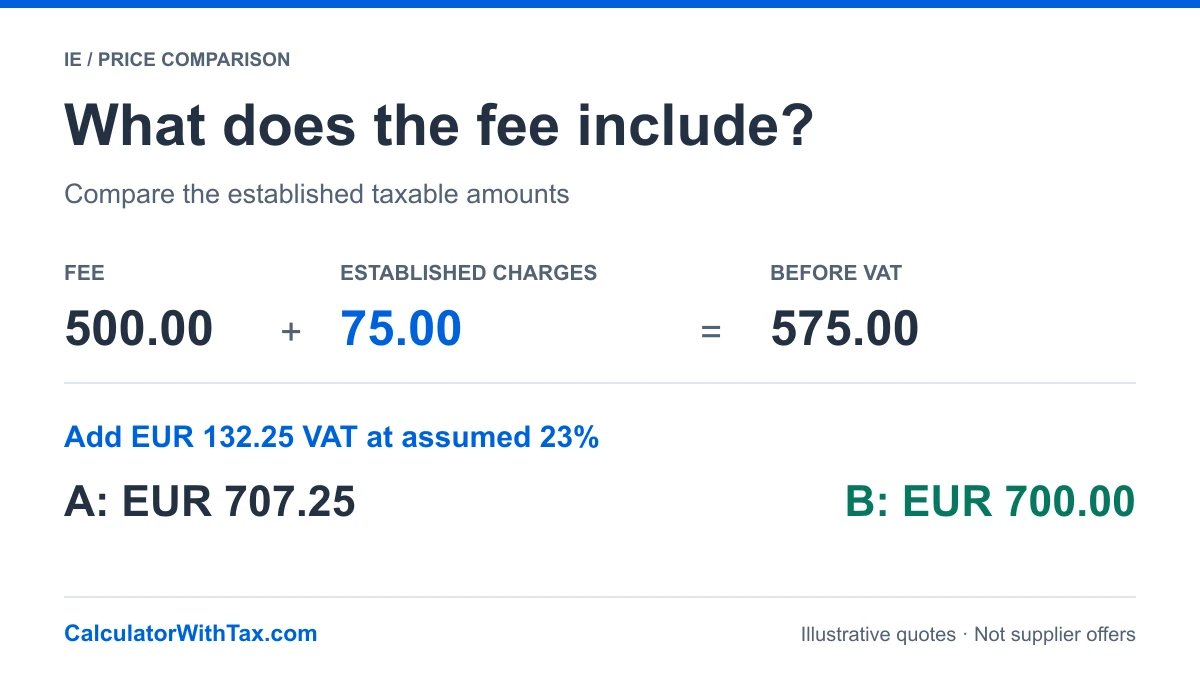
Consider a separate synthetic case: A quotes EUR 500 for the service and EUR 75 of incidental charges already established as part of the same taxable amount. B quotes EUR 700 including VAT for the equivalent complete package. Do not compare EUR 500 directly with EUR 700.
A’s established taxable base is EUR 575. At the assumed 23%, VAT is EUR 132.25 and the inclusive amount is EUR 707.25. B is lower by EUR 7.25. Its EUR 700 inclusive figure contains EUR 130.89 VAT, leaving EUR 569.11 before VAT under the engine’s display convention.
An omitted charge changes the base
Synthetic EUR 500 fee plus EUR 75 incidental charges already established as part of the same taxable amount; B is EUR 700 inclusive, assumed 23% treatment. Synthetic examples, not actual offers or a tax-eligibility decision.
Quote B is lower by EUR 7.25 on the stated tax basis.
Quote A including VATEUR 707.25
Quote B including VATEUR 700.00
Country-engine results. Other charges and tax recovery are not calculated.
| Quote | Before VAT | VAT | Including VAT |
|---|---|---|---|
| A · exclusive input | EUR 575.00 | EUR 132.25 | EUR 707.25 |
| B · inclusive input | EUR 569.11 | EUR 130.89 | EUR 700.00 |
Quote B would match Quote A at an inclusive price of EUR 707.25, with all other terms equal. A lower price is not a recommendation to choose a supplier.
These charges and quotes are synthetic. Revenue’s separate consultancy example is evidence that an established taxable base can contain more than the headline professional fee; it is not a ruling on these invented charges or every reimbursement.
Normalize both prices without changing their treatment
For the assumed standard-rated example:
VAT on Quote A = round(500 × 23 ÷ 100) = 115.00
Quote A including VAT = 615.00
VAT inside Quote B = round(600 × 23 ÷ 123) = 112.20
Quote B before VAT = 600.00 − 112.20 = 487.80
The inclusive fraction is 23/123 because the total includes the base and VAT together. Directly removing 23% of EUR 600 would not recover its original base. Use the Irish VAT arithmetic guide for the fuller addition and reverse method.
Separate price, cash payment and recoverability
The inclusive amount is not automatically the same as the cost after any allowable VAT recovery. This tool does not determine registration, business use or input-tax entitlement. The example cannot establish what a purchaser may deduct.
Likewise, this comparison does not apply cash rounding. It rounds the VAT component first to cents, half-cents up, as the site’s documented display convention. That is not presented as a universally verified Irish legal rounding policy. Several lines or different treatments can require a different aggregation method.
Questions to resolve before accepting a fee
- What work and service period are included in the quoted fee?
- Which incidental charges are included, and has their treatment been established?
- Is the stated total before VAT or inclusive, using the same applicable treatment?
- Are you comparing the payable price rather than assuming a VAT recovery?
If any answer is unclear, ask for the missing breakdown. Leave disbursements, special schemes, different treatments and mixed invoices to an appropriately scoped assessment. The reference calculator and these examples remain subject to pending professional tax review.
Frequently asked questions
Does an exclusive fee include VAT?
No. A VAT-exclusive fee still needs its applicable VAT component added. Establish the full taxable amount and treatment separately.
Can I assume all Irish fees have 23% VAT?
No. This comparison assumes a standard-rated supply for illustration. The calculator does not classify a service or determine a category's eligibility.
Is cash rounding the same as VAT rounding?
No. This comparison uses the calculator's cent display for VAT and does not round the final payment to a cash denomination.
Can incidental charges change a fee comparison?
Yes. In the synthetic example, an established EUR 500 fee plus EUR 75 taxable incidental charges gives EUR 707.25 including assumed 23% VAT. That is higher than an all-in EUR 700 offer.
Does a fee-only quote necessarily cover the full taxable amount?
No. Clarify the charges and their treatment before using a total. This tool does not determine whether an expense is an incidental charge, disbursement or special case.
Use the same country engine
Add tax or extract the included amount with the calculation method used in these examples. Select the treatment applicable to your transaction separately.
Ireland VAT calculator