
IN · gst
GST on a discount shown before or at the invoice: India
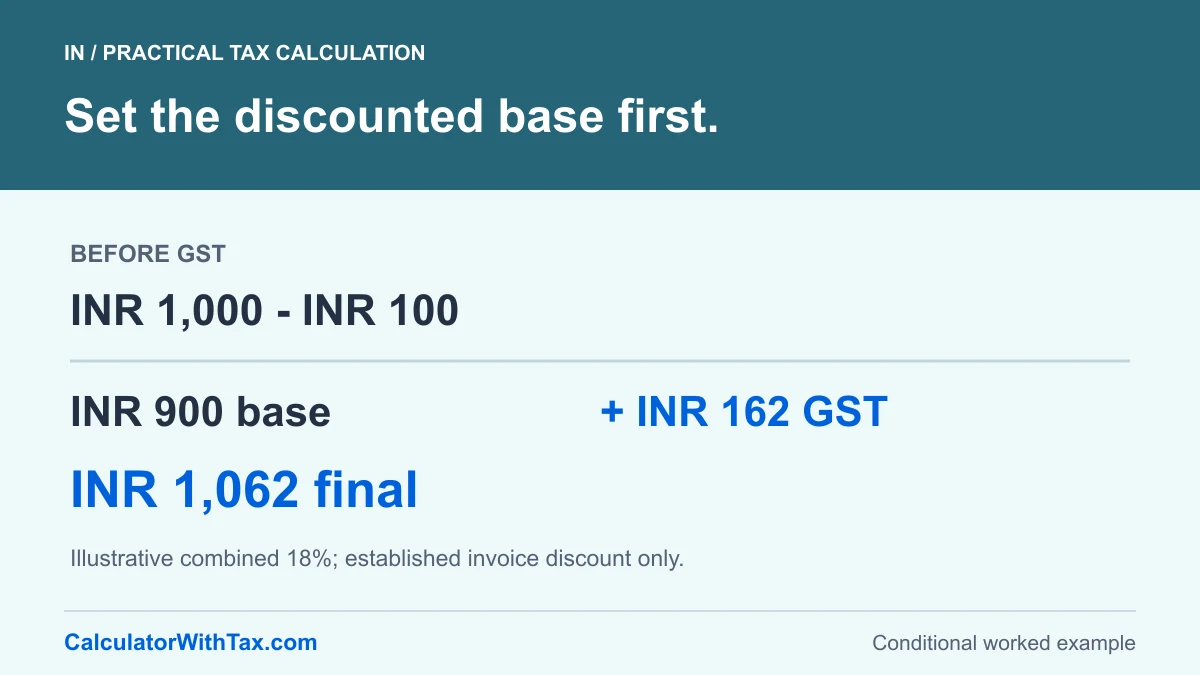
For an INR 1,000 before-GST price with an established 10% invoice-time discount, the base becomes INR 900. At an illustrative combined 18% GST assumption, tax is INR 162 and the total is INR 1,062. The rate and transaction treatment must be established separately.
Establish the invoice-time reduction before calculating GST
For a discount that meets the relevant before- or at-supply conditions and is duly recorded in the invoice, the calculation begins with the discounted taxable value, not the undiscounted headline price.
Assume a synthetic INR 1,000 before-GST price and an established 10% invoice-time discount. The reduction is INR 100, leaving INR 900. At an illustrative combined 18% GST input, tax is INR 162 and the completed amount is INR 1,062.
Eighteen percent is not presented as a verified rate for any particular product or service. This guide does not determine classification, rate schedules, intra-state versus inter-state treatment, cess or registration. Those facts must be settled before applying the arithmetic to a real invoice.
The section 15 scope used here
CBIC’s official CGST Act section 15 page states the before- or at-supply invoice-recording condition in subsection 15(3)(a). That narrow case is the legal scope of this article. Other valuation rules can affect the transaction before any discount calculation is appropriate.
The official page read on 20 October 2026 also displays a substituted subsection 15(3)(b) with a commencement footnote marked “w.e.f. yet to be notified.” This guide does not treat that displayed substitution as operative merely because it appears on the page. It does not resolve post-supply discounts or rely on a future commencement date.
Keeping that boundary explicit prevents an invoice-time example from becoming a misleading universal rule for every commercial rebate. The calculator starts after the applicable reduction in value has been established.
Follow the INR 1,000 example
The price before GST is INR 1,000. The agreed invoice-time reduction is 10% of that amount, or INR 100. The assumed taxable value is therefore INR 900. Applying the illustrative 18% combined rate gives INR 162, and adding that tax produces INR 1,062.
The invoice working should preserve all four quantities: original exclusive price, discount, discounted base and GST. If a system shows only the final total, it becomes harder to identify whether an error came from the price basis, the reduction or the tax calculation.
Calculate an established invoice discount
Discount established before or at supply and duly recorded; one illustrative 18% combined rate, not a current rate catalogue. No post-supply amendment activation, ITC or tax-head classification.
Illustrative combined GST = established discounted exclusive base x 18/100.
- Discounted price with GST
- INR 1,062.00
Before-discount price: INR 1000.00; Established discount: INR 100.00; Taxable base: INR 900.00; Illustrative combined GST: INR 162.00; Final price: INR 1062.00
| Starting assumptions | Tax in the stated amount | Scenario result |
|---|---|---|
| Established before-or-at-supply reduction: INR 1,000.00; 10% | INR 162.00 | Discounted price with GST: INR 1,062.00 |
| Established before-or-at-supply reduction: INR 2,500.00; 20% | INR 360.00 | Discounted price with GST: INR 2,360.00 |
| Established before-or-at-supply reduction: INR 1,000.00; 0% | INR 180.00 | Discounted price with GST: INR 1,180.00 |
The adjustable illustration fixes the GST input at the disclosed illustrative 18% so that the effect of the invoice discount is isolated. It does not contain a hidden product-rate lookup. Changing a purchase description would not authorize applying 18% to it.
Do not tax the undiscounted base and call it the same method
Tax on INR 1,000 at the illustrative 18% would be INR 180. Subtracting only the INR 100 exclusive discount from an INR 1,180 total would leave INR 1,080, not INR 1,062. That does not reflect the assumed reduction of taxable value used in this example.
The INR 18 difference is the illustrative tax on the INR 100 reduction. The correct sequence for this established case reduces the base before calculating GST. A system can use an equivalent calculation internally, but its labels and final components should still reconcile to that same basis.
Do not confuse this example with a reduction applied to a stated GST-inclusive amount. An exclusive INR 100 reduction and an inclusive INR 100 reduction are different agreements. Establish which amount the discount wording describes before comparing results.
A second example makes the base visible
Assume INR 2,500 before GST and an established 20% invoice-time discount. The reduction is INR 500, leaving INR 2,000 before tax. At the same illustrative combined 18%, GST is INR 360 and the total is INR 2,360.
With no discount on the original INR 1,000 exclusive price, the illustrative GST is INR 180 and the total is INR 1,180. A zero discount changes neither the product’s tax classification nor its rate. It simply leaves the input base unchanged.
These are synthetic single-amount examples checked with decimal arithmetic. They are not CBIC worked invoices, customer case studies or evidence that a real item belongs in an 18% category. Their purpose is to expose the order of operations after classification has been completed.
Inclusive-price discounts require a different starting point
If the amount supplied is already GST-inclusive, do not multiply that inclusive amount by the rate to identify its included tax. First establish the final inclusive consideration and use the appropriate inclusive fraction for its actual treatment.
The Indian reverse-GST guide explains that distinction using explicit input assumptions. It does not turn the manually entered percentage into an approved rate catalogue or decide which tax components apply.
For a bill containing more than one rate, a single reverse calculation on the grand total will not generally reconstruct the components. Allocate the discount appropriately under the applicable rules and retain the relevant line treatment. This article’s one-base example does not implement that allocation.
Post-supply adjustments are not a checkbox
A later volume rebate, commercial credit note or retrospective reduction involves facts and rules beyond the invoice-time case. The timing of an agreement, the connection to original invoices, recipient implications and the operative statutory text may matter.
The pending-commencement annotation on the official page is a reason to verify the effective text for the actual transaction, not a reason to choose whichever version seems simpler. This article deliberately stops short of a post-supply conclusion. It also does not determine the requirements or consequences of a section 34 credit note.
A payment received at a lower amount does not, by itself, prove that GST can be recalculated on that lower figure. The commercial reason and legal treatment must be established separately. The calculator cannot infer them from a bank entry.
Keep tax components and reporting outside the illustration
The combined tax amount shown here does not assign CGST, SGST, UTGST or IGST. Do not divide it into components without establishing the supply facts. It also excludes cess, reverse-charge questions, input-tax credit eligibility and return preparation.
The example rounds displayed monetary amounts to two decimals using the shared decimal helper. That convention does not certify invoice-wide or return-wide rounding for India. Multi-line aggregation and statutory reporting requirements require their own review.
A dependable invoice-time check
- Establish the applicable valuation rules and actual rate independently.
- Confirm that the reduction is within the before- or at-supply case and recorded appropriately.
- Identify whether the stated price and reduction are exclusive or inclusive.
- Calculate the established discounted base before its tax.
- Reconcile the invoice components and retain the supporting agreement.
- Review later changes separately rather than extending this example automatically.
A useful calculator makes the assumptions visible. It should not convert an illustrative rate or a not-yet-operative provision into a precise-looking but unsupported tax answer.
Frequently asked questions
Is GST calculated before or after an invoice-time discount?
For a discount within the established section 15(3)(a) conditions, the discount is excluded from the value before GST is calculated. This article concerns discounts before or at supply duly recorded in the invoice.
Is 18% the correct GST rate for every Indian purchase?
No. Eighteen percent is an illustrative combined input used to explain the arithmetic. Determine the actual product or service rate, date, place of supply and applicable components separately.
What is the example total after a 10% discount on INR 1,000?
Assuming INR 1,000 is before GST, the discount is INR 100 and the base is INR 900. At the illustrative 18%, GST is INR 162 and the final amount is INR 1,062.
Can I use the same rule for a post-sale discount?
Not automatically. Post-supply discounts have separate conditions and commencement questions. The official section 15 page read for this guide shows a substituted provision marked as not yet notified; this article does not treat it as operative.
Does this split tax into CGST, SGST or IGST?
No. The example shows a combined illustrative tax amount only. It does not determine the supply type, assign components, include cess or prepare a GST return.
Check a separately established amount
Use one confirmed taxable amount and the applicable percentage. The manual calculator does not select a rate or classify the transaction.
Open the manual calculator