
NZ · business-workflows
Plus GST vs GST inclusive: compare New Zealand quotes
Plus GST means GST is still to be added; GST inclusive means it is already included. At an assumed 15%, NZD 80 plus GST becomes NZD 92, below a comparable NZD 94 inclusive quote by NZD 2.
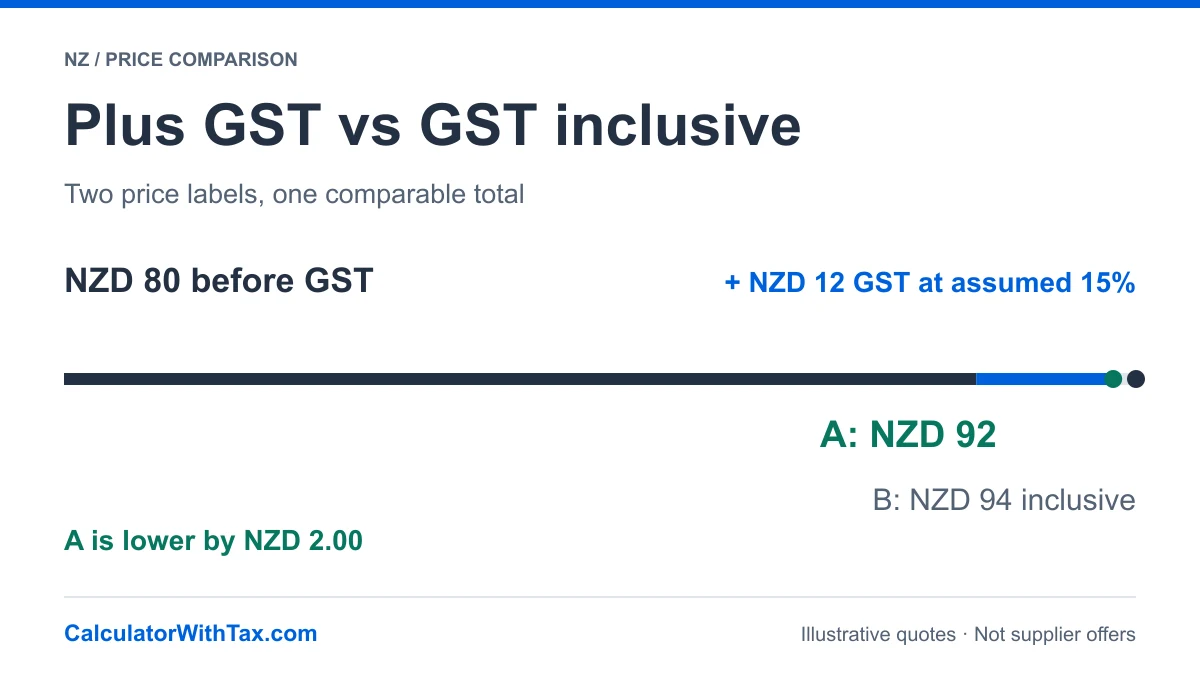
Plus GST and GST inclusive are different starting points
Plus GST starts before the GST component. GST inclusive starts after it has already been included. To compare cash prices, first put both quotes on the same inclusive basis. Do not add GST a second time to an inclusive amount.
This guide assumes ordinary standard-rated supplies in NZD whose treatment has already been established. Its purpose is to compare quote wording and totals, not decide GST registration, classify a transaction or prepare a GST return.
Compare the totals after GST
Consider two synthetic offers for the same ordinary standard-rated supply: NZD 80 plus GST and NZD 94 GST inclusive. Assume the supplier and transaction meet the relevant GST conditions; this guide does not determine them.
At the assumed 15% treatment, the first offer adds NZD 12 GST and becomes NZD 92. The second remains NZD 94. On an inclusive basis, Quote A is NZD 2 lower. Extracting GST from Quote B gives NZD 12.26 GST and NZD 81.74 before GST under the engine’s provisional cent-display policy.
Compare your two quotes
Assumed standard-rated New Zealand supply at 15%. Synthetic examples, not actual offers or a tax-eligibility decision.
One already-classified amount per quote, assumed 15%; no currency conversion. Maximum 1,000,000,000,000 per input, two decimal places. Inputs stay on this device.
Quote A is lower by NZD 2.00 on the stated tax basis.
Quote A including GSTNZD 92.00
Quote B including GSTNZD 94.00
Country-engine results. Other charges and tax recovery are not calculated.
| Quote | Before GST | GST | Including GST |
|---|---|---|---|
| A · exclusive input | NZD 80.00 | NZD 12.00 | NZD 92.00 |
| B · inclusive input | NZD 81.74 | NZD 12.26 | NZD 94.00 |
Quote B would match Quote A at an inclusive price of NZD 92.00, with all other terms equal. A lower price is not a recommendation to choose a supplier.
The break-even inclusive price for B is NZD 92. The gap to NZD 94 is a difference between two totals, not GST itself: Quote A’s GST is NZD 12. Keep those two numbers separate when explaining the result to a supplier or colleague.
Identify which amount the percentage describes
The same percentage cannot be applied unchanged to two different price bases. Fifteen percent describes the GST relative to an exclusive base. Once GST is included, the total contains 115 parts for every 100 original parts.
Quote A GST = 80 × 15 ÷ 100 = 12.00
Quote A inclusive = 80.00 + 12.00 = 92.00
Quote B included GST = round(94 × 3 ÷ 23) = 12.26
IRD’s calculating-GST guidance provides addition and extraction examples using these respective bases. Our quote figures are separate synthetic illustrations, not an IRD endorsement of the offers.
A whole-cent example that does not depend on a rounding tie
IRD also publishes the combination NZD 100 before GST, NZD 15 GST, NZD 115 inclusive. If one quote uses NZD 100 plus GST and another uses NZD 115 inclusive for an equivalent supply, the totals match exactly. The comparison framing is derived; the three source amounts are independently published.
An exact whole-cent cross-check
IRD publishes NZD 100 exclusive, NZD 15 GST and NZD 115 inclusive. Comparing two quotes with those amounts is a derived illustration. Source amounts and derived comparison are distinguished below.
Both quotes have the same inclusive total.
Quote A including GSTNZD 115.00
Quote B including GSTNZD 115.00
Country-engine results. Other charges and tax recovery are not calculated.
| Quote | Before GST | GST | Including GST |
|---|---|---|---|
| A · exclusive input | NZD 100.00 | NZD 15.00 | NZD 115.00 |
| B · inclusive input | NZD 100.00 | NZD 15.00 | NZD 115.00 |
Quote B would match Quote A at an inclusive price of NZD 115.00, with all other terms equal. A lower price is not a recommendation to choose a supplier.
This is a useful check before dealing with a price that has fractions of a cent. At these amounts, the tax component is already a whole number of cents, so no choice about an exact half-cent changes the result. It does not settle the policy for other inputs.
Preserve the fraction until the rounding step
Use the exact 3/23 fraction rather than a shortened decimal. Small differences can become visible when the input grows or sits near a cent boundary. The New Zealand GST calculator uses decimal arithmetic and reconciles the displayed GST with the remaining amount.
Its half-cent-down candidate policy remains provisional: professional review and current amendment applicability are not complete. For example, a synthetic NZD 0.10 before GST creates exact GST of NZD 0.015; this engine displays NZD 0.01 under that candidate policy. A half-up convention would display NZD 0.02. That difference is a reason to disclose the policy, not claim one method is universally mandatory. See the New Zealand GST guide for the stated limits.
Keep one-price arithmetic separate from return filing
Comparing these quotes does not decide the accounting period in which a transaction belongs, a GST credit, or a return balance. IRD’s return guidance considers additional inputs beyond the quoted price. This one-amount calculator does not implement those workflows.
A quote-comparison checklist
- Match the goods or service, quantity and delivery terms.
- Ask whether each quoted figure is plus GST or inclusive.
- Compare the same complete inclusive amounts, using the exact fraction when extracting GST.
- Keep GST credits, filing periods and any cent-rounding decision separate from that price comparison.
If a quote omits its GST basis, clarify it with the supplier. Zero-rated, exempt, historical, transitional or mixed transactions need their own supported assessment. The displayed GST component is information about an assumed price, not personalized tax advice.
Frequently asked questions
Does plus GST mean GST is already included?
No. In this comparison, plus GST describes an exclusive amount to which the applicable GST must be added. Confirm unclear supplier wording rather than guessing.
Why use 3/23 instead of 15% to extract GST?
At an assumed 15% treatment, GST is 15/115 of the inclusive total, which simplifies exactly to 3/23. Fifteen percent applies to the exclusive amount instead.
Can this comparison prepare my GST return?
No. Return calculations depend on matters beyond one quoted price, including accounting basis and adjustments.
Can a plus-GST quote equal an inclusive quote?
Yes. At an assumed 15%, NZD 100 plus NZD 15 GST equals NZD 115 including GST. Different labels do not necessarily mean different totals.
Does the smallest inclusive price always mean the best offer?
No. Match the specification, delivery and other terms first. A lower arithmetic total does not establish supplier quality, tax recovery or suitability.
Use the same country engine
Add tax or extract the included amount with the calculation method used in these examples. Select the treatment applicable to your transaction separately.
New Zealand GST calculator