
ZA · business-workflows
South Africa VAT-inclusive discount calculator and examples
Assuming an ordinary 15% VAT-inclusive price of ZAR 1,150 and an established 10% price reduction, the final price is ZAR 1,035. Its VAT component is ZAR 135 and its before-VAT amount is ZAR 900. Documentation and adjustment eligibility are separate.
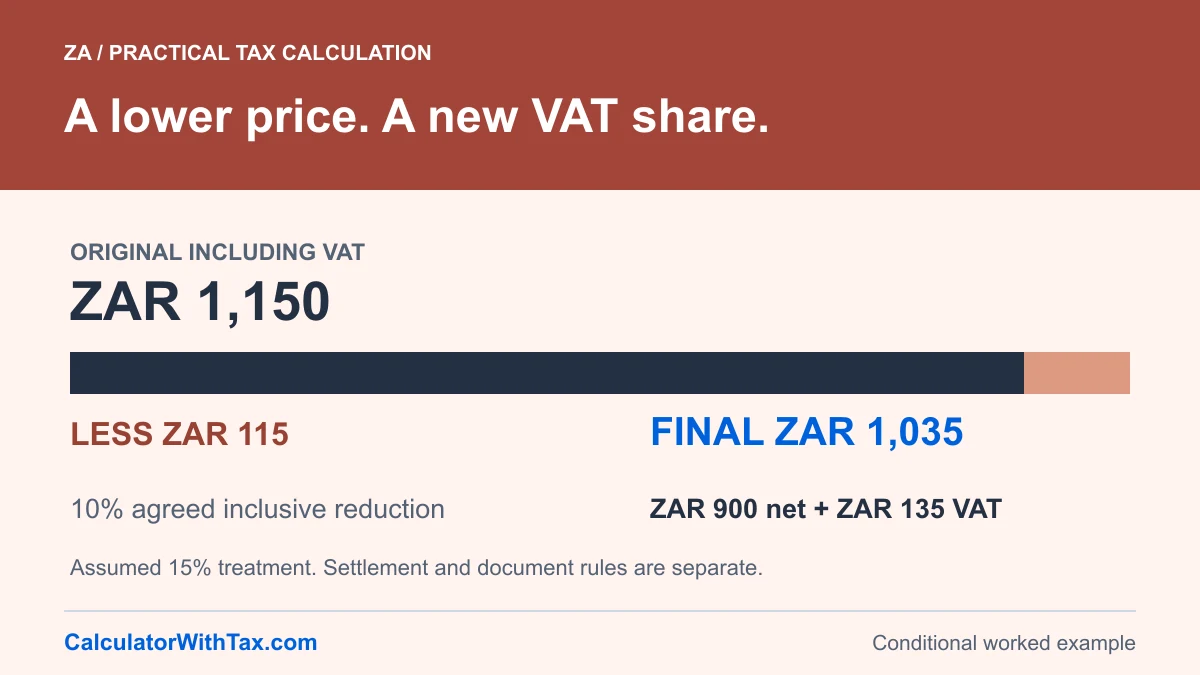
Discount the known inclusive price, then extract VAT
A South Africa VAT-inclusive discount calculation begins by identifying what the reduction applies to. If the agreed discount is 10% of a ZAR 1,150 VAT-inclusive price, it removes ZAR 115 and leaves ZAR 1,035 payable. For a supply already established as wholly subject to 15% VAT, that remainder contains ZAR 135 VAT and ZAR 900 before VAT.
The example assumes a real price reduction has already been established. It does not determine whether a discount qualifies, when it takes effect for VAT, or which correction documents and return entries are needed. It also does not classify the goods or establish vendor status.
SARS’s VAT overview is the official reference for the 15% standard-rate assumption used here. A familiar standard rate is not evidence that every supply carries it. Zero-rated, exempt and mixed supplies cannot be forced into this one-treatment formula.
Keep the discount amount separate from the VAT amount
For the synthetic ZAR 1,150 example, the original before-VAT price is ZAR 1,000 and original VAT is ZAR 150. A 10% reduction of the full inclusive price is ZAR 115. The final ZAR 1,035 contains ZAR 900 before VAT and ZAR 135 VAT.
The ZAR 115 reduction therefore includes a ZAR 100 reduction in the before-VAT amount and a ZAR 15 reduction in the VAT component under these exact assumptions. The discount is not ZAR 115 plus another ZAR 15; that would count part of the adjustment twice.
Separate an agreed inclusive price reduction
One established South African 15% taxable price, with the reduction already accepted as applicable. Manual net-first reverse display; no credit-note, settlement-condition or return assessment.
Included VAT = final established inclusive price x 3/23 before cent rounding.
- Final inclusive price
- ZAR 1,035.00
Original inclusive price: ZAR 1150.00; Established discount: ZAR 115.00; Final before VAT: ZAR 900.00; Included VAT: ZAR 135.00; Final inclusive price: ZAR 1035.00
| Starting assumptions | Tax in the stated amount | Scenario result |
|---|---|---|
| Agreed percentage of the inclusive price: ZAR 1,150.00; 10% | ZAR 135.00 | Final inclusive price: ZAR 1,035.00 |
| Agreed percentage of the inclusive price: ZAR 230.00; 15% | ZAR 25.50 | Final inclusive price: ZAR 195.50 |
| Agreed percentage of the inclusive price: ZAR 1,150.00; 0% | ZAR 150.00 | Final inclusive price: ZAR 1,150.00 |
The adjustable example shows the original inclusive price, the agreed reduction and the remaining inclusive price. It then extracts VAT from that remaining amount. Its comparison bars represent money, not separate tax percentages added to an inclusive price.
Why the VAT fraction is 15 over 115
At a 15% treatment, a price consists of 100 before-VAT parts plus 15 VAT parts. An inclusive price therefore has 115 parts in total. The tax component is 15 over 115, simplifying to 3 over 23.
For ZAR 1,035, that fraction gives ZAR 135 VAT. Subtracting it leaves ZAR 900 before VAT. Multiplying ZAR 1,035 by 15% instead would calculate ZAR 155.25, which is not the VAT already included in that amount.
The formula is useful only after the amount is known to contain that single treatment. More digits in the answer do not correct a wrong base. The South African VAT guide explains adding tax to a known exclusive amount versus extracting it from a known inclusive amount.
Compare a 15% price reduction without confusing the percentages
Assume another ordinary 15% VAT-inclusive price of ZAR 230 and an agreed 15% price discount. The discount removes ZAR 34.50, leaving ZAR 195.50. That remaining amount contains ZAR 25.50 VAT and ZAR 170 before VAT.
Here, 15% appears twice with different meanings. The discount percentage measures a reduction from the original inclusive price. The VAT percentage applies to the remaining before-VAT base. They happen to be numerically equal in this example, but they are not interchangeable operations.
With no discount, the original ZAR 1,150 still contains ZAR 150 VAT. A zero discount changes neither the purchase price nor its treatment. It does not mean the supply is zero-rated.
A fixed ZAR 100 reduction needs a clear label
A reduction of ZAR 100 from an inclusive ZAR 1,150 price leaves ZAR 1,050 payable. By contrast, reducing its ZAR 1,000 before-VAT price by ZAR 100 leaves a ZAR 900 before-VAT base and a ZAR 1,035 final amount at 15%.
Those are different commercial offers. The first reduces the final cash price by ZAR 100; the second reduces the before-VAT price by ZAR 100 and also changes the corresponding VAT. Asking whether “the discount is before or after VAT” is often really asking which of those price bases the agreement describes.
Do not resolve ambiguous wording by selecting whichever method gives a lower total. Obtain the supplier’s stated final consideration and tax treatment. The calculator can reproduce that decision, but it cannot supply the missing agreement.
Conditional and post-sale reductions need separate records
An unconditional agreed sale price, a discount available only after prompt payment and a later correction are not necessarily the same event for records and timing. The SARS VAT 404 guide for vendors discusses credit and debit notes and the circumstances around adjustments.
This page does not decide when a condition is satisfied, generate a compliant credit note, assign a VAT period or calculate a purchaser’s corresponding adjustment. It starts after the final price reduction and its assumed treatment have been established. A calculator result should not be used to bypass those questions.
Keep the original invoice, discount terms, reason for any later change and required correction records together. The final arithmetic is easier to audit when the commercial change can be traced without guessing from a lower bank payment.
Rounding can change the last cent of a component
The example uses decimal arithmetic and a two-decimal single-amount display. For other amounts, extracting VAT from a rounded final price may not exactly match subtracting separately rounded VAT components from an earlier price.
That does not automatically prove an invoice error. Establish whether the records round each line, one tax amount or an aggregate, and reconcile according to the applicable approach. Do not alter a discount percentage to make two different rounding scopes appear identical.
This is not a multi-line invoicing engine. It also does not treat vouchers, third-party reimbursements, mixed-rate allocations or settlement fees as ordinary price discounts without further assessment.
A reliable discount-checking sequence
- Confirm the original amount and whether it already includes VAT.
- Establish the relevant treatment and the scope of the discount agreement.
- Identify whether the reduction is percentage-based or a fixed amount, inclusive or exclusive.
- Calculate the final consideration on that stated basis.
- Extract its known VAT component and reconcile the displayed total.
- Handle required documents, conditions and reporting adjustments separately.
The result is useful because it keeps the questions in order. A known inclusive price can be broken down precisely; an unresolved commercial or tax classification cannot be repaired by a more elaborate formula.
Frequently asked questions
How do I calculate VAT after a 10% inclusive-price discount?
First establish that the reduction applies to the full inclusive price. For ZAR 1,150, a 10% reduction leaves ZAR 1,035. At the assumed 15% treatment, extract VAT using 15 over 115, giving ZAR 135.
Can I multiply the final inclusive amount by 15%?
No. Fifteen percent applies to the before-VAT base. An inclusive amount uses the fraction 15 over 115, or 3 over 23.
Is a ZAR 100 discount inclusive or exclusive of VAT?
The wording must be established. A ZAR 100 reduction in the final inclusive price is not the same as a ZAR 100 reduction in the before-VAT price.
Does this decide the VAT treatment of a settlement discount?
No. It assumes a known final price reduction. Conditional discounts, timing, credit-note requirements and return adjustments need separate assessment.
Can I apply the formula to a mixed-rate basket?
Not automatically. The illustration assumes one amount wholly subject to the established 15% treatment. A mixed basket requires appropriate allocation and actual component treatment.
Check a separately established amount
Use one confirmed taxable amount and the applicable percentage. The manual calculator does not select a rate or classify the transaction.
Open the manual calculator