
AU · business-workflows
GST credits for business and private use: worked examples
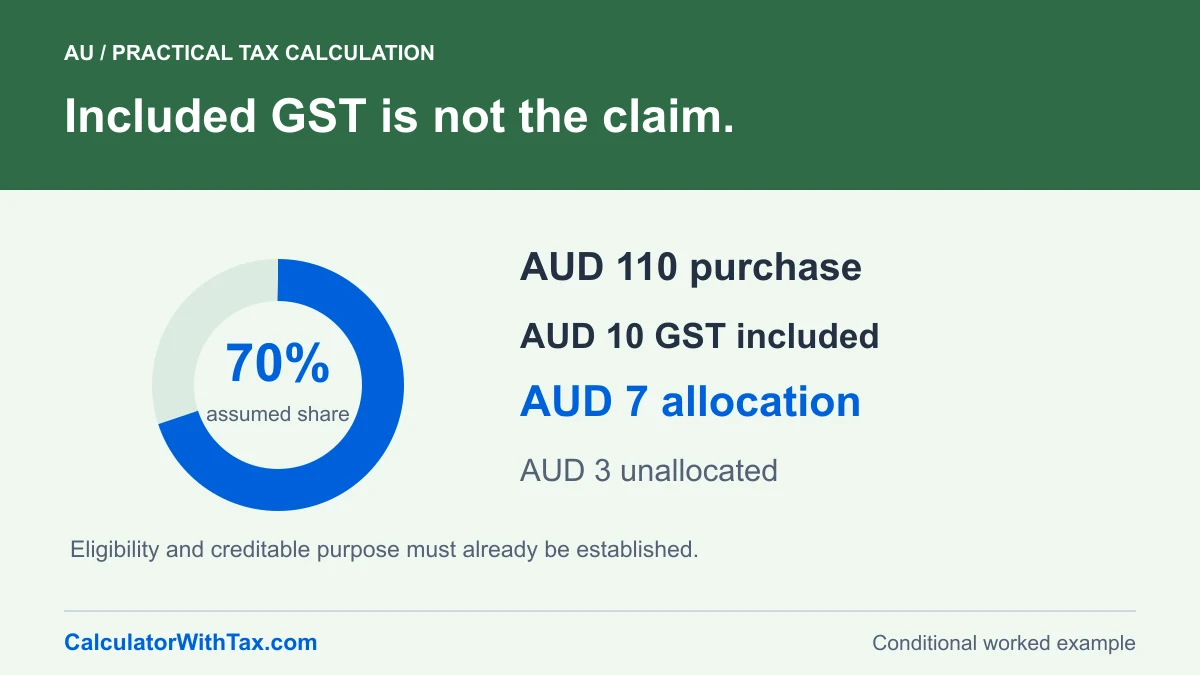
Included GST is not automatically the amount claimable. A GST-inclusive AUD 110 purchase contains AUD 10 GST; an independently established 70% creditable proportion gives an illustrative AUD 7 allocation, subject to the other entitlement conditions.
Extract the GST, then assess the allocation
An Australian GST-credit calculation has two separate stages. First, identify the GST included in a purchase whose tax treatment is already known. Second, determine what portion, if any, belongs in a GST-credit claim. The first stage is arithmetic; the second depends on entitlement and the acquisition’s use.
For an ordinary purchase already confirmed as wholly subject to 10% GST, AUD 110 includes AUD 10 GST. If an independently established creditable proportion is 70%, and the simplified assumptions below hold, the illustrated allocation is AUD 7. The remaining AUD 3 is outside that allocation. Neither figure by itself establishes a claim or a refund.
Establish the creditable-acquisition conditions first
Sections 11-5, 11-15, 11-25 and 11-30 of the GST Act compilation dated 1 January 2026 address creditable acquisitions, purpose, the full credit and partial entitlement. Relevant conditions include a taxable supply to you, consideration, registration or a requirement to register, and creditable purpose. Private or domestic purposes and input-taxed supplies require separate consideration.
This example assumes those conditions have been assessed, the full consideration is provided, and there are no special restrictions or adjustments changing the result. “70% business use” is not automatically proof of “70% creditable purpose.” The percentage is an established input, not something the calculator can infer from a business name or purchase description.
Why the included GST is one-eleventh
A 10% tax is calculated on the before-GST price. An inclusive price therefore represents 110 parts: 100 before GST and 10 GST. The GST fraction is 10 over 110, which simplifies to 1 over 11.
For AUD 110, dividing by 11 gives AUD 10 GST and leaves AUD 100 before GST. Multiplying the inclusive amount by 10% instead gives AUD 11, overstating the component by AUD 1. The ATO small-business learning resource explains GST on purchases; the calculation here uses the same established inclusive-price relationship.
The denominator only works for an amount wholly carrying that assumed treatment. A combined receipt containing GST-free items is not automatically an amount from which one-eleventh can be claimed. Identify the actual taxable components and supporting information first.
Separate included GST from an allocation
Assumed ordinary 10% taxable purchase, full consideration and independently established credit conditions. The allocation is arithmetic, not a BAS or entitlement assessment.
Included GST = confirmed inclusive purchase x 1/11; allocation uses the established creditable proportion.
- Conditional GST allocation
- AUD 7.00
Purchase including GST: AUD 110.00; GST included: AUD 10.00; Conditional allocation: AUD 7.00; Unallocated GST: AUD 3.00
| Starting assumptions | Tax in the stated amount | Scenario result |
|---|---|---|
| Conditional creditable allocation: AUD 110.00; 100% | AUD 10.00 | Conditional GST allocation: AUD 10.00 |
| Conditional creditable allocation: AUD 110.00; 70% | AUD 10.00 | Conditional GST allocation: AUD 7.00 |
| Conditional creditable allocation: AUD 110.00; 25% | AUD 10.00 | Conditional GST allocation: AUD 2.50 |
Compare 100%, 70% and 25% without changing the purchase
Keep the same synthetic AUD 110 purchase. At an established 100% creditable proportion, the simplified allocation of its AUD 10 included GST is AUD 10. At 70%, it becomes AUD 7. At 25%, it becomes AUD 2.50.
The supplier’s GST amount has not changed between those cases. What changes is the portion allocated under the buyer’s independently established circumstances. The supplier still charged the same purchase price. A smaller credit allocation is not a supplier discount and does not change the amount paid at checkout.
Likewise, AUD 77 is 70% of the AUD 110 inclusive price, but it is not a GST credit. Confusing purchase-cost allocation with tax-component allocation can overstate a result dramatically. Keep separate columns for the full purchase, included GST, creditable proportion and resulting tax allocation.
Keep consideration and purpose separate
The illustration assumes the buyer provides the full consideration. A partly creditable acquisition can involve more than one factor. Section 11-30’s structure is not generally replaced by entering a convenient private-use percentage and ignoring other conditions.
If another party pays part of the consideration, if the arrangement has several supplies, or if a special restriction applies, establish the relevant treatment before using a simplified multiplication. The example does not ask enough questions to resolve those situations. A precise AUD result should not be mistaken for a complete entitlement decision.
For the same reason, do not use the percentage input to manufacture a desired refund. It should represent a supportable allocation method applied to the actual acquisition, with records retained separately. The tool stores no evidence of use and cannot validate a business log, agreement or tax invoice.
What a useful working paper contains
Record the supplier, date, purchase description, inclusive consideration and GST information, then document the basis for the creditable proportion. State whether the amount includes private or domestic use or relates to input-taxed supplies. Identify any specialist rule requiring further review.
The numerical working paper should make it possible to reproduce the calculation without reverse-engineering a final number. For this example, that means AUD 110 inclusive, AUD 10 included GST, a 70% established proportion and AUD 7 illustrated allocation. Keep the invoice and entitlement analysis with that working paper rather than treating a calculator screenshot as the only record.
Do not infer invoice-document thresholds, attribution periods or adjustment obligations from this diagram. The example does not validate them. A later change in actual use may require a separate analysis instead of rewriting the original purchase’s facts.
Rounding is not a new entitlement rule
The component uses the existing Australian GST calculator to extract a known GST amount and displays the subsequent allocation to two decimal places. That is a transparent example convention, not a declaration of how every BAS figure or special acquisition must be rounded.
For very small purchases, rounding an included GST amount and then allocating it can differ from carrying full precision through a broader working paper. The prescribed method for the actual records matters. Do not adjust the creditable percentage merely to remove a one-cent difference.
The Australian GST guide distinguishes a single-amount calculation from invoice aggregation. Use that distinction when checking a purchase made up of several taxable and non-taxable lines.
Do not subtract a potential credit from a quoted price too early
When comparing suppliers, first compare equivalent cash totals. An AUD 110 inclusive purchase still requires AUD 110 paid to the supplier even if an AUD 7 allocation may later be available under established conditions.
The inclusive versus exclusive quote guide handles the price-basis comparison. A potential GST credit is a separate buyer-side issue, and its timing and entitlement can differ between buyers. Calling a quote “AUD 103 after GST” without explaining the assumptions obscures both the payment and the possible credit.
A bounded result, not a return calculation
Use this example when the included GST and creditable proportion have already been established and you want a reproducible allocation. Do not use it to decide registration, classify a purchase, calculate special asset restrictions, prepare a BAS or promise a refund.
A reliable answer identifies which stage is complete. Here, the arithmetic is explicit and testable. The underlying entitlement, records, relevant reporting period and any later adjustments remain matters to establish for the actual acquisition.
Frequently asked questions
Is the GST shown in a purchase always a GST credit?
No. Included GST is arithmetic. A GST-credit entitlement depends on the creditable-acquisition conditions and any applicable exclusions, documentation and timing requirements.
How much GST is included in AUD 110 at 10%?
AUD 10. Divide the GST-inclusive amount by 11. Multiplying AUD 110 by 10% would incorrectly produce AUD 11.
What does a 70% creditable proportion do?
Under the simplified full-consideration assumptions here, it allocates 70% of the included GST. For AUD 10 included GST, that is AUD 7, not 70% of the entire purchase price.
Does business use always mean creditable purpose?
No. Private or domestic use and acquisitions relating to input-taxed supplies require particular attention, and exceptions or special rules can apply. The tool does not classify the acquisition.
Does this calculate a BAS refund?
No. It illustrates an allocation for one purchase. It does not determine reporting periods, validate tax invoices, account for all adjustments or calculate a return balance.
Use the same country engine
Add tax or extract the included amount with the calculation method used in these examples. Select the treatment applicable to your transaction separately.
Australia GST calculator