
CA · business-workflows
Ontario HST on tips, gratuities and service charges
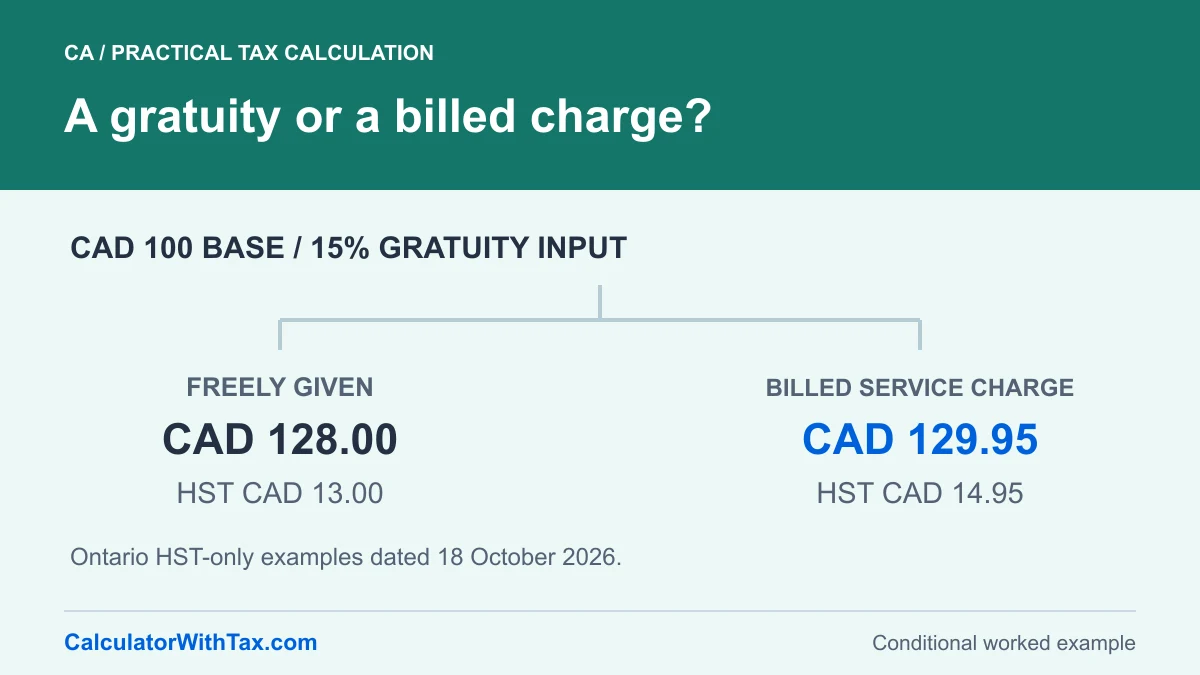
In a bounded Ontario example dated 18 October 2026, CAD 100 before 13% HST plus a freely given CAD 15 tip totals CAD 128. A CAD 15 service charge included in the taxable bill instead gives CAD 14.95 HST and CAD 129.95 payable.
The amount’s role matters more than its label
For Ontario HST on tips and gratuities, distinguish a freely given tip outside the bill from a service charge added to the bill. Calling both amounts a gratuity does not make their tax treatment identical.
The comparisons below assume an ordinary supply independently established as subject to Ontario’s 13% HST reference on 18 October 2026. They calculate HST only. They do not determine place of supply, registration, exemptions, payroll treatment, cash rounding or separate PST/QST.
CRA’s special-cases guidance distinguishes freely given gratuities from mandatory or suggested amounts added to a bill as a service charge. That distinction is the source-based starting point. The calculator does not classify a restaurant’s actual checkout process from a label or terminal screenshot.
A freely given CAD 15 tip on a CAD 100 bill
Assume CAD 100 before HST and a freely given CAD 15 gratuity that is not added to the taxable bill as a service charge. At the established 13% treatment, HST on the CAD 100 supply is CAD 13. The bill including HST is CAD 113.
Adding the freely given CAD 15 tip to that payment gives CAD 128 overall. The HST stays CAD 13 in this scenario. The tip changes how much the customer pays, but not the base on which this example calculates HST.
The 15% setting is a commercial illustration, calculated on the before-HST amount. It is not a required tipping rate. A customer could choose a different amount or basis without making that preference a general tax rule.
A CAD 15 service charge added to the bill
Now assume the CAD 15 is instead a service charge added to the taxable bill. The HST base becomes CAD 115. At 13%, HST is CAD 14.95, giving CAD 129.95 payable.
The CAD 1.95 difference from the freely given tip scenario is 13% of the CAD 15 charge. It does not come from a new provincial percentage. The same rate has been applied to a different established base.
Compare two established gratuity situations
Ontario 13% HST-only examples dated 18 October 2026. Confirm freely given gratuity versus a service charge added to the bill; separate PST/QST and cash rounding excluded.
HST = established Ontario taxable base x 13/100, dated 18 October 2026.
- Payment with gratuity
- CAD 128.00
Before-HST amount: CAD 100.00; Freely given gratuity: CAD 15.00; HST: CAD 13.00; Payment: CAD 128.00
| Starting assumptions | Tax in the stated amount | Scenario result |
|---|---|---|
| Freely given gratuity outside the taxable base: CAD 100.00; 15% | CAD 13.00 | Payment with gratuity: CAD 128.00 |
| Service charge included in the taxable base: CAD 100.00; 15% | CAD 14.95 | Payment with gratuity: CAD 129.95 |
| Service charge included in the taxable base: CAD 200.00; 10% | CAD 28.60 | Payment with gratuity: CAD 248.60 |
Both paths use the same synthetic CAD 100 starting amount and 15% extra. Select the scenario only after its facts are established. The controls are an arithmetic comparison, not a ruling that a charge is outside or inside the bill.
Suggested and mandatory are not the whole test
A common shortcut is “mandatory means taxable; optional means not taxable.” That is incomplete for the cited CRA wording, which also addresses a suggested amount added as a service charge. Read how the amount enters the bill and how the arrangement actually operates.
A payment terminal’s suggested percentages alone do not supply every relevant fact. The customer may be entering a freely given gratuity, or the merchant may have already added an amount to the bill. This guide does not resolve every POS configuration or industry practice.
Check the itemized receipt, the customer’s ability to choose, and the merchant’s treatment of the amount. If those facts are unclear, do not select the option that produces the smaller tax merely to obtain a desired total. Clarify the arrangement before using the formula.
Keep the tip basis visible
The example defines the extra amount as a percentage of the before-HST supply amount. CAD 100 multiplied by 15% gives CAD 15. This makes the two tax-base scenarios directly comparable.
Calculating a customer’s gratuity from an after-tax amount would produce a different extra amount. That is a different input choice, not a different HST rate. The example does not decide which tipping custom is appropriate, and it does not silently change the percentage base when the tax scenario changes.
For a fixed-dollar gratuity, document that amount directly in the real working paper. Do not imply that every service charge must be percentage-based. The percentage input is simply a bounded way to compare the scenarios across different purchase amounts.
Another bill shows the same sequence
Assume CAD 200 before HST with an extra amount calculated at 10%, or CAD 20. In the billed-service-charge case, the taxable base is CAD 220. HST is CAD 28.60 and the final payable amount is CAD 248.60.
The worked table uses the same Canadian engine as the GST/HST calculator. It is a synthetic reference example, not a CRA invoice sample or a customer case study. Keep its date and HST-only scope attached when comparing it with another calculation.
The CRA regional reference table distinguishes provincial references. A different region or relevant date cannot be substituted merely to lower the result. Place-of-supply rules must be established separately.
Why reversing the total payment can mislead
In the freely given tip example, CAD 128 includes both a CAD 113 HST-inclusive bill and a CAD 15 tip outside that base. Treating all CAD 128 as a single HST-inclusive taxable amount would extract tax from the tip too.
Use the itemized bill to identify the correct taxable component. A card statement showing one combined payment does not necessarily identify the taxable base. Reverse calculation cannot discover whether the payment contains a freely given gratuity, a taxable service charge or another amount with different treatment.
The Canadian GST/HST guide explains why a known component and correct scope matter. The Ontario quote-comparison guide addresses a separate problem: comparing before-HST and HST-included advertised prices before any gratuity is considered.
Rounding and the reference date remain separate limits
The examples use the engine’s single-amount cent display. CRA RC4022 is a further official reference for charging and fractional amounts. This display is not a complete invoice or return system, and cash-payment rounding is not applied here.
The supported Canadian reference window ends on 18 October 2026. Publishing this article on 20 October does not extend that engine window or certify later transactions. Its examples deliberately retain the supported reference date.
Check a real receipt in this order
- Establish the province, date and treatment of the supply.
- Identify whether the extra amount is freely given or added to the bill as a service charge.
- Record the amount and, if percentage-based, its stated calculation base.
- Calculate HST on the appropriate established taxable amount.
- Reconcile the bill, any separate gratuity and the final payment.
A reliable comparison preserves those distinctions. It does not promise a complete Canadian tax total, decide gratuity policy or infer all missing facts from the word “tip.”
Frequently asked questions
Is HST charged on a freely given tip in Ontario?
CRA distinguishes freely given gratuities not added to the bill from service charges added to it. The ordinary freely given tip case is not subject to GST/HST; first establish the actual arrangement.
What about a suggested gratuity added to the bill?
CRA's guidance includes a mandatory or suggested amount added to a bill as a service charge in the GST/HST base. Do not assume only mandatory charges can be taxable.
Must the tip be calculated before HST?
This example chooses a percentage of the before-HST amount to make comparison consistent. It does not prescribe a legal tipping percentage or whether a customer should choose a before- or after-tax basis.
Does a terminal tip prompt automatically determine the tax treatment?
No. A screen label alone does not establish whether the amount is a freely given gratuity or a charge added to the bill. The example requires that fact to be settled first.
Does this calculate every Canadian sales tax?
No. It is an Ontario HST-only reference example dated 18 October 2026. Separate PST/QST, cash rounding and later-date determinations are excluded.
Use the same country engine
Add tax or extract the included amount with the calculation method used in these examples. Select the treatment applicable to your transaction separately.
Canada GST/HST calculator