
IE · vat
Irish cash rounding and VAT: cash vs card examples
For an illustrative EUR 10.22 bill wholly carrying an established 23% VAT treatment, the displayed VAT is EUR 1.91. Optional cash rounding gives EUR 10.20 payable; a card payment remains EUR 10.22. The payment adjustment does not recalculate VAT.
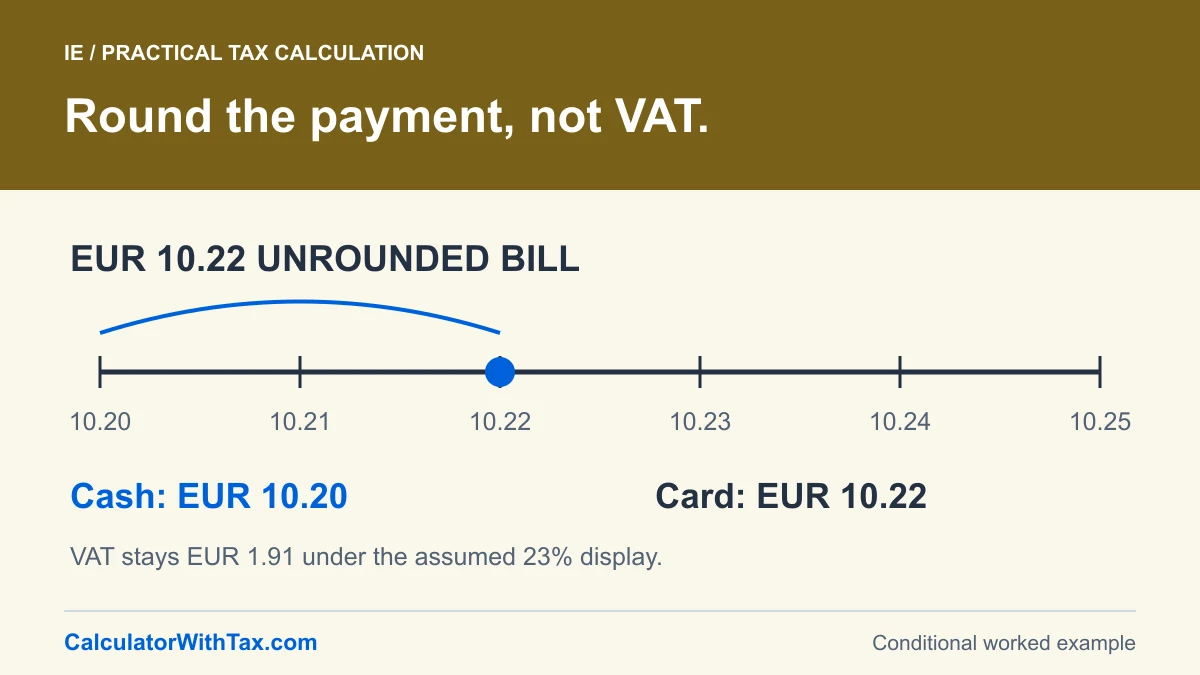
Round the cash settlement, not the VAT base
Irish cash rounding and VAT answer different questions. VAT describes a tax component of the relevant supply. Cash rounding adjusts how an already calculated total is settled in cash. It does not turn that rounded payment into a new taxable selling price.
For a synthetic EUR 10.22 inclusive bill assumed wholly subject to 23% VAT, the site’s single-amount display gives EUR 1.91 VAT and EUR 8.31 before VAT. Under optional nearest-five-cent cash rounding, payment is EUR 10.20. A card payment remains EUR 10.22. The EUR 0.02 settlement difference does not cause the displayed VAT to be recomputed.
What the official rounding arrangement covers
The Central Bank of Ireland’s rounding guidance describes a voluntary arrangement for cash transactions. It applies to the total bill rather than individual prices. Card and other electronic payments are not rounded under that cash arrangement. One- and two-cent coins remain legal tender, and exact change can be requested.
That is different from an invoice system rounding fractional VAT to cents. It is also different from a shop changing a product’s advertised price. Keep those processes distinct when reviewing a till receipt or comparing a cash receipt with a card statement.
The 23% rate in the example is a separately assumed standard-rate treatment, drawn from Revenue’s rate table. The example does not determine whether an item actually qualifies for that rate, a reduced rate, zero rating or exemption.
Follow one EUR 10.22 bill through both payment methods
First calculate the bill using the appropriate product treatments and invoice method. In this one-treatment illustration, the inclusive starting amount is EUR 10.22. Extracting its VAT uses 23 over 123, not 23% of the inclusive amount. The engine displays EUR 1.91 VAT, leaving EUR 8.31 before VAT.
Next consider settlement. A cash customer using the optional rounding arrangement pays EUR 10.20. The cash adjustment is minus EUR 0.02. A card customer pays the original EUR 10.22. Both begin with the same bill; only the payment adjustment differs.
Keep VAT separate from cash settlement
One amount with an assumed 23% treatment. Irish VAT-first half-up display is a convention; voluntary cash rounding is a separate final-payment example, not an invoice or return engine.
VAT in the unrounded single-treatment bill = bill x 23/123 before cent rounding.
- Rounded cash payment
- EUR 10.20
Unrounded bill: EUR 10.22; VAT before cash rounding: EUR 1.91; Rounded cash payment: EUR 10.20; Settlement difference: EUR -0.02
| Starting assumptions | Tax in the stated amount | Scenario result |
|---|---|---|
| Voluntary cash rounding accepted: EUR 10.22 | EUR 1.91 | Rounded cash payment: EUR 10.20 |
| Voluntary cash rounding accepted: EUR 10.23 | EUR 1.91 | Rounded cash payment: EUR 10.25 |
| Card or exact payment: EUR 10.22 | EUR 1.91 | Exact payment: EUR 10.22 |
The comparison intentionally shows the unrounded bill and the settlement separately. It does not suggest that a merchant should alter line prices or manufacture a discount to explain the two-cent difference. The payment method is an explicit input rather than an invisible rounding setting.
Read the final cent digits
Within a five-cent interval, totals ending in one or two cents round down to zero, while three or four round up to five. Totals ending in six or seven round down to five, while eight or nine round up to the next ten-cent point. Totals already ending in zero or five do not move.
For example, EUR 10.21 and EUR 10.22 settle at EUR 10.20 under the arrangement. EUR 10.23 and EUR 10.24 settle at EUR 10.25. EUR 10.26 and EUR 10.27 also settle at EUR 10.25, while EUR 10.28 and EUR 10.29 settle at EUR 10.30. These examples follow the official retailer guidebook.
The direction depends on the total’s last cents, not whether its VAT component happens to be closer to one cent or another. Do not round the tax separately to five cents.
Why rounding every line gives the wrong question
Suppose a receipt contains several items. Individually rounding each product before adding them can create a different total from rounding the completed bill once. The cash arrangement concerns that completed bill, so applying it repeatedly at line level changes the method.
For a mixed-rate basket, calculate the actual VAT components using their appropriate treatments first. Then take the resulting total to the cash-settlement stage. A single reverse calculation at 23% on the whole basket would not establish the correct tax simply because 23% is a familiar Irish rate.
The Irish VAT calculator handles a single already established treatment. Its amount is not a substitute for item classification or a mixed-basket invoice calculation. The Irish VAT guide explains those limits and the distinction between a display convention and a mandatory invoice policy.
Do not reverse VAT from a rounded cash payment
When checking a receipt, use the original calculated total and line information, not just the amount of cash handed over. A cash payment alone has lost some information: several neighboring unrounded totals can settle at the same five-cent point.
For example, EUR 10.21 and EUR 10.22 can both settle at EUR 10.20. You cannot tell which original total applied merely by reversing VAT from EUR 10.20. Even when a particular rounded cent result happens to match, the method remains unreliable because it starts from the settlement rather than the supply amount.
A bank-card statement is not a line-level VAT invoice either. Payment evidence and tax records serve different purposes. Retain the receipt and its tax information instead of asking a calculator to infer missing product and rate details from one payment figure.
Cash rounding is not a commercial price comparison
A two-cent settlement adjustment is not the same as comparing two suppliers with different before-VAT quotes. Establish the full equivalent prices first. The Irish exclusive-fee versus inclusive-total guide demonstrates that normalization before payment-method effects are considered.
Likewise, do not describe a card surcharge, service charge or actual negotiated reduction as cash rounding. Those may change the underlying arrangement and require their own treatment. The example is intentionally limited to optional settlement of an existing cent-denominated total.
A receipt review that keeps the quantities clear
- Identify the original bill and its actual VAT information.
- Confirm whether the transaction is being settled in cash or electronically.
- If the voluntary cash arrangement applies, round the total once to the nearest five cents.
- Record the settlement difference separately from the VAT component.
- Retain the original receipt rather than reconstructing it from the payment.
The single-amount VAT display here uses the existing Irish engine’s convention; it is not presented as the sole legally prescribed invoice-rounding method. Exact-change requests, mixed supplies, returns and commercial adjustments remain separate facts to establish. Clear labels make the result useful: original bill, VAT component, payment method and final settlement each retain their own meaning.
Frequently asked questions
Does cash rounding change Irish VAT?
No. The Central Bank's guidance distinguishes rounding the cash settlement from calculating VAT on the unrounded amount. Do not reverse VAT from the rounded cash payment as a substitute for the original bill.
Does a EUR 10.22 card payment round to EUR 10.20?
Not under this cash-rounding arrangement. The card payment remains EUR 10.22; optional cash rounding would settle at EUR 10.20.
Is cash rounding compulsory?
The arrangement is voluntary. The official guidance allows consumers to request exact change; one- and two-cent coins remain legal tender.
Should every item price be rounded to five cents?
No. Apply the cash-settlement rounding to the total bill, not each item price or each VAT component.
Can the example extract VAT from a mixed-rate shopping basket?
No. The VAT illustration assumes one established 23% treatment. A mixed basket requires its actual line treatments and VAT calculation; cash settlement is then considered separately.
Use the same country engine
Add tax or extract the included amount with the calculation method used in these examples. Select the treatment applicable to your transaction separately.
Ireland VAT calculator