
NZ · business-workflows
New Zealand GST-inclusive partial refund calculation
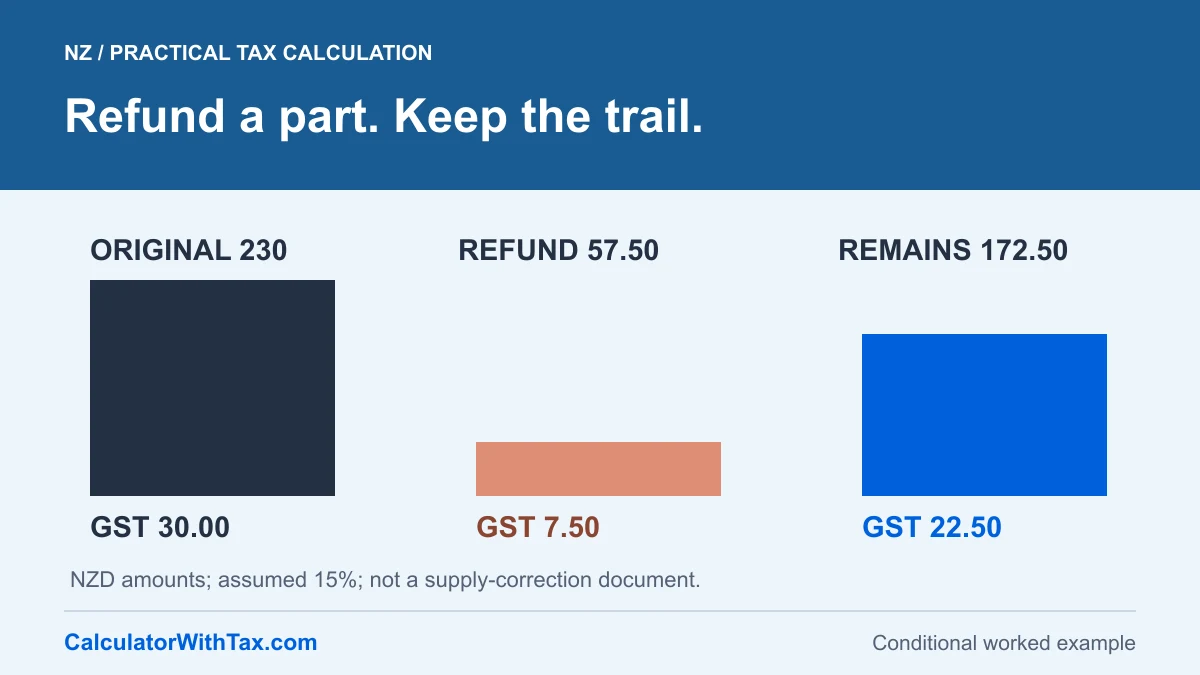
For an original NZD 230 price and an agreed NZD 57.50 GST-inclusive refund, assuming the same 15% treatment, the refund contains NZD 7.50 GST and leaves NZD 172.50. Refund entitlement and supply-correction records are separate questions.
Separate the agreed refund from its GST component
A New Zealand GST-inclusive partial refund calculation starts with an amount that has already been established. If a customer is to receive NZD 57.50 back, and that amount has the same assumed 15% treatment as the original taxable supply, NZD 7.50 is the GST component, not an additional amount to refund on top.
This guide illustrates one ordinary single-treatment price adjustment. It does not determine the right to return goods, decide how much a seller must refund, or prepare tax records. Mixed supplies, fees retained by a seller, rate changes and special arrangements need their own analysis before this arithmetic is used.
Use the inclusive fraction, not 15% of the refund
Inland Revenue’s calculation guidance explains adding and extracting GST. At an established 15% treatment, an inclusive amount contains 115 parts: 100 before GST and 15 GST. The extraction fraction is 15 over 115, which simplifies to 3 over 23.
For NZD 57.50, the GST component is NZD 7.50 and the before-GST component is NZD 50. Multiplying NZD 57.50 by 15% would instead give NZD 8.625 before rounding. That is the wrong base, not a rounding issue.
If an agreement instead says “NZD 50 plus GST,” establish that exclusive basis first. Under the stated treatment, the completed refund would be NZD 57.50. The labels describe different starting points even when the same final amount is reached.
Reconcile the original, refund and remaining price
Assume an original NZD 230 GST-inclusive price. Its before-GST amount is NZD 200 and its GST component is NZD 30. An agreed NZD 57.50 inclusive partial refund removes NZD 50 before GST and NZD 7.50 GST, leaving NZD 172.50 inclusive.
That remainder contains NZD 150 before GST and NZD 22.50 GST under the same assumptions. Both the cash balance and the component balance reconcile in this example: NZD 230 less NZD 57.50 equals NZD 172.50, while NZD 30 less NZD 7.50 equals NZD 22.50.
Reconcile an agreed GST-inclusive refund
One established 15% supply and positive refund magnitudes. Provisional NZ GST-first half-down display; no supply-correction document or period-wide compliance determination.
GST in the agreed inclusive refund = refund x 3/23 before the disclosed cent rounding.
- Remaining inclusive amount
- NZD 172.50
Original charge: NZD 230.00; Agreed refund: NZD 57.50; GST in refund: NZD 7.50; Remaining amount: NZD 172.50
Rounded GST reconciliation difference: NZD 0.00. Separate rounded amounts need not reproduce an original document's GST.
| Starting assumptions | Tax in the stated amount | Scenario result |
|---|---|---|
| Original, agreed refund and remaining amount: NZD 230.00; 57.50 NZD | NZD 7.50 | Remaining inclusive amount: NZD 172.50 |
| Original, agreed refund and remaining amount: NZD 115.00; 23 NZD | NZD 3.00 | Remaining inclusive amount: NZD 92.00 |
| Original, agreed refund and remaining amount: NZD 0.20; 0.10 NZD | NZD 0.01 | Remaining inclusive amount: NZD 0.10 |
The bars show amounts, not a promise that all refunds are proportional to the original invoice. The example requires the refund not to exceed the original price and uses the same treatment throughout. It does not allocate a refund between differently treated goods or calculate compensation unrelated to that supply.
A smaller worked example
For a synthetic NZD 115 original price and NZD 23 agreed inclusive refund, the original GST is NZD 15. The refund contains NZD 3 GST and NZD 20 before GST. The remaining NZD 92 contains NZD 12 GST and NZD 80 before GST.
The refund here is one-fifth of the original inclusive price, so each exact component also falls by one-fifth before rounding. That relationship is useful for checking this example, but it does not authorize refunding an arbitrary percentage of a multi-line invoice. A real adjustment should reflect what changed in the actual supply.
Keep the before-GST reduction distinct from the cash returned. NZD 20 describes the net portion of this refund; the amount returned to the customer is NZD 23 under the assumed inclusive agreement. Sending only the net portion would not match that stated agreement.
If only one line of a larger invoice is being refunded, identify that line’s original treatment and the agreed reduction attributable to it. Do not proportionally reduce every other line merely because the refund is a fraction of the original grand total. The single-treatment example does not perform that allocation.
Tiny amounts can expose a cent difference
Now consider NZD 0.20 inclusive and a NZD 0.10 inclusive refund. Under this site’s provisional GST-first half-down display, the original GST rounds to NZD 0.03. The refund’s GST rounds to NZD 0.01, and the remaining NZD 0.10 also has NZD 0.01 displayed GST.
Subtracting the rounded refund GST from the rounded original GST leaves NZD 0.02, whereas independently extracting GST from the remainder gives NZD 0.01. The example therefore displays a NZD 0.01 reconciliation difference. It does not hide the difference or decide where an invoice system should allocate it.
The inclusive cash amounts still reconcile exactly. The issue arises from separately rounding three fractional tax amounts. Repeating calculations to more decimal places without deciding the records’ applicable approach is not enough to resolve the document-level treatment.
Keep the rounding scope explicit
Section 19O of the GST Act concerns fractional cents in specified information and permits alternative scopes subject to consistency within a taxable period. Its wording is not a mandate to apply one rounding algorithm to every commercial amount or every return.
The site’s New Zealand engine remains provisional. Its single-amount GST-first half-down display is exposed so that readers can reproduce the examples; it is not represented as comprehensive professional approval of an invoice or period-wide process. The New Zealand GST guide explains that boundary in more detail.
When a penny difference matters, retain the original unrounded calculation, the original document’s method, the refund method and the chosen reconciliation procedure. Do not change the refund’s agreed cash amount just to make an independent reverse calculation match.
Calculation and supply correction are different jobs
Inland Revenue’s supply-correction guidance addresses changes such as altered prices and returned goods. The broader taxable-supply information guidance explains the records framework introduced from 1 April 2023.
Use those references to determine what information the actual correction needs. A numeric breakdown alone does not identify the correct recipient, link all required records, select a reporting period or establish a time limit. This article does not generate compliant correction information or submit an adjustment.
Check the price basis before issuing a refund
- Establish the reason and agreed amount of the adjustment.
- Identify whether that amount includes GST or is before GST.
- Confirm the treatment of the affected supply rather than choosing a rate for convenience.
- Separate the refund into its known components and calculate the cash remainder.
- Reconcile rounding with the original records and applicable scope.
- Prepare and retain the required correction information separately.
If the original offer’s wording is unclear, the plus GST versus GST-inclusive quote guide helps distinguish the price bases. Once those facts are settled, the New Zealand GST calculator can check a single known amount. Neither replaces the missing agreement or the underlying tax analysis.
Frequently asked questions
How much GST is in a NZD 57.50 inclusive refund at 15%?
NZD 7.50, using the inclusive fraction 15 over 115, or 3 over 23. The remaining NZD 50 is the before-GST portion of that agreed refund.
Can I multiply the inclusive refund by 15%?
No. That applies the percentage to an amount that already includes GST. Use the inclusive fraction when the refund itself is confirmed as GST-inclusive at that treatment.
Does the calculation establish a customer's refund entitlement?
No. The amount and reason for the refund must already be agreed or otherwise established. The example only separates a known inclusive amount.
Why can the remaining GST differ by a cent?
Separately rounding the original price, refund and remainder can produce a reconciliation difference. The example exposes that difference instead of silently allocating it to a document or return.
Is this an approved New Zealand credit-note generator?
No. It does not prepare supply correction information, determine reporting periods or certify a legally compliant rounding approach. The engine remains provisional.
Use the same country engine
Add tax or extract the included amount with the calculation method used in these examples. Select the treatment applicable to your transaction separately.
New Zealand GST calculator