
GB · reverse-tax
Reverse VAT calculator for a partial refund: split net and VAT
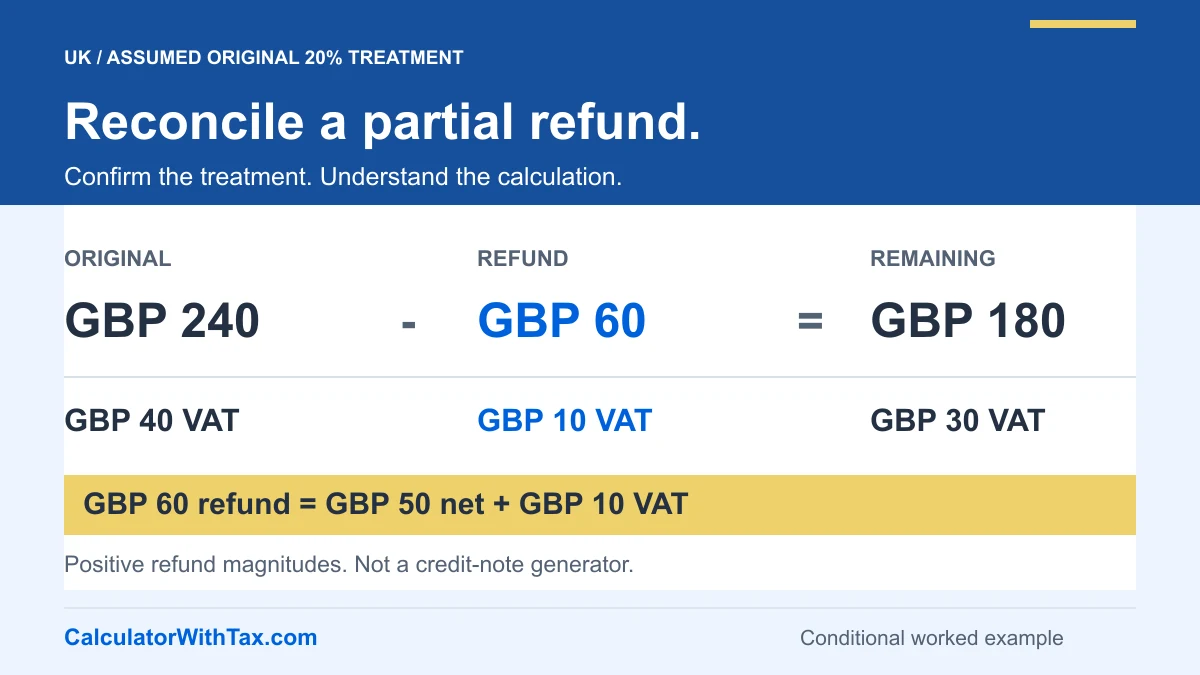
If an agreed GBP 60 refund includes VAT at the original confirmed 20% rate, it contains GBP 50 net and GBP 10 VAT. Calculate the refund's components, not 20% of its inclusive amount.
GBP · Illustrative 20% assumption
See the VAT calculation
One amount, assumed 20% treatment. This example does not determine the rate applicable to your transaction.
- Before VAT
- GBP 50.00
- VAT amount
- GBP 10.00
- Including VAT
- GBP 60.00
GBP 50.00 + GBP 10.00 = GBP 60.00
VAT is rounded first to pennies, exact half-pennies up. The chart shows shares of the total, not the percentage applied to the before-tax amount.
Start with an agreed refund and the original treatment
A reverse VAT calculator can explain how much VAT is included in a partial refund after the refund and applicable treatment have been established. It cannot decide whether a refund is owed or whether a proposed credit note meets the legal requirements.
HMRC’s VAT Notice 700, including its credit-note and tax-rate guidance, distinguishes these obligations from simple arithmetic. Its time-of-supply manual also explains why issuing a credit note does not ordinarily create a new tax point. We consulted these references on 19 October 2026.
The worked case assumes one original supply confirmed at 20%, a GBP 240 inclusive charge and a subsequently agreed GBP 60 inclusive reduction. It is not a template for every refund, cancellation or bad-debt adjustment.
Split the inclusive refund into net and VAT
The refund’s GBP 60 is an inclusive amount. Divide it by 1.20 to recover its net component:
Net refund component = 60 / 1.20 = GBP 50.00
VAT component = 60 - 50 = GBP 10.00
The exact unrounded fraction is 20/120, equivalent to 1/6. Multiplying GBP 60 directly by 20% gives GBP 12, which is not the included VAT under these assumptions.
The adjustable example uses the same UK engine as the UK VAT calculator. Enter the positive refund magnitude, not a negative invoice or ledger entry. The tool’s positive amounts describe a breakdown; your accounting system separately records the sign and nature of an actual adjustment.
Reconcile original, refunded and remaining amounts
At the established 20% treatment, the original GBP 240 charge contains GBP 200 net and GBP 40 VAT. Subtracting the agreed GBP 60 refund leaves GBP 180, containing GBP 150 net and GBP 30 VAT.
| Scenario | Input | Rate | Before tax | Tax | Total |
|---|---|---|---|---|---|
| Agreed VAT-inclusive refund magnitude | GBP 60.00 | 20% | GBP 50.00 | GBP 10.00 | GBP 60.00 |
| Original inclusive charge | GBP 240.00 | 20% | GBP 200.00 | GBP 40.00 | GBP 240.00 |
| Amount remaining after that refund | GBP 180.00 | 20% | GBP 150.00 | GBP 30.00 | GBP 180.00 |
Check all three relationships: GBP 200 minus GBP 50 is GBP 150 net; GBP 40 minus GBP 10 is GBP 30 VAT; GBP 240 minus GBP 60 is GBP 180 total. The table calculates each amount with the UK engine, rather than embedding an unrelated manual percentage.
These examples have exact penny results. With other amounts, line and aggregate rounding can create a small reconciliation difference. Do not silently change a tax amount just to force an apparent match; inspect the original figures and required rounding scope.
Use the relevant original rate, not an automatic current default
HMRC’s credit-note rate guidance refers to the tax point of the original supply. The example’s 20% is therefore a confirmed assumption about that supply, not a rule that every refund should use the current standard rate.
For an older purchase, retrieve the original invoice and relevant treatment. A refund involving several rates, exempt amounts, additional fees or other adjustments needs a justified breakdown before a one-rate calculator is meaningful.
Read how to add and remove UK VAT for the underlying formula. For a different task, the inclusive-versus-exclusive quote guide compares supplier prices without treating them as refunds.
Keep the calculation separate from credit-note compliance
The UK engine rounds VAT first to pennies, with exact half-pennies rounded up, then derives the other component by subtraction. This one-amount convention is not a complete credit-note, invoice-allocation or VAT-return workflow.
Confirm the applicable HMRC requirements before issuing a document or adjusting a return. Retain original records privately. The calculator does not need customer identities, invoice attachments or payment details to show a conditional numerical breakdown.
Frequently asked questions
How much VAT is in an agreed GBP 60 refund at 20%?
If the refund includes one confirmed 20% VAT treatment, it contains GBP 50 net and GBP 10 VAT. The unrounded VAT fraction is 20/120, or 1/6 of the inclusive refund.
Should I calculate 20% of the inclusive refund?
No. That would give GBP 12 on GBP 60. The 20% rate applies to the net base, so the correct included amount in this example is GBP 10.
Should the calculation use today's VAT rate?
Do not substitute today's rate automatically. HMRC's credit-note guidance refers to the rate at the tax point of the original supply. Establish the relevant treatment before using this example.
Does this create a valid VAT credit note?
No. The tool breaks down a positive agreed refund amount. Credit-note validity, records, timing, eligibility and return adjustments require separate assessment under HMRC guidance.
Can I use one percentage on a refund covering several tax rates?
Not without a justified allocation. Identify the amounts belonging to each original treatment first. An inclusive total alone may not provide enough information.
Use the same country engine
Add tax or extract the included amount with the calculation method used in these examples. Select the treatment applicable to your transaction separately.
UK VAT calculator