
GB · vat
VAT on delivery and postage charges in the UK
A separate delivery line does not by itself decide its VAT treatment. Establish whether delivery is part of the agreed supply of delivered goods or a separate optional service, then calculate using the appropriate treatment.
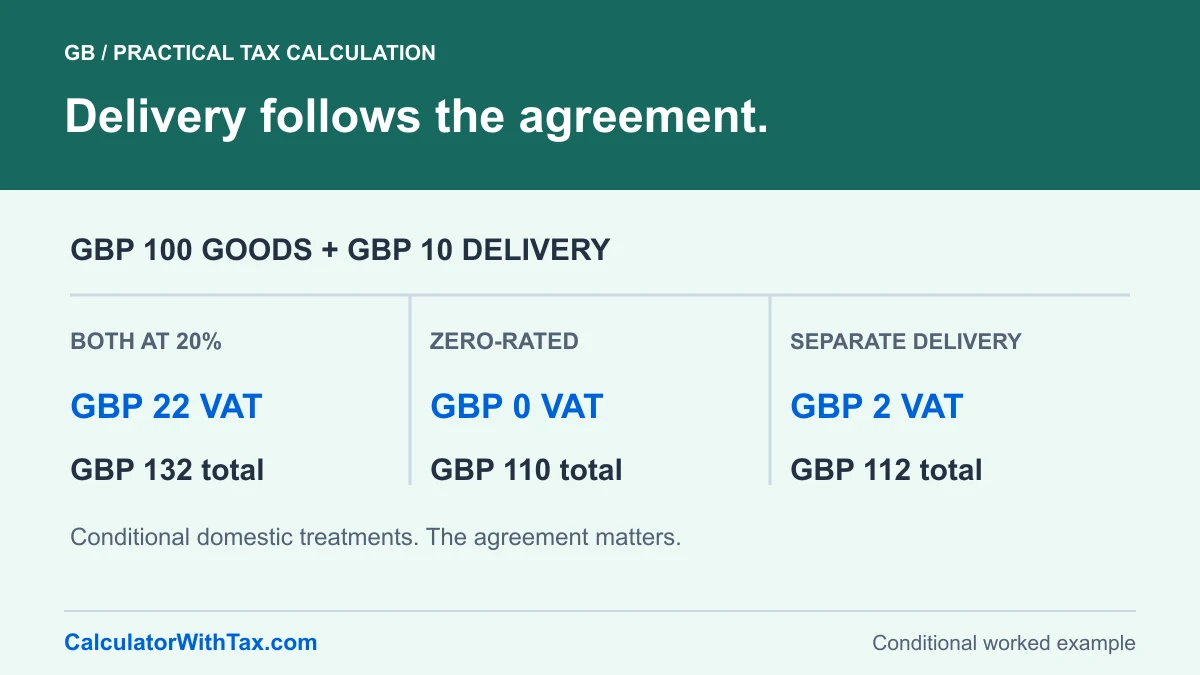
The delivery agreement comes before the percentage
To calculate UK VAT on delivery and postage charges, first establish what has been supplied. A separate postage line on an invoice is not enough to decide the answer. The relevant distinction in this guide is between a contract for delivered goods and a genuinely separate optional delivery service.
The examples assume a VAT-registered seller, an ordinary domestic transaction and independently established goods treatment. They are not a test of registration, place of supply, export relief or product eligibility. The UK VAT rate reference identifies the 20% standard rate and 0% zero rate used in the comparisons; choosing a case does not prove that a real transaction qualifies.
Read the contract, not only the invoice layout
HMRC Notice 700/24 explains how delivery forming part of a supply of delivered goods can follow the goods’ treatment, while a separate optional delivery service can be treated differently. A separately stated charge can still form part of the delivered-goods contract. Conversely, merely describing a service as “postage” does not settle its classification.
Before calculating, ask whether the customer contracted to receive delivered goods, could collect them instead, and separately selected a delivery service. Preserve the actual terms. The simple cases below assume those questions have already been answered; the interactive selection is not a legal classification engine.
Three GBP 100 purchases, three conditional totals
Start with GBP 100 before VAT for the goods and GBP 10 before VAT for delivery. In the first case, both are standard-rated at 20%. The base is GBP 110, VAT is GBP 22 and the customer pays GBP 132.
In the second case, the goods are already established as zero-rated and the GBP 10 delivery forms part of the contract for those delivered goods. Under that assumption, the GBP 110 combined amount has zero VAT and the customer pays GBP 110.
In the third case, the goods remain zero-rated, but the GBP 10 is a separate ordinary domestic delivery service assumed to be standard-rated. VAT is GBP 2 on that delivery, so the customer pays GBP 112. The GBP 2 difference from the second case follows the different supply assumption, not a different price for the goods.
Compare established delivery treatments
Ordinary domestic UK examples only. Contract and supply classification are inputs, not decisions made here; 20% is assumed where standard treatment applies.
Standard-rated component VAT = established exclusive component x 20/100.
- Delivered total
- GBP 132.00
Goods before VAT: GBP 100.00; Delivery before VAT: GBP 10.00; VAT: GBP 22.00; Delivered total: GBP 132.00
| Starting assumptions | Tax in the stated amount | Scenario result |
|---|---|---|
| Goods and delivery at 20%: GBP 100.00; 10 GBP | GBP 22.00 | Delivered total: GBP 132.00 |
| Established zero-rated delivered goods: GBP 100.00; 10 GBP | GBP 0.00 | Delivered total: GBP 110.00 |
| Zero-rated goods; separate 20% delivery: GBP 100.00; 10 GBP | GBP 2.00 | Delivered total: GBP 112.00 |
These are synthetic comparisons, not HMRC invoice samples. Changing the input values changes arithmetic within the selected assumptions; it does not evaluate a contract or expand the scenarios to every postal product.
Use a combined base only when the treatment matches
For the standard-rated example, combining GBP 100 and GBP 10 before applying 20% is convenient because both components share the assumed treatment. Calculating GBP 20 on the goods and GBP 2 on delivery reaches the same GBP 22 tax in this particular example.
That convenience disappears when the components differ. In the optional-delivery case, applying 20% to the whole GBP 110 would charge GBP 22 instead of the assumed GBP 2. Applying 0% to the whole amount would omit the delivery VAT. Keep the two bases separate until their classification is established.
The UK VAT calculator can check a single known base at a selected reference treatment. It does not decide whether goods and delivery should be combined. A multi-rate invoice also requires appropriate allocation and reconciliation rather than one percentage applied to the grand total.
Separate a delivery cost from a delivery charge
A merchant’s cost of purchasing postage is not necessarily the charge made to the buyer. The business might absorb the cost, charge a different amount, include delivery in its selling price or arrange a separate service. Those are different commercial facts.
In particular, the VAT treatment of a Royal Mail service purchased by a merchant is not automatically the treatment of the merchant’s recharge to the customer. Review the seller’s own supply under the relevant HMRC guidance. Do not label every recharge exempt simply because an upstream postal receipt did not show VAT.
If the advertised goods price already includes delivery, do not invent another delivery amount and add tax to it. First establish the actual selling price and what it contains. This is a price-basis problem before it is a multiplication problem.
Compare delivered quotes on the same basis
Suppose two sellers quote the same products but one includes delivery while the other shows it separately. Comparing only the goods headline can make the separately charged offer appear lower even when the complete payable amount is higher.
Obtain the goods amount, delivery amount, inclusive or exclusive wording and the established treatment for each component. Normalize each offer to its complete payable price. The VAT-inclusive versus exclusive quote guide explains that normalization for a single treatment; delivery needs an additional classification check before using that shortcut.
Keep commercial comparison distinct from tax recovery. A buyer’s possible input-tax position is not the same as the cash total payable to a seller, and this guide does not determine recoverability. The general VAT guide covers adding and extracting a known VAT component.
Why a reverse calculation needs the right denominator
For one established 20% inclusive amount, extracting VAT uses the fraction 20 over 120, not 20 over 100. But a complete bill containing both zero-rated goods and standard-rated optional delivery cannot generally be reversed at 20% as though every pound had the same treatment.
Use the separately established inclusive amount for the relevant component, or reconstruct it from reliable invoice lines. A correct formula applied to the wrong combined base still produces an incorrect breakdown. Rounding the result more precisely will not fix that classification error.
The examples use the existing UK engine’s cent display for a single amount. They do not prescribe one mandatory method for every multi-line invoice or prove a seller’s rounding policy is wrong when pennies differ.
Keep an audit-friendly delivery check
- Record the seller’s VAT status and the relevant transaction facts.
- Establish the goods’ treatment independently.
- Read whether delivery belongs to the agreed goods supply or a separate service.
- Identify whether each quoted charge is already VAT-inclusive.
- Calculate only after the bases and treatments are settled.
- Retain the contract, invoice and calculation together.
The broader HMRC VAT guide, Notice 700, supplies additional context on valuation and supplies. Exports, imports, approval goods, direct marketing, unusual agency arrangements and mixed baskets are beyond this narrow comparison. When one of those facts is present, obtain the applicable guidance rather than forcing the transaction into one of the three illustration paths.
Frequently asked questions
Is VAT always charged on delivery in the UK?
Not on one universal basis. The contract, nature of the supply and applicable treatment matter. This guide compares specific ordinary domestic cases rather than classifying every delivery service.
Does showing postage separately make it a separate VAT supply?
Not automatically. A delivery charge forming part of a contract for delivered goods can follow the goods' treatment even when shown separately.
What happens when zero-rated goods have an optional delivery service?
For the assumed separate ordinary domestic delivery service here, GBP 10 delivery at 20% adds GBP 2 VAT, while the already established zero-rated goods remain at 0%.
Can I copy the VAT treatment from a Royal Mail receipt?
Not automatically. The treatment of the postal service purchased by a merchant does not by itself determine the merchant's own supply to its customer.
Does the comparison cover exports or mixed-rate baskets?
No. Cross-border supplies, mixed-rate allocation, approval arrangements and specialist services need separate assessment.
Use the same country engine
Add tax or extract the included amount with the calculation method used in these examples. Select the treatment applicable to your transaction separately.
UK VAT calculator