
GB · income-tax
Personal Allowance Over GBP 100,000: Understand the Taper
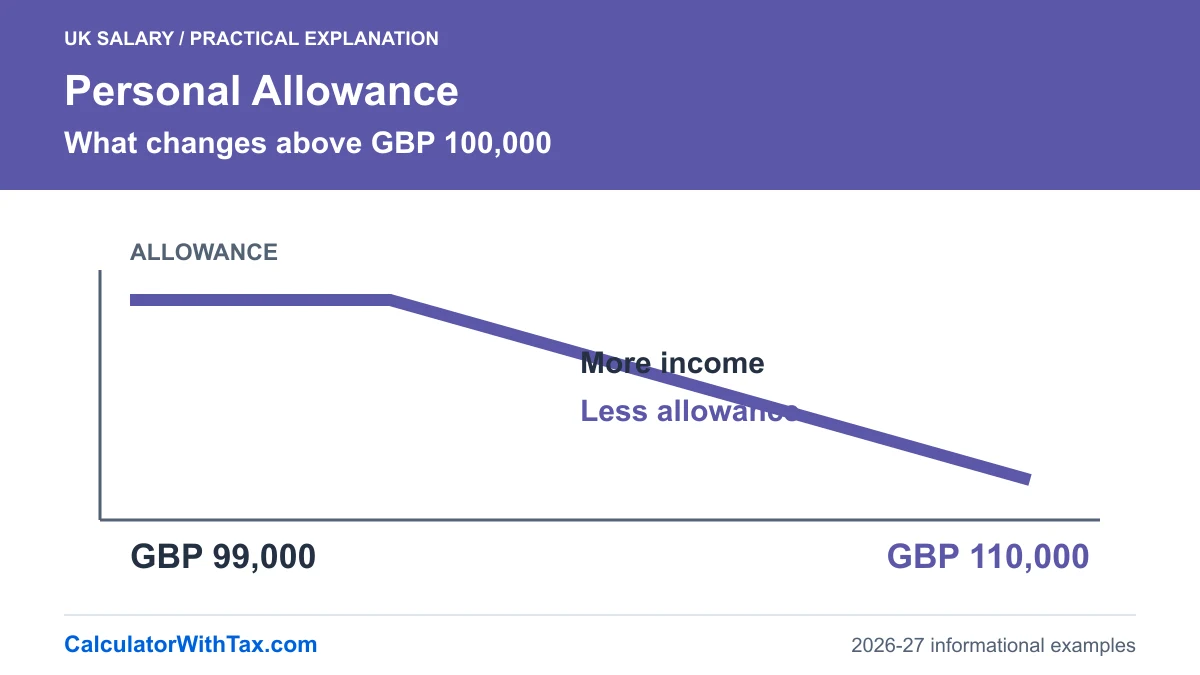
Above GBP 100,000 adjusted net income, the Personal Allowance reduces as income rises. This is separate from moving into a tax band, and adjusted net income is not the same as take-home pay.
Published
Separate the allowance taper from the tax bands
The Personal Allowance determines how much income is left outside the annual Income Tax calculation. A tax band determines the rate on a slice of taxable income. When the allowance shrinks, more income becomes taxable even if the headline rate on the next slice has not changed.
HMRC’s current allowance guidance sets the reduction above £100,000 adjusted net income. The standard £12,570 allowance reduces by £1 for every £2 above that threshold, reaching zero at £125,140. This guide uses 2026–27 salary-only examples to explain the mechanism, not to prescribe tax planning.
Adjusted net income is not net salary
The word net can mislead here. Adjusted net income is not the money received after PAYE, employee NI or other payroll deductions. HMRC’s adjusted-net-income guidance describes taxable income and specified adjustments used for this measure.
Our restricted calculator excludes other income, pension contributions, Gift Aid and other reliefs. Within that explicit model, annual salary supplies the income used for the taper. In a real case with additional income or qualifying adjustments, entering salary alone does not establish the correct adjusted net income.
Do not subtract an unexplained pension amount from salary and assume the difference is the right input. Different relief mechanisms require their own verified treatment. The salary-only tool is not a contribution planner and does not calculate how much someone should contribute.
Work through the GBP 110,000 allowance example
At an assumed £110,000 salary-only adjusted net income, the excess above £100,000 is £10,000. Half of that excess is £5,000. Subtracting £5,000 from £12,570 leaves a £7,570 allowance.
| Step | Salary-only example |
|---|---|
| Adjusted net income used | £110,000 |
| Excess over £100,000 | £10,000 |
| Half the excess | £5,000 |
| Remaining standard allowance | £7,570 |
The example uses whole amounts so the reduction is easy to inspect. At a fractional boundary, the statutory whole-pound provision matters. The engine rounds the remaining allowance up to a whole pound and never below zero; it does not silently round salary to the nearest thousand before calculating.
Compare a salary below the taper with one inside it
Both rows below use England, one full-year job, monthly category A NI and no excluded deductions. The comparison deliberately changes more than one pound, so read its difference as a whole scenario comparison, not a single marginal rate.
Compare the same full-year salary-only baseline below and inside the allowance taper.
Synthetic 2026–27 examples: one full-year UK-resident employee, regular monthly category A NI, salary-only income and no pensions, loans or other excluded deductions. Independent professional tax review incomplete.
Take-home £67,978.00Income Tax £27,032.00Employee NI £3,990.00
Take-home £72,358.04Income Tax £33,432.00Employee NI £4,209.96
| Scenario | Gross | Allowance | Income Tax | Employee NI | Annual net | Monthly average net |
|---|---|---|---|---|---|---|
| Below the taper | £99,000.00 | £12,570.00 | £27,032.00 | £3,990.00 | £67,978.00 | £5,664.83 |
| Inside the taper | £110,000.00 | £7,570.00 | £33,432.00 | £4,209.96 | £72,358.04 | £6,029.84 |
Second scenario minus first: gross £11,000.00, Income Tax £6,400.00, employee NI £219.96, annual net £4,380.04. A negative difference means a reduction, not a refund.
Reference checked 20 October 2026. NI is summed from twelve rounded monthly contributions. Average components are rounded before net is derived; direct annual-net division can differ by a penny.
Notice both the salary and allowance columns. The higher salary does not simply add gross income while leaving the tax-free amount untouched. The annual Income Tax change reflects additional salary plus the allowance change. NI remains a separate earnings-period calculation.
Understand the phrase 60 percent tax trap
In an appropriate rest-of-UK salary-only part of the taper, another £2 of income can bring £1 of previously sheltered income into tax. If both amounts fall at 40%, the extra £3 of taxable income produces £1.20 Income Tax. Dividing £1.20 by the £2 income increase gives a 60% marginal Income Tax effect before NI.
This is an explanation of interacting rules, not the creation of a separate 60% statutory band. It is not the average rate on all income, not a Scottish calculation and not a statement about every penny boundary. Whole-pound allowance and penny rounding mean an individual tiny change can behave differently from a smooth percentage illustration.
Nor is the phrase a complete household assessment. Benefits, other charges and excluded deductions can matter outside this model. Avoid presenting a headline percentage as the answer to a personal decision about salary, donations or pensions.
Use the calculation for the question it can answer
The UK take-home pay calculator can show how this restricted annual salary model changes across the taper. It cannot determine all reliefs, validate a tax code, prepare a return or reproduce cumulative payroll.
Before comparing two cases, keep the tax year, jurisdiction and employee assumptions unchanged. If your question requires reliefs or other income, use the official adjusted-net-income guidance and suitable qualified advice instead of forcing the case into the baseline.
Frequently asked questions
What starts the Personal Allowance taper?
The stated threshold is GBP 100,000 adjusted net income, not GBP 100,000 of take-home pay. The allowance reduces by GBP 1 for every GBP 2 above that amount, subject to the applicable whole-pound rule.
Is adjusted net income the amount in my bank account?
No. It is a tax measure involving taxable income and specified adjustments. This calculator equates it to salary only because all other income and reliefs are excluded from its baseline.
What allowance does the salary-only GBP 110,000 example use?
The example has GBP 10,000 above the taper start, so the GBP 12,570 standard allowance is reduced by GBP 5,000 to GBP 7,570. It is not a personal relief calculation.
Can the calculator tell me how much pension contribution to make?
No. Pension contributions and their relief mechanisms are outside the model. Do not treat changing the salary input as a calculation of a pension strategy.
Is a 60% tax band a separate statutory band?
No. In a relevant rest-of-UK salary-only interval, the combined effect of 40% tax and allowance withdrawal can produce a 60% marginal Income Tax effect. That is not a universal rate, does not include NI and does not describe Scottish bands.
Explore the supported annual salary baseline
Compare annual Income Tax and projected monthly employee NI. Pensions, loans, tax-code adjustments and actual PAYE payslips are not calculated.
UK take-home pay calculator