
GB · income-tax
50k Tax Bracket: How a Pay Rise Changes UK Take-Home Pay
In the stated England, Wales or Northern Ireland baseline, GBP 50,000 is below the standard-allowance higher-rate threshold. Crossing a band does not apply its rate to the whole salary.
Published
GBP 50,000 is not itself the standard higher-rate boundary
For 2026–27, the standard-allowance table for England, Wales and Northern Ireland places the higher-rate boundary above £50,270 gross. The phrase “50k tax bracket” is convenient shorthand, but rounding the boundary down to £50,000 can distort a pay-rise calculation.
This guide uses one full-year employment, the standard allowance and regular monthly category A NI. It does not assume that every person earning £50,000 has the same tax situation. Scottish rates differ, and another allowance or other income can change where a person’s income sits.
Break a GBP 5,000 increase into slices
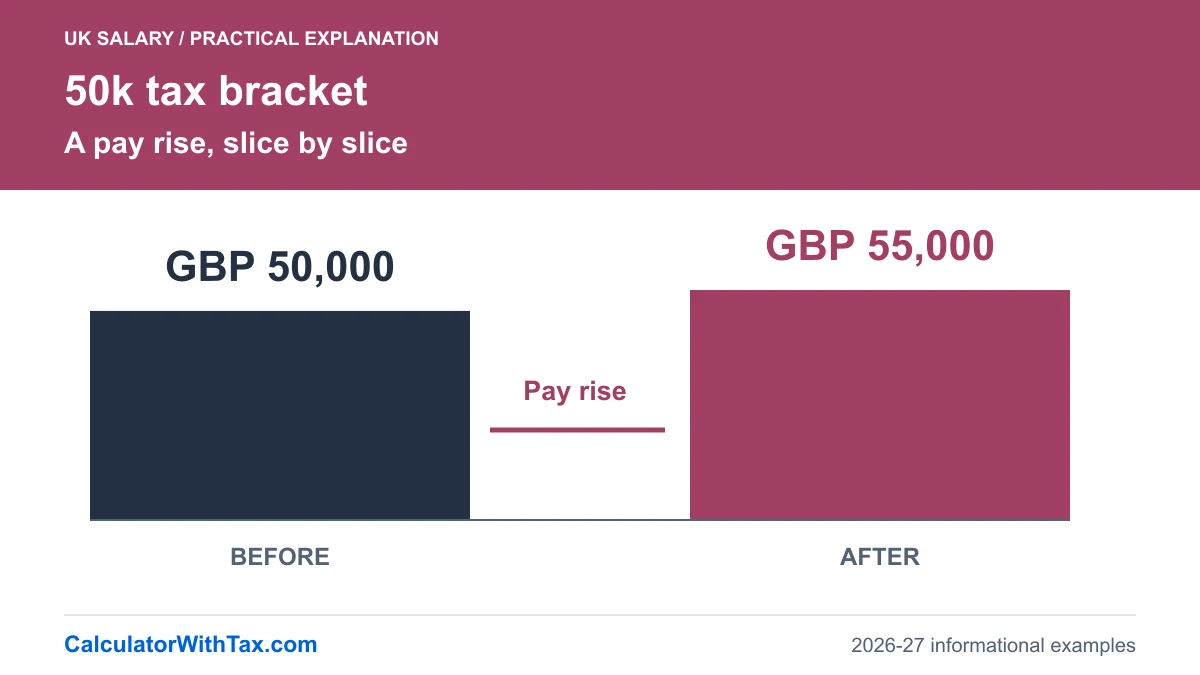
Compare a £50,000 salary with £55,000 under otherwise identical baseline assumptions. The increase is £5,000 gross. The first £270 reaches the stated £50,270 boundary; the remaining £4,730 falls above it.
| Part of the increase | Baseline Income Tax rate | Additional Income Tax |
|---|---|---|
| First £270 | 20% | £54 |
| Remaining £4,730 | 40% | £1,892 |
| Total £5,000 increase | Two slices, not one rate on all salary | £1,946 |
The £1,946 is the difference in annual Income Tax under these assumptions. It is not the total tax on £55,000, and it is not the whole reduction in the gross rise: projected employee NI changes too. Keep the tax-only comparison separate from the final take-home comparison.
The slice explanation also shows why charging 40% against the entire £55,000 is wrong. Earlier parts of the salary do not suddenly move into the higher band because a later part crosses a boundary.
Compare the complete supported estimates
The table and diagram below come from the same engine as the UK take-home pay calculator. Each row is a separate full-year salary scenario, not a mid-year salary change.
Compare the same full-year circumstances before and after a gross pay rise.
Synthetic 2026–27 examples: one full-year UK-resident employee, regular monthly category A NI, salary-only income and no pensions, loans or other excluded deductions. Independent professional tax review incomplete.
Take-home £39,520.12Income Tax £7,486.00Employee NI £2,993.88
Take-home £42,457.96Income Tax £9,432.00Employee NI £3,110.04
| Scenario | Gross | Allowance | Income Tax | Employee NI | Annual net | Monthly average net |
|---|---|---|---|---|---|---|
| Before the pay rise | £50,000.00 | £12,570.00 | £7,486.00 | £2,993.88 | £39,520.12 | £3,293.35 |
| After the pay rise | £55,000.00 | £12,570.00 | £9,432.00 | £3,110.04 | £42,457.96 | £3,538.16 |
Second scenario minus first: gross £5,000.00, Income Tax £1,946.00, employee NI £116.16, annual net £2,937.84. A negative difference means a reduction, not a refund.
Reference checked 20 October 2026. NI is summed from twelve rounded monthly contributions. Average components are rounded before net is derived; direct annual-net division can differ by a penny.
Use the difference row to reconcile the change: gross increase minus additional Income Tax minus the change in employee NI equals the increase in annual net. Comparing net alone can hide which rule caused the difference; comparing tax alone can miss the NI contribution.
A promotion halfway through a year is not the same input as earning the new annual salary for the whole year. Do not enter £55,000 and interpret its twelve-month projection as a calculation of the months already paid at £50,000. Partial-year and cumulative PAYE cases remain outside this model.
Marginal and average rates answer different questions
A marginal comparison asks what happens to an additional slice of income. An average Income Tax rate asks what share of the entire gross amount is annual Income Tax. A combined deduction share includes employee NI as well and should not be labeled an Income Tax rate.
In this example, the increase straddles two Income Tax bands, so even a tax-only percentage of the whole increase is a blended result. That blended figure does not create a new statutory band. It simply summarizes the two-slice arithmetic above.
Similarly, a graphic showing tax as a fraction of gross salary is not displaying the rate applied to the last pound. Keep the denominator visible whenever a percentage appears: total gross, additional gross or a taxable slice.
Do not generalize this into a household decision
The supported example is intentionally narrower than a decision about accepting a job or promotion. Pensions, student loans, salary sacrifice, benefits and additional charges are excluded. The result cannot establish how a household’s total income or eligibility changes.
For the same reason, an irregular bonus is not interchangeable with a full-year fixed-salary increase. A real payroll deduction can depend on the payment period, code and history. Use the example to understand the shape of progressive taxation, not to override payroll information.
Reproduce the comparison without changing the question
Keep year, jurisdiction and employee assumptions fixed while changing only annual salary. Read the annual results first, then compare average monthly figures if useful. The higher-rate explanation belongs to this guide; the calculator owns the general adjustable salary task, so a separate article is not needed for every nearby salary amount.
If your income is near the allowance taper rather than this band boundary, continue with the Personal Allowance guide. It explains a different mechanism and should not be collapsed into the simple two-slice calculation here.
Frequently asked questions
Is GBP 50,000 automatically in the 40% Income Tax band?
Not in this 2026/27 England, Wales or Northern Ireland standard-allowance baseline: the gross boundary is GBP 50,270. Scottish rates and adjusted allowances require separate treatment.
Does crossing a tax band tax my entire salary at the higher rate?
No. The higher rate applies to the income falling in that band. Earlier slices retain their applicable treatment. An allowance change can separately affect the calculation.
Is tax on my pay rise the same as my average tax rate?
No. Tax on the change compares two outcomes. An average rate compares total tax with total income. Employee NI is another deduction and must be identified separately.
Does the example prove a pay rise always improves every household's finances?
No. This baseline excludes benefits, additional charges, loans and pensions. Its salary-only result is not a whole-household assessment.
Can I use the same threshold for Scotland?
No. Scottish employment-income bands differ. Choose the correct jurisdiction and use the separate full-year regional comparison.
Explore the supported annual salary baseline
Compare annual Income Tax and projected monthly employee NI. Pensions, loans, tax-code adjustments and actual PAYE payslips are not calculated.
UK take-home pay calculator