
GB · income-tax
Why Is My Tax Code Not 1257L? A Practical Check Before You Act
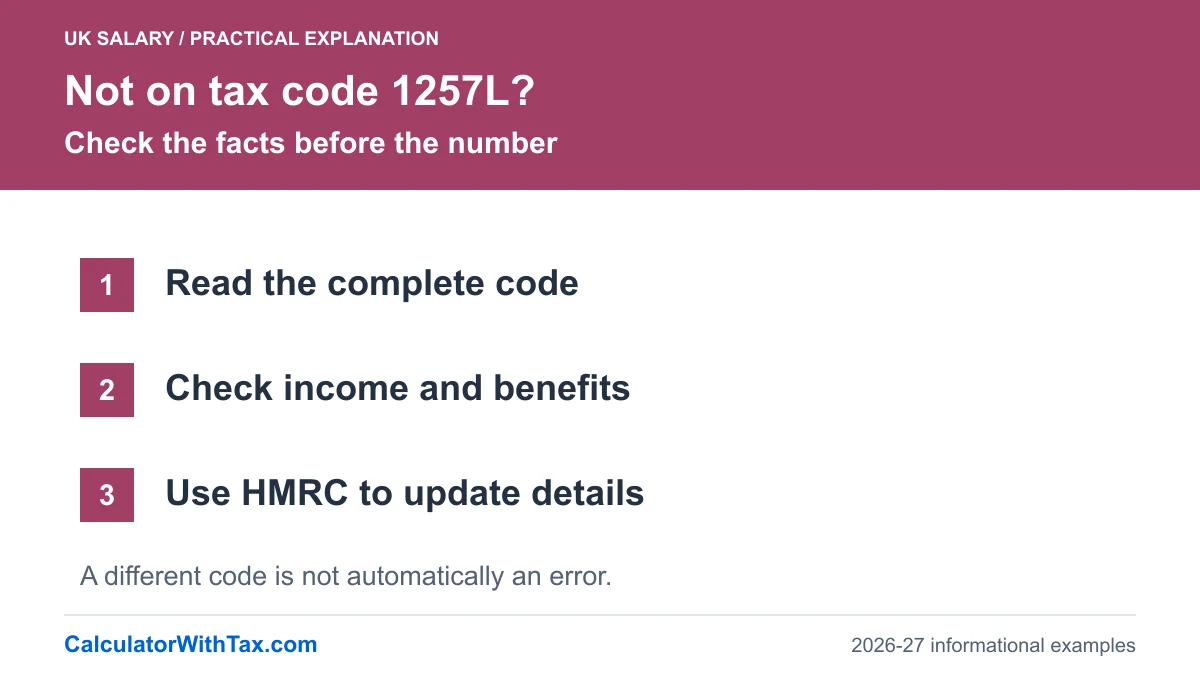
A code different from 1257L is not automatically wrong. Check the complete code and the employment, income and benefit details behind it before requesting a correction through HMRC.
Published
A different code is a question, not a verdict
Seeing a code other than 1257L can be surprising, particularly if colleagues use the familiar code. That comparison does not establish an error. A code reflects information about the individual and the employment, not a universal label that every employee should request.
HMRC lists several reasons a code may change, including changes in income, employment and relevant benefits or adjustments. A changed code may be appropriate, or it may rely on incorrect or incomplete information. The useful investigation starts with that information.
Do not set a target net payment and work backwards to a code that produces it. The aim is a correct record and treatment, not making a payslip resemble a generic calculator result.
First read the whole code and the correct record
Check the complete characters, including regional prefixes and emergency or non-cumulative indicators. Confirm that the code belongs to the current job and tax year. A code on an older document is not necessarily the instruction currently applied by payroll.
Separate code meaning from code correctness. The 1257L guide explains the ordinary number and letter; the cumulative guide explains the time basis. Neither can decide your circumstances simply from a screenshot.
| Item | Useful question | Avoid this assumption |
|---|---|---|
| Current employment or pension | Is it active and attributed correctly? | Every listed income source is still current |
| Estimated taxable income | Does the estimate match the relevant circumstances? | Annual salary alone describes every taxable amount |
| Company benefits and adjustments | Are the facts complete and up to date? | A smaller code number is necessarily a mistake |
| Code basis and period | Are you comparing this period with the same period? | An annual average is an expected emergency-code payment |
| Previous documents | Are the records for the right job and year? | An old code must remain the correct code |
Use private records and official services for these checks. This site does not need your National Insurance number, address, P45 or a real payslip to explain the process.
Check the facts through HMRC’s official route
HMRC’s update guidance directs people to check and update the details used for their code. Review the employment, pension, income, benefit and relevant expense information in the official service rather than asking a third-party calculator to assign a replacement code.
If an employer has not applied a new code, that is a different question from whether HMRC should issue one. Ask the payroll team which instruction they hold, while using HMRC for the underlying personal tax information. This guide does not grant someone authority to change another person’s records.
Avoid fixed promises about how soon a change or repayment will arrive. Processing, payroll timing and the actual tax position must be checked through the official channels. A published explanation is not an individual case decision.
What a GBP 38,000 baseline can and cannot show
Suppose a reader earns £38,000 and wants a reference point. The following example ignores code-specific adjustments and uses only the stated annual baseline. It is not a calculation of that reader’s actual code.
A standard baseline cannot validate an actual code, benefit adjustment or refund.
Synthetic 2026–27 examples: one full-year UK-resident employee, regular monthly category A NI, salary-only income and no pensions, loans or other excluded deductions. Independent professional tax review incomplete.
Take-home £30,880.12Income Tax £5,086.00Employee NI £2,033.88
| Scenario | Gross | Allowance | Income Tax | Employee NI | Annual net | Monthly average net |
|---|---|---|---|---|---|---|
| Unadjusted baseline, not a code check | £38,000.00 | £12,570.00 | £5,086.00 | £2,033.88 | £30,880.12 | £2,573.35 |
Reference checked 20 October 2026. NI is summed from twelve rounded monthly contributions. Average components are rounded before net is derived; direct annual-net division can differ by a penny.
If an actual net payment is lower, several explanations remain possible: a deduction excluded here, a different pay period, a changed income pattern or a valid code adjustment. The table cannot rank those possibilities or prove overpayment. Precision in the baseline result does not remove missing inputs from the real case.
Use the UK take-home pay calculator only if its baseline circumstances match the question you want answered. If they do not, leave its confirmation unchecked rather than treating the result as an audit of payroll.
Keep code correction separate from refund calculation
A code change affects the instruction used in PAYE. Establishing that someone has overpaid or underpaid tax requires the relevant income, tax-paid information and applicable circumstances. Knowing that a code differs from 1257L does not supply those facts.
Do not calculate an alleged refund by subtracting a generic monthly average from a payslip and multiplying by twelve. That can combine mismatched periods and omit relevant adjustments. This guide offers an evidence checklist, not a return, refund forecast or recovery service.
Finish with a clear question
A useful question identifies the job, tax year, full code and the particular fact that may be wrong, without exposing private identifiers publicly. Keep a note of what you checked and which official route you used. If you need help beyond the official guidance, seek suitably qualified assistance through an appropriate private channel.
Frequently asked questions
Is every code other than 1257L incorrect?
No. Regional prefixes, benefits, other income, adjustments and other relevant circumstances can change the appropriate code. Familiarity is not a correctness test.
Can I ask the employer to use 1257L because an article recommends it?
This article does not prescribe a replacement code. Check the underlying information and follow the appropriate HMRC route rather than selecting a code to obtain a preferred net amount.
Can the annual calculator diagnose a code error?
No. The baseline cannot validate a code, include every adjustment or reconstruct actual tax paid. A difference from its net estimate is not proof of a payroll mistake.
Where should I check missing or incorrect details?
Use HMRC's official Check your Income Tax service and code-update guidance. Review employment, pension, estimated taxable income, benefits and relevant expenses using your private official account.
Will changing details guarantee a refund?
No. Correcting information and establishing a tax overpayment are different questions. This guide does not calculate a refund, timing or a final personal tax bill.
Explore the supported annual salary baseline
Compare annual Income Tax and projected monthly employee NI. Pensions, loans, tax-code adjustments and actual PAYE payslips are not calculated.
UK take-home pay calculator