
GB · income-tax
Tax Code 1257L: What It Means for Your Take-Home Pay
1257L commonly identifies the standard Personal Allowance in PAYE. It is not your tax bill, a refund promise or enough information to predict a payslip. Read the complete code and its basis.
Published
Read 1257L as an instruction, not a tax amount
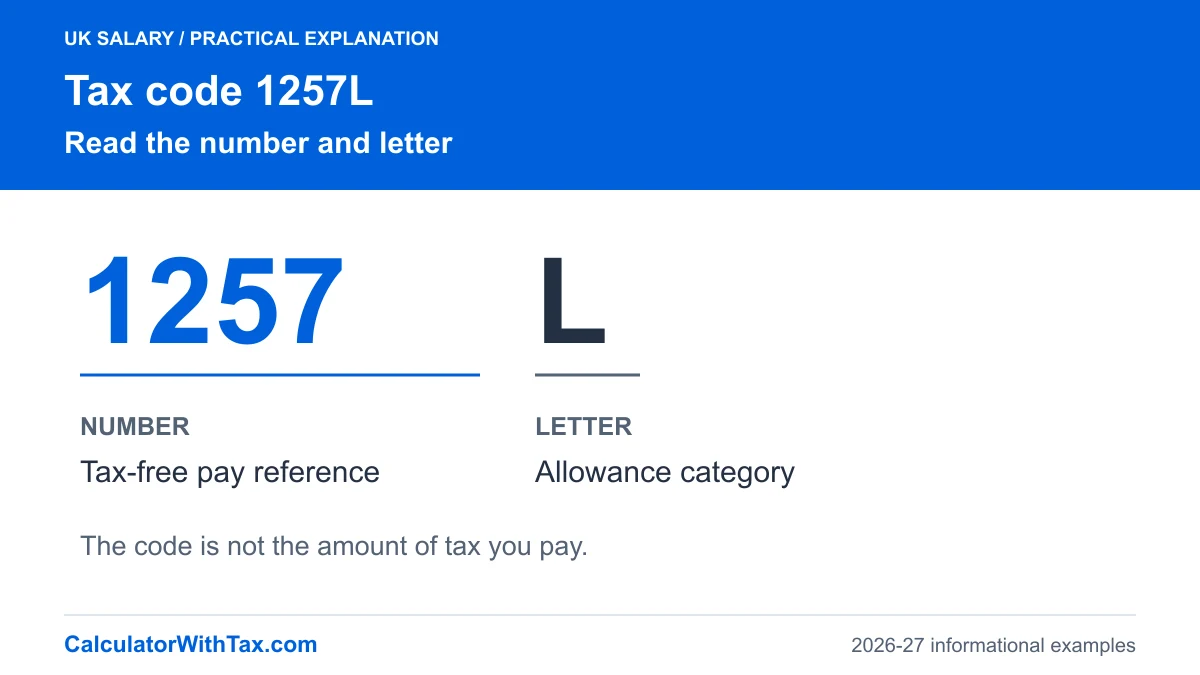
A tax code helps an employer operate PAYE. Its number and letters describe how tax-free pay and the applicable treatment should be handled. HMRC’s code guide identifies 1257L as a common code for someone with one job or pension, and L as the standard-allowance category.
For 2026–27, the standard annual Personal Allowance is £12,570. That gives context to the familiar number 1257. It does not mean the employer pays you £12,570 extra, that your tax is £1,257, or that all your salary is taxed at one flat percentage. The code is an input to withholding, not a complete description of your finances.
Keep the distinction between the annual allowance and detailed payroll free-pay calculations. Multiplying a code number by ten is a useful explanation of its broad meaning, not a substitute for PAYE tables, rounding or payroll history. Our annual model uses the stated annual allowance rather than claiming to reproduce a tax-code calculation penny for penny.
Check the complete code, including its beginning and end
Two payslips can share the characters 1257L while using different regional or period instructions. Reading only the middle of a code can therefore hide the detail that explains a difference.
| Part to inspect | Question it helps answer | What it does not establish |
|---|---|---|
| Number and allowance letter | Which tax-free pay instruction is being used? | The final tax bill for all your income |
| S or C prefix, where applicable | Is Scottish or Welsh treatment indicated? | Whether your residence details are correct |
| W1, M1, X or NONCUM indicator | Is an emergency or non-cumulative period basis indicated? | The amount of a refund or arrears |
| Employment and tax-year details | Does the instruction belong to this job and year? | Whether a separate job uses the same allowance |
The related guide on cumulative and non-cumulative codes explains the period question separately. This article deals with the ordinary code’s meaning; it does not calculate what an emergency-code payslip should contain.
A GBP 32,000 salary example with explicit limits
Imagine a full-year employee in England with £32,000 annual salary, regular monthly pay, category A employee NI and no other income or excluded deductions. The following illustration uses the same annual estimate as the UK take-home pay calculator.
A standard-allowance annual baseline, not PAYE calculated from a tax code.
Synthetic 2026–27 examples: one full-year UK-resident employee, regular monthly category A NI, salary-only income and no pensions, loans or other excluded deductions. Independent professional tax review incomplete.
Take-home £26,560.12Income Tax £3,886.00Employee NI £1,553.88
| Scenario | Gross | Allowance | Income Tax | Employee NI | Annual net | Monthly average net |
|---|---|---|---|---|---|---|
| England baseline | £32,000.00 | £12,570.00 | £3,886.00 | £1,553.88 | £26,560.12 | £2,213.35 |
Reference checked 20 October 2026. NI is summed from twelve rounded monthly contributions. Average components are rounded before net is derived; direct annual-net division can differ by a penny.
The table is not an output obtained by entering 1257L into a payroll simulator. No tax code is entered at all. It shows what the restricted annual baseline produces when its assumptions are true. If the employee has a company benefit, pension contribution or student loan, that is a different scenario and this net figure should not be presented as their expected payslip.
This distinction makes the example useful without overstating it. You can see the separate roles of annual gross salary, the allowance, Income Tax and employee NI, while retaining a clear boundary between planning arithmetic and an employer’s actual PAYE run.
Why employee NI is a separate deduction
A tax code concerns Income Tax withholding. It does not replace the earnings-period and category rules used for employee National Insurance. A familiar code is not evidence that NI has been calculated correctly, and a change in NI does not by itself demonstrate that the code is wrong.
In the example, annual Income Tax is combined with twelve projected monthly NI amounts. A weekly paid employee, a director or someone changing NI category during the year needs a different treatment. Do not take the monthly average net and describe it as a guaranteed payroll deduction schedule.
What to compare with your records
Read the code on the current payslip alongside the tax year, employer and pay period. Distinguish this-period figures from year-to-date figures before comparing them. A yearly total divided by twelve is not necessarily the amount an employer should have deducted in a particular month.
If a figure looks unexpected, identify the question first: is it the meaning of the code, the income information HMRC holds, the payroll basis, or a deduction outside Income Tax? Sending the whole problem to a single annual calculator cannot settle those different questions.
Use the official HMRC services for personal code information. Never post a P45, National Insurance number or full payslip to a public comment thread to ask strangers to validate it. A safe public example needs only invented amounts and clearly stated assumptions.
Use the right next step
Use the salary calculator for an annual baseline only when its displayed circumstances match yours. Use HMRC’s code guidance for code interpretation and the official correction route when the underlying information appears wrong. A code alone cannot establish that a refund is due, and this article does not prescribe a replacement code.
Frequently asked questions
Does 1257L mean I pay GBP 1,257 in tax?
No. The number is part of the tax-free pay instruction, not the amount of tax due. Tax depends on taxable pay, the applicable rates, the code basis and other relevant circumstances.
Is 1257L itself an emergency code?
Not by itself. Check for a W1, M1, X or NONCUM indicator. The period basis matters as well as the number and letter.
Why might a Scottish code begin with S?
The S prefix indicates Scottish Income Tax treatment. A full-year regional comparison needs the correct taxpayer jurisdiction, not merely the employer's office location.
Can the calculator verify my tax code?
No. It estimates a restricted annual salary baseline and projected monthly employee NI. It does not accept or validate tax codes or calculate cumulative PAYE.
Does this code guarantee the standard allowance fits my circumstances?
No. Income, benefits, other jobs and adjustments may affect the appropriate code or final liability. Check the details HMRC used rather than assuming a familiar code is necessarily correct.
Explore the supported annual salary baseline
Compare annual Income Tax and projected monthly employee NI. Pensions, loans, tax-code adjustments and actual PAYE payslips are not calculated.
UK take-home pay calculator