
US · income-tax
60k a Year Is How Much Biweekly? Compare 26 and 24 Paychecks
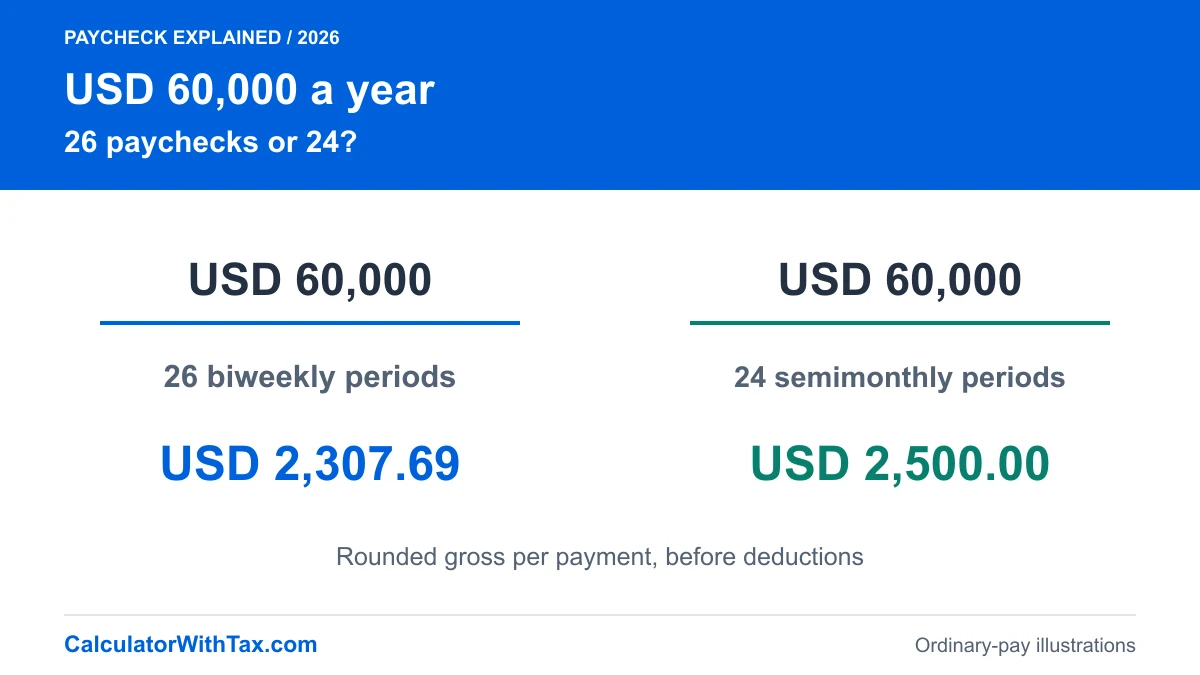
With 26 equal biweekly periods, USD 60,000 a year is USD 2,307.69 gross per payment, rounded to cents. Twice-monthly pay instead uses 24 periods and gives USD 2,500.00 gross. Neither figure is take-home pay.
Published
Divide annual gross salary by the assumed number of payments
For 26 equal biweekly payments, divide $60,000 by 26. The exact quotient continues beyond two decimal places; rounded to cents, it is $2,307.69 gross per payment. This is a frequency conversion, not a tax calculation.
Twice-monthly pay answers a different question. Dividing the same $60,000 by 24 gives $2,500.00 gross. The larger individual payment does not represent a pay rise: fewer payments distribute the same assumed annual salary.
Our calculator uses the weekly, biweekly, semimonthly and monthly period counts in IRS Publication 15-T. They are inputs to this model, not a promise about every employer’s payday calendar or salary-allocation policy.
Compare the denominators before comparing deposits
| Assumed schedule | Equal periods | Gross division | Rounded gross payment |
|---|---|---|---|
| Weekly | 52 | 60,000 ÷ 52 | $1,153.85 |
| Biweekly | 26 | 60,000 ÷ 26 | $2,307.69 |
| Semimonthly | 24 | 60,000 ÷ 24 | $2,500.00 |
| Monthly | 12 | 60,000 ÷ 12 | $5,000.00 |
These are rounded gross equivalents. They do not include benefits, overtime, unpaid periods or any rule about how an employer allocates salary across a year. In particular, the weekly and biweekly rounded amounts should not be multiplied back into annual salary and assumed to reproduce it exactly.
If an offer says biweekly, ask for the actual pay schedule. Do not change the denominator to 24 merely because a budget is arranged in months. Keep calendar timing and the mathematical gross equivalent in separate columns of your planning worksheet.
What happens when the ordinary Florida withholding model is added?
For a controlled net-pay illustration, assume a Florida-only employee in 2026, single W-4 status, Step 2(c) unchecked and zero adjustments. These are invented first-payment scenarios with no prior employer wages or excluded deductions. Compare annual salary input of $60,000 at two frequencies.
Hold annual salary fixed while comparing two pay-frequency assumptions and cent rounding.
Synthetic 2026 Florida-only ordinary wages; single W-4 status, Step 2(c) unchecked, no adjustments or prior wages unless shown below. No benefits, retirement deductions or supplemental pay. Each chart and table uses the calculator engine, not a real person's record. Professional tax review incomplete.
Take-home pay: $1,938.07Federal income tax: $193.08Social Security: $143.08Medicare: $33.46Additional Medicare: $0.00
Take-home pay: $2,099.58Federal income tax: $209.17Social Security: $155.00Medicare: $36.25Additional Medicare: $0.00
| Scenario | Gross | Federal | Social Security | Medicare | Additional Medicare | Take-home |
|---|---|---|---|---|---|---|
| Biweekly: 26 periods | $2,307.69 | $193.08 | $143.08 | $33.46 | $0.00 | $1,938.07 |
| Semimonthly: 24 periods | $2,500.00 | $209.17 | $155.00 | $36.25 | $0.00 | $2,099.58 |
Biweekly: 26 periods: 26 periods/year; prior same-employer wages $0.00; current Social Security taxable wages $2,307.69; current Additional Medicare taxable wages $0.00. Florida personal income tax: $0.00. Gross conversion rounded to cents before withholding; annualizing that rounded amount may not reproduce the entered salary.
Semimonthly: 24 periods: 24 periods/year; prior same-employer wages $0.00; current Social Security taxable wages $2,500.00; current Additional Medicare taxable wages $0.00. Florida personal income tax: $0.00.
Exact-decimal intermediates; each deduction rounded to cents, half up. Net equals rounded gross minus displayed deductions. Employer whole-dollar rounding is not modeled. Rules checked 21 October 2026.
The two payments have different gross amounts, so their per-payment deductions and take-home amounts differ. That is not evidence that one schedule produces a larger final tax bill. This tool calculates ordinary withholding for a payment; it does not prepare an annual return or simulate every paycheck through a year.
To explore another salary, use the annual-salary input in the Florida paycheck calculator and select the correct frequency. Check its exclusions before interpreting the resulting net amount as relevant to your circumstances.
Follow the six-cent rounding difference
The model first rounds $60,000 ÷ 26 to $2,307.69. Multiplying that rounded payment by 26 gives $59,999.94. The $0.06 difference is visible because conversion happens before withholding. The engine annualizes the rounded period wages rather than quietly switching back to the unrounded salary.
This sequence matters when reproducing the calculation. Dividing an annual tax estimate by 26 is not necessarily the same process as applying the disclosed withholding method to rounded period wages. Likewise, an employer may allocate a residual cent difference differently from this equal-payment illustration.
Do not fix the difference by rounding some deductions earlier without saying so. A reproducible example needs a stated order: convert gross, round gross to cents, calculate deductions with decimal intermediates, round each deduction, then subtract the displayed total.
Build a budget around the right unit
An average monthly gross figure of $5,000 is useful for annual comparison, but it is not a claim that a biweekly worker receives exactly $5,000 gross in each calendar month. Budgeting by actual payment dates answers a different question from annual salary divided by twelve.
For a personal budget, list expected deposit dates and actual deductions separately from these gross conversions. If the employer uses an unusual calendar, a partial first period or a variable-hours arrangement, obtain its allocation details. The model does not handle a 27-payday year by silently changing the ordinary 26-period assumption.
The transferable lesson is the denominator, not the amount $60,000. For a different salary, divide by the correct period count and label the result as gross. Then consider supported deductions separately. A number without its frequency and before-or-after-tax label is not a reliable basis for comparing offers.
Frequently asked questions
Is biweekly the same as twice a month?
No. Biweekly means every two weeks; the model uses 26 periods. Semimonthly means twice a month and uses 24.
Is USD 2,307.69 my take-home amount?
No. It is rounded gross pay under the 26-period assumption. Taxes and other applicable employee deductions come afterward.
Why do 26 rounded payments not add to exactly USD 60,000?
USD 2,307.69 times 26 is USD 59,999.94. The six-cent difference is a consequence of rounding each assumed payment; actual payroll can handle residual amounts differently.
Does this model handle a 27-payday calendar?
No. It uses 26 periods for biweekly withholding and equal-gross conversion. Check the employer's actual calendar and salary-allocation policy separately.
Estimate a regular Florida paycheck
Use the same 2026 withholding engine as these examples. Benefits, supplemental wages and annual tax returns are outside its scope.
Florida paycheck calculator