
US · income-tax
What Is Federal Withholding? Paycheck Deductions vs Your Final Tax Bill
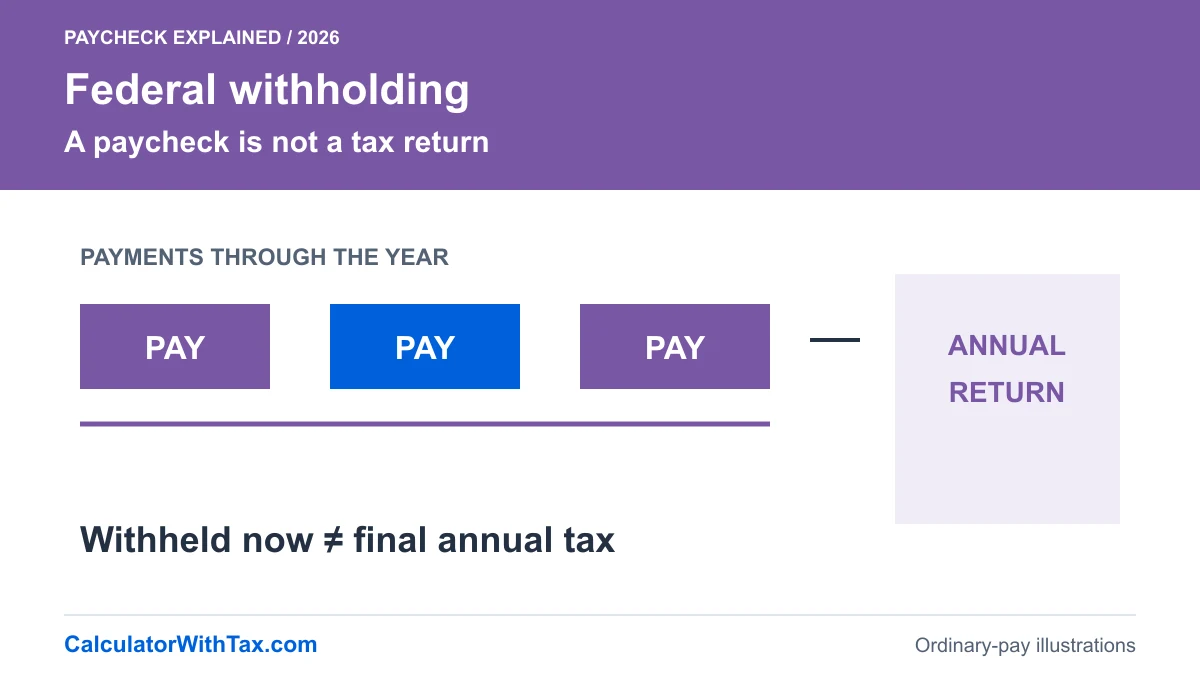
Federal income-tax withholding is money taken from a payment toward income tax. It is not the same as the tax ultimately calculated on your annual return, and it is separate from Social Security and Medicare.
Published
Withholding is a payment mechanism, not the final answer
When federal income tax is withheld from ordinary wages, part of the paycheck goes toward income tax instead of being included in take-home pay. The IRS withholding explanation identifies earnings and the information on Form W-4 as relevant to regular-pay withholding.
That payment is not itself a complete annual tax calculation. A single paycheck cannot describe all the income, deductions, credits and payments belonging to a household’s tax year. The result from an ordinary-pay calculator therefore answers a narrower question than an income-tax return.
Keep three labels separate: federal income-tax withholding, employee payroll taxes, and final annual liability. Calling all three simply “tax” makes it easy to compare figures that were never intended to match.
Identify which question you are asking
| Question | Information needed | What this calculator provides |
|---|---|---|
| What is withheld from this ordinary payment? | Pay frequency, period wages and supported W-4 inputs | A restricted 2026 estimate |
| What payroll deductions apply in the example? | Current wages and prior same-employer wages | The displayed employee FICA lines |
| What is the household’s final annual income tax? | Complete annual tax information | Not calculated |
| Will there be a refund or balance due? | Annual liability and all relevant payments and credits | Not calculated |
If you want to understand a payslip, begin with the first question. If you want to change withholding to meet an annual goal, the first question alone is insufficient. The IRS Tax Withholding Estimator provides a broader official route for supported users.
Hold the paycheck fixed and change one W-4 election
Our invented employee has $2,500 ordinary biweekly wages in Florida in 2026, no prior wages and no excluded deductions. The filing-status input is single. Both cases have zero entries for Steps 3 and 4; only Step 2(c) changes.
Show how the Step 2(c) election changes the current federal estimate without changing FICA wages.
Synthetic 2026 Florida-only ordinary wages; single W-4 status, Step 2(c) unchecked, no adjustments or prior wages unless shown below. No benefits, retirement deductions or supplemental pay. Each chart and table uses the calculator engine, not a real person's record. Professional tax review incomplete.
Take-home pay: $2,092.60Federal income tax: $216.15Social Security: $155.00Medicare: $36.25Additional Medicare: $0.00
Take-home pay: $1,925.40Federal income tax: $383.35Social Security: $155.00Medicare: $36.25Additional Medicare: $0.00
| Scenario | Gross | Federal | Social Security | Medicare | Additional Medicare | Take-home |
|---|---|---|---|---|---|---|
| Step 2(c) unchecked | $2,500.00 | $216.15 | $155.00 | $36.25 | $0.00 | $2,092.60 |
| Step 2(c) checked | $2,500.00 | $383.35 | $155.00 | $36.25 | $0.00 | $1,925.40 |
Step 2(c) unchecked: 26 periods/year; prior same-employer wages $0.00; current Social Security taxable wages $2,500.00; current Additional Medicare taxable wages $0.00. Florida personal income tax: $0.00.
Step 2(c) checked: 26 periods/year; prior same-employer wages $0.00; current Social Security taxable wages $2,500.00; current Additional Medicare taxable wages $0.00. Florida personal income tax: $0.00.
Exact-decimal intermediates; each deduction rounded to cents, half up. Net equals rounded gross minus displayed deductions. Employer whole-dollar rounding is not modeled. Rules checked 21 October 2026.
The model’s federal withholding rises from $216.15 to $383.35, a difference of $167.20. The same dollar difference reduces take-home pay. Social Security and Medicare stay unchanged because the current and prior wage inputs have not changed.
This is a comparison of two instructions applied to one payment. It is not advice to select the box, and it does not prove that the second case is correctly withheld for a particular household. The calculator has no information about the amount or timing of another job’s pay.
Why annualization does not turn the estimate into a return
The regular-pay method uses annualized period wages as an intermediate. In the unadjusted $2,500 biweekly case, multiplying by 26 gives $65,000. That number helps select the applicable calculation within the withholding method. It is not a finding that this employee actually earns exactly that amount during the year.
A worker may begin employment partway through a year or have changing pay. Our model does not reconstruct that history. Nor does it add other household income and reconcile prior federal withholding. Multiplying the current deduction by the assumed number of periods would remain a projection under repeated inputs, not a completed return.
The distinction is especially important when interpreting a larger deduction. More withholding from this check means less current take-home under the same other inputs. It does not by itself prove that the employee’s underlying annual tax liability has increased.
Use differences as a diagnostic, not a refund promise
If a payroll figure differs from an example, record the actual frequency, applicable W-4 entries and whether the payment is ordinary wages. A bonus, benefit arrangement or special payroll instruction can put the payment outside this tool’s scope before any numerical comparison begins.
For a supported ordinary payment, compare one field at a time in the Florida paycheck calculator. Use its copy or print record to retain the assumptions. A clear record helps explain whether a difference came from wages, a W-4 entry or the prior-wage position.
For an annual withholding decision, move to the official estimator or appropriate professional help with the complete information. Do not enter a large adjustment just because the resulting paycheck looks preferable. The useful target is an appropriate instruction for your circumstances, not an arbitrary deduction or a promised refund.
Frequently asked questions
Is federal withholding my final income tax?
No. It is a payment toward tax. An annual return uses the relevant income, deductions, credits and payments to reconcile the year's position.
Does higher withholding guarantee a larger refund?
No. A withholding change alone does not establish the full annual position. This tool does not calculate a refund.
Does W-4 Step 2(c) change Social Security here?
No. In this controlled comparison the wages and prior wages stay the same, so the employee payroll-tax deductions stay the same.
Is there one federal withholding percentage for every paycheck?
No. Regular-pay withholding depends on inputs and the applicable method. The example's federal amount is not a universal flat rate.
Estimate a regular Florida paycheck
Use the same 2026 withholding engine as these examples. Benefits, supplemental wages and annual tax returns are outside its scope.
Florida paycheck calculator