
US · income-tax
Additional Medicare Tax Withholding: Crossing USD 200,000 in Employer Wages
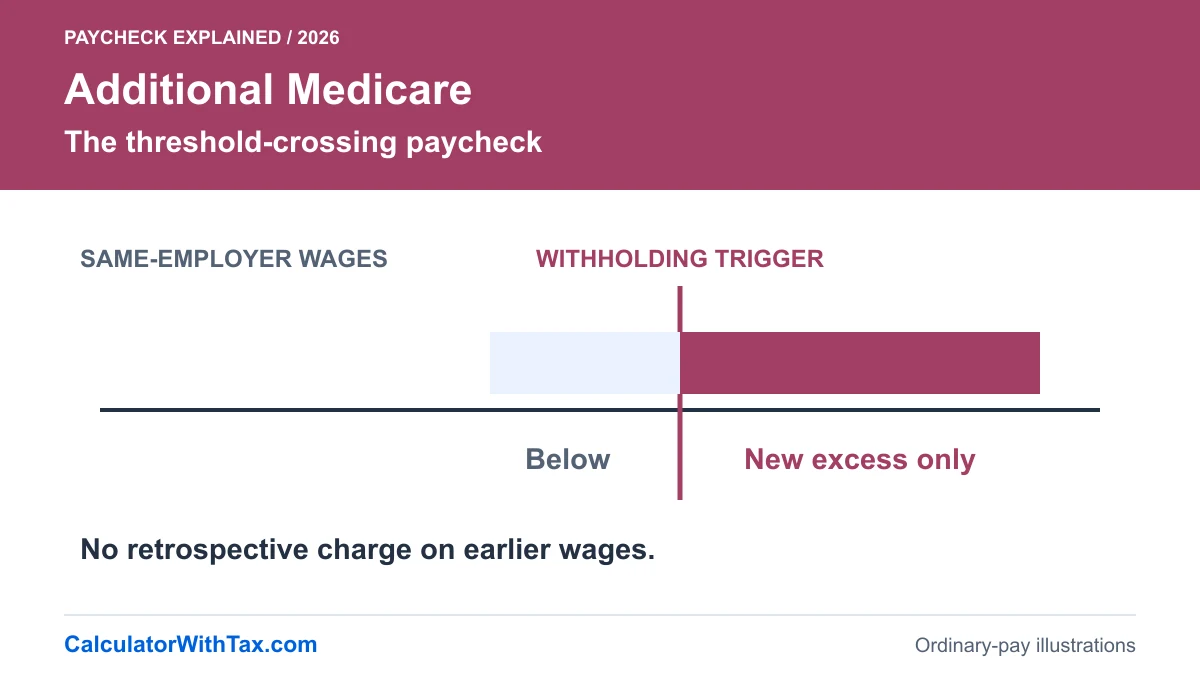
An employer starts Additional Medicare withholding on wages it pays above USD 200,000 in the calendar year. The 0.9% extra applies to the current payment's qualifying excess, not retrospectively to every earlier dollar.
Published
Separate the employer trigger from the annual return
The IRS Additional Medicare questions and answers distinguishes employer withholding from final liability. An employer begins withholding the extra 0.9% on wages it pays above $200,000 during the calendar year, regardless of filing status.
Annual liability uses different filing-status thresholds: $250,000 for married filing jointly, $125,000 for married filing separately, and $200,000 for the other listed statuses. These are not interchangeable instructions for the employer. Our tool calculates the employer withholding illustration, not that annual liability.
This distinction prevents a common mistake: changing the calculator’s employer trigger to $250,000 merely because the W-4 status is married filing jointly. That would answer the wrong question.
Isolate the new excess created by the current payment
Suppose prior same-employer wages are $199,000 and the new ordinary payment is $2,500. After the payment, the total is $201,500. The newly created excess over $200,000 is $1,500. Additional Medicare withholding is therefore $13.50 in this model.
Do not charge the extra rate on the entire $2,500, and do not charge it on the earlier $199,000. The current payment creates only $1,500 of new wages above the employer trigger. Keeping the before and after totals visible makes that boundary easier to check.
| Measurement | Below-or-at case | Crossing case |
|---|---|---|
| Prior same-employer wages | $197,500.00 | $199,000.00 |
| Current ordinary payment | $2,500.00 | $2,500.00 |
| Total after payment | $200,000.00 | $201,500.00 |
| New excess in this payment | $0.00 | $1,500.00 |
| Additional Medicare withheld | $0.00 | $13.50 |
Compare the full deduction breakdown
Both invented cases use single W-4 status, biweekly pay, Step 2(c) unchecked and no W-4 adjustments. The employee lives and works only in Florida and has no excluded benefits or supplemental wages. Only prior wages change.
Compare a payment below the employer threshold with one crossing it; do not retrospectively tax earlier wages.
Synthetic 2026 Florida-only ordinary wages; single W-4 status, Step 2(c) unchecked, no adjustments or prior wages unless shown below. No benefits, retirement deductions or supplemental pay. Each chart and table uses the calculator engine, not a real person's record. Professional tax review incomplete.
Take-home pay: $2,247.60Federal income tax: $216.15Social Security: $0.00Medicare: $36.25Additional Medicare: $0.00
Take-home pay: $2,234.10Federal income tax: $216.15Social Security: $0.00Medicare: $36.25Additional Medicare: $13.50
| Scenario | Gross | Federal | Social Security | Medicare | Additional Medicare | Take-home |
|---|---|---|---|---|---|---|
| Prior wages USD 197,500 | $2,500.00 | $216.15 | $0.00 | $36.25 | $0.00 | $2,247.60 |
| Prior wages USD 199,000 | $2,500.00 | $216.15 | $0.00 | $36.25 | $13.50 | $2,234.10 |
Prior wages USD 197,500: 26 periods/year; prior same-employer wages $197,500.00; current Social Security taxable wages $0.00; current Additional Medicare taxable wages $0.00. Florida personal income tax: $0.00.
Prior wages USD 199,000: 26 periods/year; prior same-employer wages $199,000.00; current Social Security taxable wages $0.00; current Additional Medicare taxable wages $1,500.00. Florida personal income tax: $0.00.
Exact-decimal intermediates; each deduction rounded to cents, half up. Net equals rounded gross minus displayed deductions. Employer whole-dollar rounding is not modeled. Rules checked 21 October 2026.
The crossing case has $13.50 less take-home. Regular Medicare remains $36.25 in both payments. Social Security is zero in both because their prior wages already exceed the 2026 cap. This isolates the additional deduction without presenting it as a change to every tax line.
The chart and table show the same decimal-engine results. Small colored sections can be difficult to compare by eye, so the dollar figures provide the authoritative reading of the example. The section width is a proportion of gross, not a separate estimate.
What changes after the employer threshold is already exceeded?
If prior wages already exceed $200,000, an ordinary current payment is entirely above that trigger. The calculation subtracts the prior excess from the excess after the new payment. This prevents earlier excess wages from being counted again when estimating another check.
For example, $205,000 before a $2,500 payment becomes $207,500 afterward. The excess grows from $5,000 to $7,500: a $2,500 increase. At 0.9%, that current-payment deduction is $22.50. The model does not recalculate an additional tax on the whole $7,500 excess for this paycheck.
Use the right prior-wage record
Use eligible wages paid by this employer before the payment. Do not enter the amount after the payment, and do not replace it with total household earnings. The Florida paycheck calculator assumes the same ordinary wage base for the supported federal, Social Security and Medicare calculations.
A worker with multiple employers or a spouse’s income can have an annual position that differs from the employer withholding pattern. The absence of this deduction on one check is not proof that no additional tax will be due. Equally, withholding beginning at the employer trigger does not itself establish the household’s final amount.
For that broader question, use the applicable annual-return instructions or qualified help with complete records. Keep the ordinary payment calculation as a transparent explanation of one deduction, rather than stretching it into a return estimator it was not built to be.
Frequently asked questions
Does the employer withholding threshold change with W-4 filing status?
No. The USD 200,000 same-employer withholding trigger is separate from filing-status thresholds for final annual liability.
Is the whole threshold-crossing paycheck subject to the extra 0.9%?
Only the current wages above the employer threshold attract the extra deduction in this ordinary-wage example.
Is Additional Medicare a replacement for regular Medicare?
No. The model calculates regular Medicare separately and adds Additional Medicare on the applicable excess.
Does a zero additional withholding amount establish no annual liability?
No. Household income, filing status and other employers can affect the annual position. This tool does not prepare that reconciliation.
Estimate a regular Florida paycheck
Use the same 2026 withholding engine as these examples. Benefits, supplemental wages and annual tax returns are outside its scope.
Florida paycheck calculator