
US · income-tax
Social Security Wage Base Limit 2026: The Paycheck That Crosses the Cap
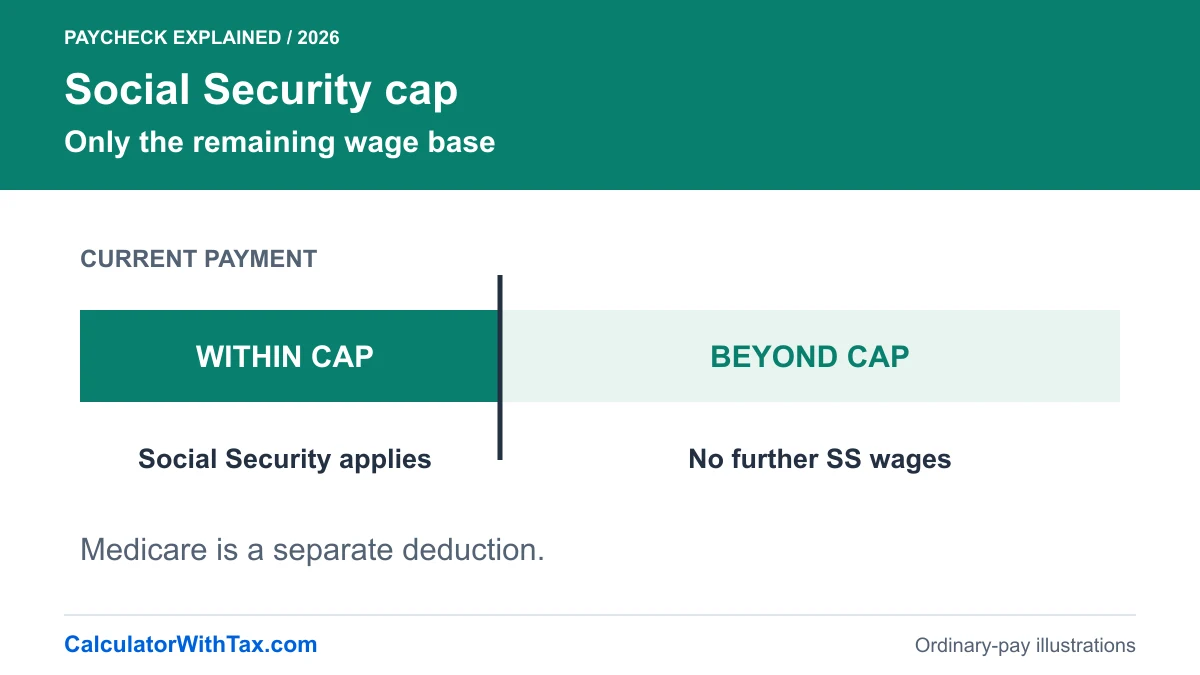
For 2026, the Social Security wage base is USD 184,500. In the ordinary same-employer example, only the current wages still within the cap attract the employee's 6.2% Social Security deduction.
Published
Read the wage-base row for the correct year
The Social Security Administration’s contribution and benefit base table lists $184,500 for 2026. A page may already display a later year’s headline. The row matching the wages’ year is the relevant evidence for this example.
The 2026 IRS employer guide gives the employee Social Security rate as 6.2% and distinguishes Medicare’s separate treatment. This article concerns ordinary employee payroll deductions. It does not calculate Social Security benefits, self-employment tax or income tax on retirement benefits.
The practical question is not simply whether annual salary is above the limit. For a particular payment, determine how much wage base remains before that payment. That remaining amount controls the current example’s Social Security deduction.
Calculate the remaining base before taxing the new payment
For the supported ordinary same-base scenario, remaining Social Security wages are the greater of zero and $184,500 minus eligible prior same-employer wages. The taxable part of this payment is the smaller of that remaining amount and the current gross wages.
With $183,500 of prior wages, the remaining base is $1,000. A new $2,500 payment therefore contributes only $1,000 to the Social Security calculation. Multiplying $1,000 by 6.2% gives $62.00. Applying 6.2% to the entire payment would instead produce $155.00 and miss the cap crossing.
| Step | Crossing example | At-cap example |
|---|---|---|
| Prior same-employer wages | $183,500.00 | $184,500.00 |
| Remaining 2026 wage base | $1,000.00 | $0.00 |
| Current ordinary wages | $2,500.00 | $2,500.00 |
| Current Social Security taxable wages | $1,000.00 | $0.00 |
| Employee Social Security | $62.00 | $0.00 |
Compare complete payments without hiding the other lines
Both invented scenarios use a $2,500 biweekly Florida payment, single W-4 status, Step 2(c) unchecked and zero W-4 adjustments. Only prior same-employer wages change. The no-benefits, ordinary-wage assumptions remain in place.
Compare the same payment immediately before and after reaching the 2026 same-employer Social Security cap.
Synthetic 2026 Florida-only ordinary wages; single W-4 status, Step 2(c) unchecked, no adjustments or prior wages unless shown below. No benefits, retirement deductions or supplemental pay. Each chart and table uses the calculator engine, not a real person's record. Professional tax review incomplete.
Take-home pay: $2,185.60Federal income tax: $216.15Social Security: $62.00Medicare: $36.25Additional Medicare: $0.00
Take-home pay: $2,247.60Federal income tax: $216.15Social Security: $0.00Medicare: $36.25Additional Medicare: $0.00
| Scenario | Gross | Federal | Social Security | Medicare | Additional Medicare | Take-home |
|---|---|---|---|---|---|---|
| Prior wages USD 183,500 | $2,500.00 | $216.15 | $62.00 | $36.25 | $0.00 | $2,185.60 |
| Prior wages USD 184,500 | $2,500.00 | $216.15 | $0.00 | $36.25 | $0.00 | $2,247.60 |
Prior wages USD 183,500: 26 periods/year; prior same-employer wages $183,500.00; current Social Security taxable wages $1,000.00; current Additional Medicare taxable wages $0.00. Florida personal income tax: $0.00.
Prior wages USD 184,500: 26 periods/year; prior same-employer wages $184,500.00; current Social Security taxable wages $0.00; current Additional Medicare taxable wages $0.00. Florida personal income tax: $0.00.
Exact-decimal intermediates; each deduction rounded to cents, half up. Net equals rounded gross minus displayed deductions. Employer whole-dollar rounding is not modeled. Rules checked 21 October 2026.
The second payment has $62.00 more take-home in this controlled comparison because its Social Security line is $62.00 lower. Federal withholding and ordinary Medicare are unchanged. There is no need to invent a new flat overall tax rate to explain that difference.
These cases isolate a threshold position. They are not a simulation of every payment in a worker’s year. In particular, the model does not use prior wages to calculate cumulative federal income-tax withholding; that is a separate calculation from the same-employer FICA thresholds.
Do not stop Medicare when Social Security stops
The deductions answer different questions. A zero Social Security amount after the cap does not imply zero Medicare. In the illustrated $2,500 payment, regular employee Medicare remains $36.25 under the model’s 1.45% rate. Additional Medicare remains zero in both cases because neither payment crosses its separate employer threshold.
An employee can therefore see take-home rise when the Social Security cap is exhausted while still having other federal deductions. Describe the change by its actual line rather than saying the remainder of the year is tax-free.
Avoid a year-to-date input that counts the payment twice
The prior-wage field means wages before the payment being estimated. If a payslip’s year-to-date total already includes the current $2,500, copying it unchanged into that field shifts the threshold position. Confirm the meaning of the record before using it.
Do not combine another employer’s wages into this field. The tool does not reconcile multiple-employer Social Security withholding, return adjustments or special employment categories. Its one shared taxable wage base is also unsuitable where a benefits arrangement causes relevant wage bases to differ.
Use the Florida paycheck calculator to reproduce the supported case and retain the printed assumptions. If a real paycheck differs, compare the eligible prior wages and current Social Security wage base before assuming a percentage error. The cap, the year and the sequence of payments matter just as much as the rate.
Frequently asked questions
What is the Social Security wage base for 2026?
The SSA's year-by-year table lists USD 184,500 for 2026. Use the row for the payment's year rather than a newer headline figure.
Does Medicare stop when Social Security reaches its cap?
No. Regular Medicare has no wage cap. Additional Medicare withholding has a separate threshold.
Should prior wages include the current payment?
No. This tool needs eligible wages from the same employer before the current payment; it then adds the current wages itself.
Can I combine wages from multiple employers in this input?
No. The same-employer withholding illustration does not reconcile multiple-employer taxes or any return adjustment.
Estimate a regular Florida paycheck
Use the same 2026 withholding engine as these examples. Benefits, supplemental wages and annual tax returns are outside its scope.
Florida paycheck calculator