
GB · income-tax
Gross Salary vs Net Salary: Understand Your UK Take-Home Pay
Gross salary is the starting pay before deductions. Net pay is what remains after the deductions that apply. Compare the same period and check which deductions an estimate actually includes.
Published
Start with the amount before deductions
Gross salary and net salary answer different questions. Gross describes the pay before deductions; net describes what remains after the deductions relevant to that payment. Knowing one does not identify the other until the period, applicable tax treatment and other deductions are clear.
An offer quoting £45,000 a year and a payslip showing a monthly bank-payment figure are not contradictory just because the numbers differ. One is annual gross; the other is a particular payment after deductions. First put them on a comparable basis, then examine the components between them.
For an employee payslip, GOV.UK’s payslip guidance explains the earnings and deduction information that should be shown. Use those labels as the starting point rather than guessing from the largest number on the page.
Follow a GBP 45,000 annual baseline
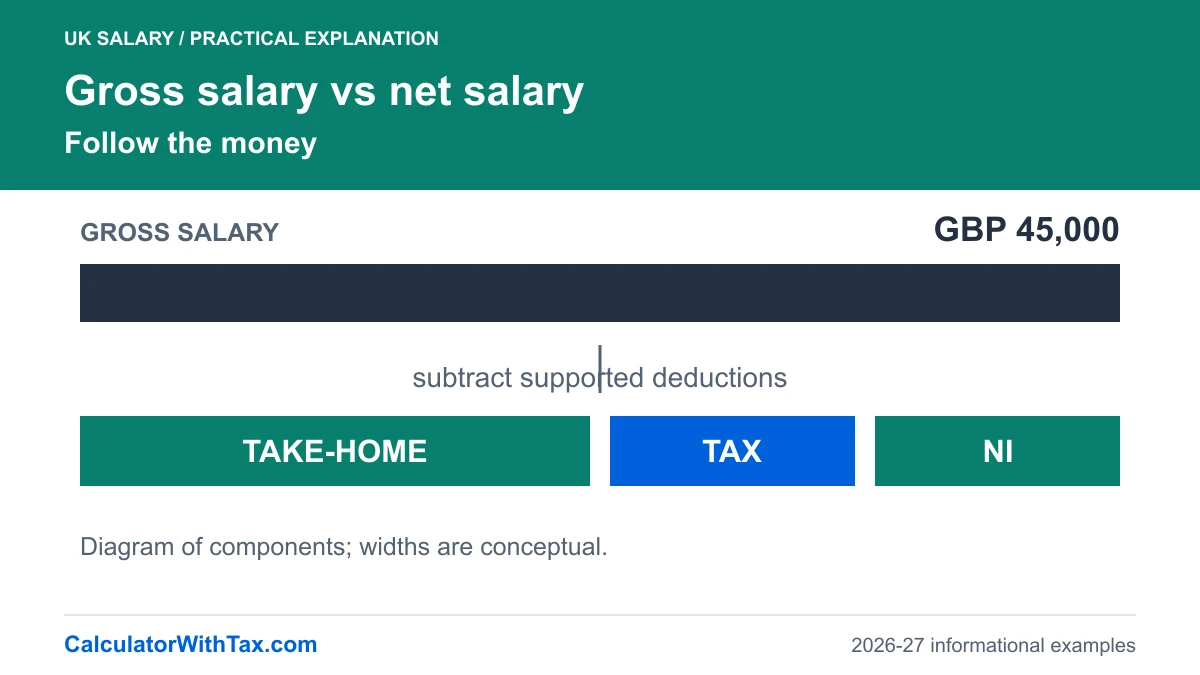
The following example assumes one full-year employment in England, regular monthly salary, category A NI and none of the excluded deductions. It shows the same calculation as our UK take-home pay calculator, not a reconstruction of a real person’s payslip.
Follow one annual salary through the supported deductions.
Synthetic 2026–27 examples: one full-year UK-resident employee, regular monthly category A NI, salary-only income and no pensions, loans or other excluded deductions. Independent professional tax review incomplete.
Take-home £35,920.08Income Tax £6,486.00Employee NI £2,593.92
| Scenario | Gross | Allowance | Income Tax | Employee NI | Annual net | Monthly average net |
|---|---|---|---|---|---|---|
| Full-year salary | £45,000.00 | £12,570.00 | £6,486.00 | £2,593.92 | £35,920.08 | £2,993.34 |
Reference checked 20 October 2026. NI is summed from twelve rounded monthly contributions. Average components are rounded before net is derived; direct annual-net division can differ by a penny.
Read the table from gross to the two included deductions, then to annual net. The total must reconcile: gross minus Income Tax minus projected employee NI equals the displayed annual take-home amount. This is more informative than applying one guessed percentage to the full salary.
The monthly net is an average equivalent from rounded components. It is helpful for comparing the scale of annual figures, but cannot reproduce payroll history, a changed tax code or an actual pension arrangement. That difference is a limitation of the model, not an instruction to ignore deductions on a payslip.
Identify what sits between gross and net
Income Tax and employee NI are separate deductions with different calculation rules. Other deductions can also affect an actual payment. A baseline that omits them is not a complete personal budget simply because it displays a precise penny amount.
| Item | How to read it | Treatment in this example |
|---|---|---|
| Gross salary | Starting employee pay before deductions | Annual input |
| Income Tax | Tax under the stated annual model | Included |
| Employee NI | Employee contributions for the stated category and periods | Twelve monthly projections included |
| Pension, salary sacrifice or student loans | Separate mechanisms requiring their own inputs | Excluded |
| Employer NI | Employer-side contribution, not employee NI | Not subtracted from employee salary |
Do not fill an unexplained gap with an invented miscellaneous deduction. Find the actual line on the payslip or ask the payroll team which item changed. An unexplained difference can involve timing, deductions, gross-pay definitions or circumstances outside this tool.
Gross salary is not the whole employer package
When comparing offers, separate the stated employee salary from employer contributions and benefits. A total employment-cost figure is not necessarily cash gross salary, and a benefit is not necessarily money that arrives in a bank account.
For a fair first comparison, identify the annual cash salary on each offer and note other items separately. Do not silently add an employer pension contribution to salary and run the resulting total through an employee-only calculator. Likewise, do not subtract employer NI from the employee’s gross input.
This guide is not a benefit-valuation or pension-tax model. Its purpose is to keep the labels correct so a later comparison is based on the right inputs. If an offer includes variable bonuses or salary sacrifice, an ordinary fixed-salary baseline cannot settle the complete package value.
Match the pay period before comparing figures
The words annual, monthly, four-weekly and weekly are part of the amount. Keep them attached to every number. A calendar month is not four weeks, and multiplying a four-week payment by twelve does not describe thirteen such payments.
If your task is conversion rather than definition, use the complementary gross-monthly-salary guide. Here the important check is simpler: are both numbers gross or net, and do both cover the same period? A comparison with mismatched labels may look precise while answering the wrong question.
A practical gross-to-net checklist
Write down the year, period and jurisdiction, then the gross amount. List the deductions actually included in the estimate and keep excluded ones visible. Reconcile the included components before comparing with a real payment.
For a payslip query, use this-period amounts together, or year-to-date amounts together. Do not subtract a year-to-date tax total from one month’s salary. If the scope does not match the calculator, use an appropriate official service or payroll explanation instead of treating the discrepancy as evidence of an error.
Frequently asked questions
Is gross salary before tax?
Yes. Gross salary is before deductions. Net pay is the remaining amount after the deductions that apply to the particular payment or estimate.
Is gross salary the same as the employer's total cost?
No. Employer costs and benefits can include amounts that are not an employee gross salary figure. Employer NI must not be subtracted from employee gross salary as though it were employee NI.
Does net salary mean gross salary minus Income Tax only?
Not generally. Employee NI and other applicable deductions can also affect net pay. This calculator includes only its stated Income Tax and monthly employee NI baseline.
Can I compare annual gross directly with monthly net?
Not meaningfully without labeling and converting the periods. Annual and monthly figures have different time bases, and a monthly average is not necessarily a payslip prediction.
Does the example include pension or student-loan deductions?
No. Those deductions, salary sacrifice and other unsupported circumstances are excluded. A real employee with them should not use the baseline net as an expected bank payment.
Explore the supported annual salary baseline
Compare annual Income Tax and projected monthly employee NI. Pensions, loans, tax-code adjustments and actual PAYE payslips are not calculated.
UK take-home pay calculator