
GB · income-tax
Cumulative vs Non-Cumulative Tax Codes: What Changes in PAYE?
Cumulative PAYE considers relevant pay and tax so far in the year. A non-cumulative basis treats the current period separately. The basis is different from the allowance code itself.
Published
The tax code and its basis are different pieces of information
The number and letter in a code describe a tax-free pay instruction and category. The cumulative or non-cumulative basis determines how the instruction is applied across time. Keeping those two ideas separate explains why matching base codes do not always produce matching this-period deductions.
HMRC’s PAYE11090 guidance describes the rolling year-to-date approach and the separate week-1 or month-1 approach. The essential difference is the pay and tax history considered, not a different flat percentage chosen by the employee.
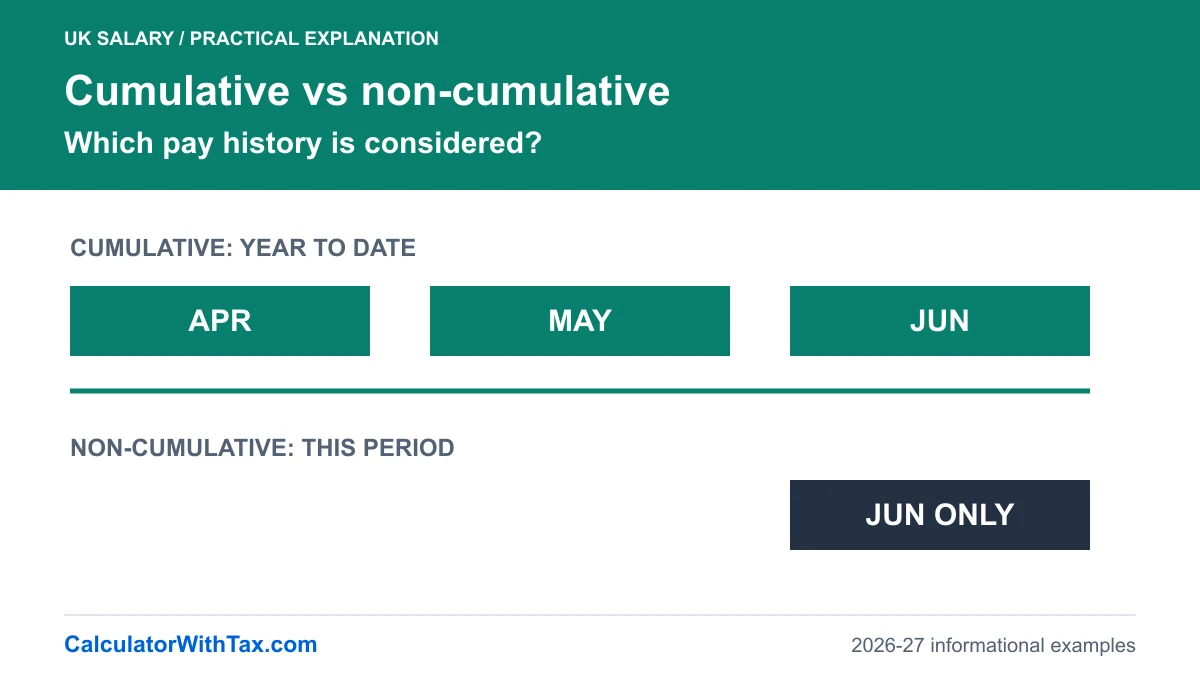
Picture a June payroll information window
Imagine a June pay run in which relevant April and May records exist. A cumulative calculation considers the appropriate year-to-date information. A non-cumulative current-period calculation does not use that earlier pay and tax in the same way.
| Information | Cumulative view | Non-cumulative current-period view |
|---|---|---|
| Current June payment | Relevant | Relevant |
| Relevant earlier pay and tax | Taken into account in the rolling calculation | Not used in the same cumulative calculation |
| Allowances and bands | Applied on the relevant cumulative basis | Applied for the isolated period |
| Result shown in this guide | Information comparison only | Information comparison only |
This is deliberately not a table of payroll deductions. Producing those deductions would require a supported PAYE model, the complete appropriate inputs and the relevant payroll instructions. No such capability is implied by drawing a timeline.
It is also unsafe to infer a refund from the timeline alone. Earlier pay may have been different, a code may have changed, or a relevant adjustment may exist. The presence of history explains why history matters; it does not tell us the correct numerical outcome without the records.
Read M1, W1, X and NONCUM in context
HMRC’s emergency-code guide describes these indicators and the current-period approach. The full code and its basis should be read together. A familiar 1257L string without the suffix is not enough to decide what a particular payslip is doing.
Do not assume that M1 means an additional tax band, a permanent penalty or proof of an employer error. It describes a basis. Likewise, a tax-free code number does not tell you how much tax has already been withheld during the year.
This article does not set a personal deadline for correction or promise a particular adjustment. For your own case, use the current official guidance and check the information HMRC and the employer hold. Do not tell payroll to use a replacement code selected from an internet example.
Where an annual salary estimate is still useful
An annual baseline can help separate the overall scale of salary deductions from the question of what happened in one pay period. The following £31,200 illustration assumes a completely regular supported year. It does not simulate the June example or either code basis.
Annual planning baseline only; the table does not calculate cumulative or M1 deductions.
Synthetic 2026–27 examples: one full-year UK-resident employee, regular monthly category A NI, salary-only income and no pensions, loans or other excluded deductions. Independent professional tax review incomplete.
Take-home £25,984.08Income Tax £3,726.00Employee NI £1,489.92
| Scenario | Gross | Allowance | Income Tax | Employee NI | Annual net | Monthly average net |
|---|---|---|---|---|---|---|
| Annual planning baseline only | £31,200.00 | £12,570.00 | £3,726.00 | £1,489.92 | £25,984.08 | £2,165.34 |
Reference checked 20 October 2026. NI is summed from twelve rounded monthly contributions. Average components are rounded before net is derived; direct annual-net division can differ by a penny.
The table’s monthly net is an average equivalent. It cannot be subtracted from an emergency-code payment to establish an overpayment. Nor does multiplying a single actual payslip by twelve reconstruct a year in which circumstances changed.
The UK take-home pay calculator remains useful for its stated annual planning question. It has no input for previous taxable pay, previous tax or a payroll period number, so it must not be presented as a cumulative PAYE checker.
Keep the NI question separate
The employee NI figures in our illustration use twelve regular monthly category A payments. That is a different mechanism from the cumulative Income Tax history described above. Changing an Income Tax code basis is not an instruction to recalculate NI using the annual Income Tax allowance.
Directors, irregular payments and other NI categories are outside this baseline. Generalizing ordinary employee NI statements to those cases would go beyond the example. Keep the earnings-period and category labels with any NI comparison.
Ask a precise question about a payslip
When seeking an explanation, identify the tax year, complete code, period basis and whether the numbers are current-period or year-to-date. Ask which information the payroll calculation used. Keep sensitive identifiers and real payroll documents out of public posts.
If the question is simply what 1257L means, use the separate code guide. If the underlying employment or income information looks wrong, use the correction checklist. Distinguishing those tasks is more productive than treating every unexpected deduction as the same tax-code problem.
Frequently asked questions
What does cumulative mean on a tax code?
It refers to a PAYE basis that takes relevant earlier pay and tax in the tax year into account. It does not mean that the code's number is the cumulative tax bill.
What do M1 and W1 mean?
They identify an emergency month-1 or week-1 basis. HMRC's guidance also describes X and NONCUM indicators. Read the complete code and the pay period.
Is non-cumulative always the same as owing tax?
No. The basis alone does not establish whether you have paid too much or too little tax. Actual pay, tax and the appropriate treatment must be checked.
Does the salary calculator compare cumulative and M1 deductions?
No. Its table is an annual salary baseline with monthly projected NI, not a PAYE history or emergency-code model. No code-switch deduction is calculated.
Can I calculate a refund by subtracting two annual averages?
No. A refund requires relevant actual tax-paid information and circumstances. Two salary averages cannot establish a refund or when an adjustment will appear in payroll.
Explore the supported annual salary baseline
Compare annual Income Tax and projected monthly employee NI. Pensions, loans, tax-code adjustments and actual PAYE payslips are not calculated.
UK take-home pay calculator