
GB · income-tax
Gross Monthly Salary: Convert Annual Pay Without Mixing Up Net Pay
For twelve equal salary months, divide annual gross by twelve. That is a gross frequency conversion, not a tax calculation. Four-weekly pay and average monthly take-home require different labels.
Published
Gross monthly pay begins with a frequency assumption
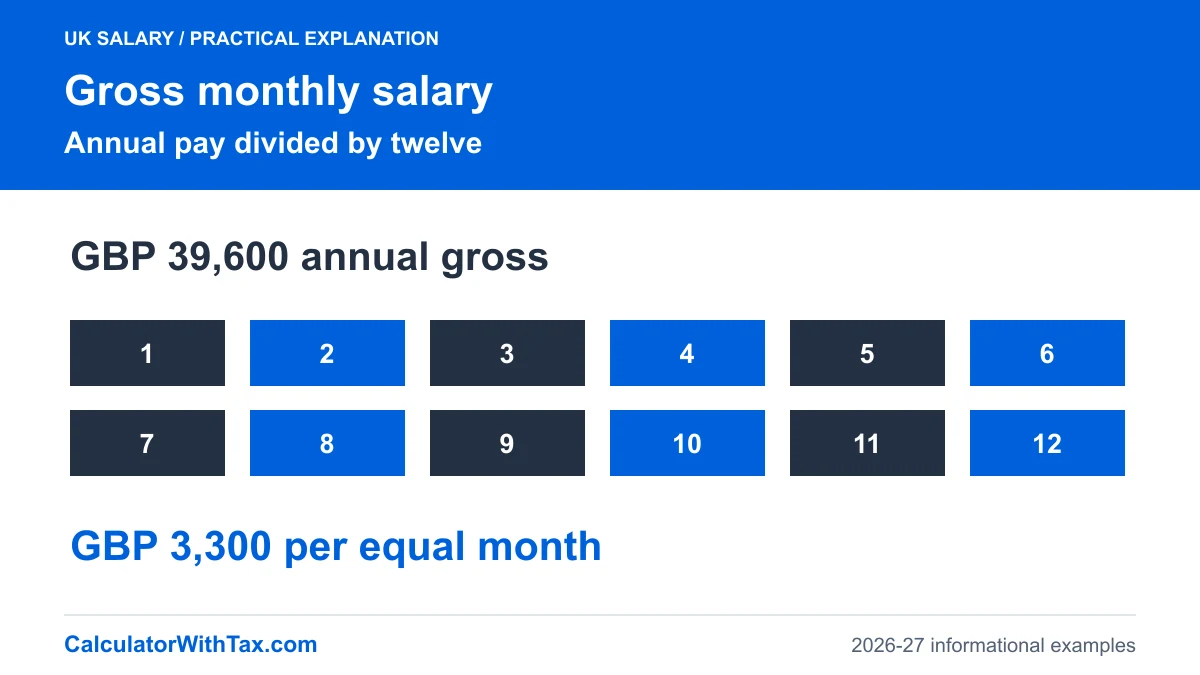
If an annual employee salary is paid in twelve equal gross months, the basic conversion is annual gross divided by twelve. At £39,600 a year, that is £3,300 gross per month. No tax rate is needed to perform that division.
The assumption matters as much as the formula. An annual offer does not, by itself, tell you whether the employer uses calendar-month, four-weekly or another payment arrangement. Read the relevant pay terms and keep the frequency alongside the amount.
This guide explains a conversion and a separate annual tax illustration. It does not calculate an employment entitlement, payroll schedule, bonus allocation or a first payslip after joining mid-year.
Divide the annual gross amount, not an after-tax figure
The formula for twelve equal gross months is:
The input must be annual gross. If the starting amount is already a monthly net payment, dividing it by twelve answers neither the annual-gross nor the monthly-gross question. Likewise, multiplying a net amount by twelve does not reverse Income Tax or establish the salary that produced it.
The gross/net guide explains those labels in more detail. Here the central check is whether the starting amount and the required amount use the same before-deduction basis. A correct division applied to the wrong kind of amount is still an incorrect answer to the reader’s question.
Calendar months and four-week periods are not interchangeable
Twelve equal calendar-month allocations use a divisor of twelve. A simplified 52-week equivalence uses thirteen four-week periods, or 52 weekly equivalents. These are alternative conversion bases for one annual amount, not promises that an employer follows a particular schedule.
| Explicit basis | Annual gross | Divisor | Gross equivalent |
|---|---|---|---|
| Twelve equal salary months | £39,600.00 | 12 | £3,300.00 |
| Thirteen four-week periods | £39,600.00 | 13 | £3,046.15 |
| Fifty-two weekly equivalents | £39,600.00 | 52 | £761.54 |
These are alternative denominators for the same annual amount, not interchangeable payment promises. The tax examples below still use the supported twelve-month employee model.
The rows are rounded independently to pennies. Multiplying a rounded weekly or four-week equivalent back by its divisor can leave a small difference from annual gross. That is rounding of an equivalent, not an instruction to create a payroll shortfall. An actual schedule needs its own penny allocation and dates.
Do not multiply a four-week payment by twelve and describe the result as thirteen payments. Attach an explicit label such as “per calendar month” or “per four-week period” before comparing offers, rent budgets or a payslip.
Add the supported annual tax calculation as a separate step
After the gross-frequency arithmetic, a different question is what remains under a stated tax model. The following example uses the same £39,600 annual salary, England jurisdiction and the UK take-home pay calculator’s regular monthly baseline.
Frequency arithmetic followed by the supported annual salary estimate.
Synthetic 2026–27 examples: one full-year UK-resident employee, regular monthly category A NI, salary-only income and no pensions, loans or other excluded deductions. Independent professional tax review incomplete.
Take-home £32,032.08Income Tax £5,406.00Employee NI £2,161.92
| Scenario | Gross | Allowance | Income Tax | Employee NI | Annual net | Monthly average net |
|---|---|---|---|---|---|---|
| Twelve regular salary months | £39,600.00 | £12,570.00 | £5,406.00 | £2,161.92 | £32,032.08 | £2,669.34 |
Reference checked 20 October 2026. NI is summed from twelve rounded monthly contributions. Average components are rounded before net is derived; direct annual-net division can differ by a penny.
The table’s monthly gross is the equal monthly salary input to the projected NI schedule. The monthly net is an average equivalent obtained from the modeled annual amounts and separately rounded components. It is not a calculation of a particular month’s PAYE from a tax code and prior history.
That distinction allows the annual and monthly columns to be useful without pretending they are a payslip. It also explains why a reader with pensions, student loans or salary sacrifice must not treat this baseline net as their expected bank payment.
Read current-period and year-to-date labels on a payslip
Official payslip guidance identifies gross earnings and deductions as relevant pay information. When comparing an estimate with a record, check whether the amounts refer to the current period or totals so far in the year.
Do not subtract a year-to-date tax amount from one month’s gross. Nor should a single unusual month be multiplied by twelve and treated as a verified full-year picture. A changed salary, period, deduction or code can make that shortcut misleading.
PAYE is the withholding system used by an employer or pension provider; an annual planning estimate is not a replacement for its detailed information. If a payroll amount is unexpected, establish the period and facts rather than assuming an annual division proves a mistake.
Keep partial-year and irregular pay outside this conversion
The advertised annual salary for a job is a rate of pay, not proof that the same gross amount will be earned within the current tax year. Starting, leaving or changing salary partway through the year requires more information than this full-year model accepts.
Use the conversion to compare clearly labeled annual and monthly gross amounts. Use the linked salary calculator only for its supported full-year circumstances. For daily equivalence, first choose a day-count basis rather than assuming a calendar month contains a fixed number of paid working days.
Frequently asked questions
How do I calculate gross monthly salary from annual pay?
For twelve equal salary months, divide the annual gross amount by twelve. GBP 39,600 divided by twelve is GBP 3,300 gross per month before deductions.
Is gross monthly salary the amount paid into my bank account?
Not generally. Gross is before deductions. Net depends on the deductions and circumstances that apply, and the calculator's monthly net is only an average under its limited baseline.
Is a month the same as four weeks?
No. Twelve four-week periods cover 48 weeks, while thirteen cover 52 weeks. Treat a four-weekly amount and a calendar-month amount as different frequency bases.
Will every month of actual payroll equal the annual net divided by twelve?
Not necessarily. PAYE history, tax codes, variable amounts and excluded deductions can matter. Even this model rounds its average components separately before deriving average net.
Can I use the calculator for a part-year job by entering the advertised annual salary?
That would model a full year at that salary, not the actual partial year. The current calculator does not model partial-year payroll or cumulative PAYE.
Explore the supported annual salary baseline
Compare annual Income Tax and projected monthly employee NI. Pensions, loans, tax-code adjustments and actual PAYE payslips are not calculated.
UK take-home pay calculator