
US · sales-tax
Florida sales tax calculator: county surtax and the $5,000 cap
Florida's general state rate is 6%, but county surtax and transaction-specific rules can change the calculation. Confirm the applicable rate and base before using a single combined percentage.
Start with the state component, not a universal checkout rate
A Florida sales tax calculator is useful only after the applicable tax treatment is known. Multiplying correctly by the wrong percentage still gives the wrong purchase total.
The Florida Department of Revenue’s sales tax guidance lists a 6% general state rate, with exceptions. Its discretionary surtax guidance explains the additional county component and the limited USD 5,000 cap. These official descriptions were checked on 19 October 2026. They do not classify your purchase.
Use the calculator with tax for established amounts and rates. It does not identify a county, determine an exemption or produce a filing-ready liability.
Confirm the county, date and taxable base
Consult the Department’s current address/jurisdiction resources and county surtax information. Keep the source, applicable date and transaction assumptions with your own records. A current result is not automatically evidence for an older receipt.
Before combining percentages, ask whether every component applies to the same amount. Separate exempt items or special treatments before calculating. A county component can have a different base from the state component; the example below shows why that matters.
Our illustrative 1% county rate is an assumption, not a claim about a named county. Confirm the real percentage independently. Do not add a state component again if an official result already reports the combined rate.
Add a confirmed same-base percentage
Assume one USD 200 taxable base is subject to 6% state tax and an independently established 1% county surtax, both on the whole amount. The combined input is 7%:
Tax = 200 x (7 / 100) = USD 14.00
Total = 200 + 14 = USD 214.00
Enter 200, 7 and Add tax. The state-only comparison gives USD 12 tax, while the assumed county component adds USD 2. The state-only row is an explanation, not a recommendation to omit applicable local tax.
| Scenario | Input | Rate | Before tax | Tax | Total |
|---|---|---|---|---|---|
| Assumed 6% state + 1% county on the same base | USD 200.00 | 7% | USD 200.00 | USD 14.00 | USD 214.00 |
| State component only, not a checkout recommendation | USD 200.00 | 6% | USD 200.00 | USD 12.00 | USD 212.00 |
| Same one-rate example, tax included | USD 214.00 | 7% | USD 200.00 | USD 14.00 | USD 214.00 |
| Component | Base used | Rate assumed applicable | Tax |
|---|---|---|---|
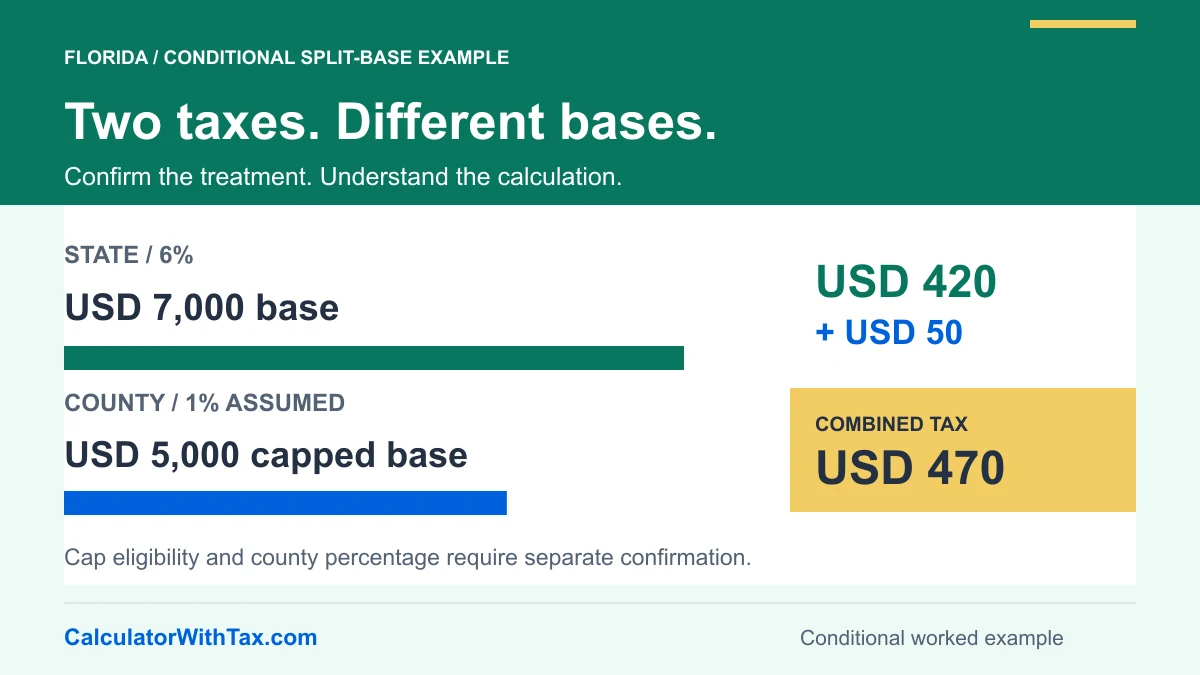
| State | USD 7,000.00 | 6% | USD 420.00 |
| County | USD 5,000.00 | 1% | USD 50.00 |
| Combined tax | Different component bases | Not 7% on all USD 7,000 | USD 470.00 |
Total: USD 7,470.00. Eligibility for this cap and the actual county percentage must be established separately.
Why the county surtax cap needs a separate calculation
The Department describes a USD 5,000 surtax limit for an individual item of tangible personal property. It also identifies transactions where that cap does not apply, including admissions, transient rentals, prepaid calling arrangements and services. This is not a blanket cap on the whole invoice.
For a conditional single USD 7,000 item that qualifies for the cap, assume 6% state tax and 1% county surtax. Calculate state tax on USD 7,000 and county tax on USD 5,000. The results are USD 420 and USD 50, giving USD 470 tax and USD 7,470 total.
Applying 7% to all USD 7,000 would instead give USD 490 tax. The USD 20 difference comes from using the wrong county base, not from rounding. The table computes the two components separately with the same manual engine; the adjustable one-rate calculator does not automate cap eligibility or split-base calculations.
Remove tax only when one-rate assumptions hold
For the earlier USD 214 example at one confirmed 7% rate, divide by 1.07 to recover USD 200. Included tax is USD 14. The exact unrounded tax fraction is 7/107 of the inclusive total.
Do not apply that shortcut to a mixed receipt or a capped split-base calculation. For the general derivation, read the reverse sales tax guide. For before-tax inputs, see how to calculate sales tax.
Reconcile cents without changing the inputs
The tool rounds added tax half-up to cents. On extraction it rounds the recovered base, then takes the difference as tax. Florida’s guidance discusses rounding and item-versus-invoice scope separately; matching a displayed example does not establish complete collection or invoice compliance.
For a receipt discrepancy, compare taxable amounts, component bases, rates and rounding scope in that order. Keep personal addresses and receipt details private when reporting an arithmetic issue.
Frequently asked questions
Is Florida sales tax always 6%?
6% is the general state rate, not a universal final rate. Applicable county surtax, exemptions and transaction-specific rules must be checked separately.
How much is tax on USD 200 at a confirmed 7% combined rate?
If the entire USD 200 has one confirmed 7% treatment, tax is USD 14 and the total is USD 214. The 1% county component in this illustration is assumed, not assigned to a county.
Does the USD 5,000 cap apply to state sales tax?
The described cap concerns discretionary county surtax on qualifying individual tangible-personal-property items. It is not a blanket USD 5,000 cap on state tax or on every receipt. Consult the Department's rules for the transaction.
Can I reverse a capped calculation using one combined rate?
Not reliably. If components used different bases, dividing the full payment by one combined-rate multiplier does not reconstruct those components. Obtain the item and tax breakdown first.
Does this calculator find Florida county rates?
No. Consult the Florida Department of Revenue's official address/jurisdiction resources, then enter established inputs manually. The tool does not decide cap eligibility or taxability.
Manual example
Illustrative arithmetic only. Not an official tax rate.
- Amount before tax
- Tax amount
- Total
200.00 + 14.00 = 214.00
Open the full calculator