
US · sales-tax
New Jersey sales tax calculator: 6.625%, totals and rounding
For a sale confirmed at New Jersey's general 6.625% rate, multiply the taxable amount by 0.06625. Keep the rate's precision, round monetary results separately, and do not confuse cash-payment rounding with tax calculation.
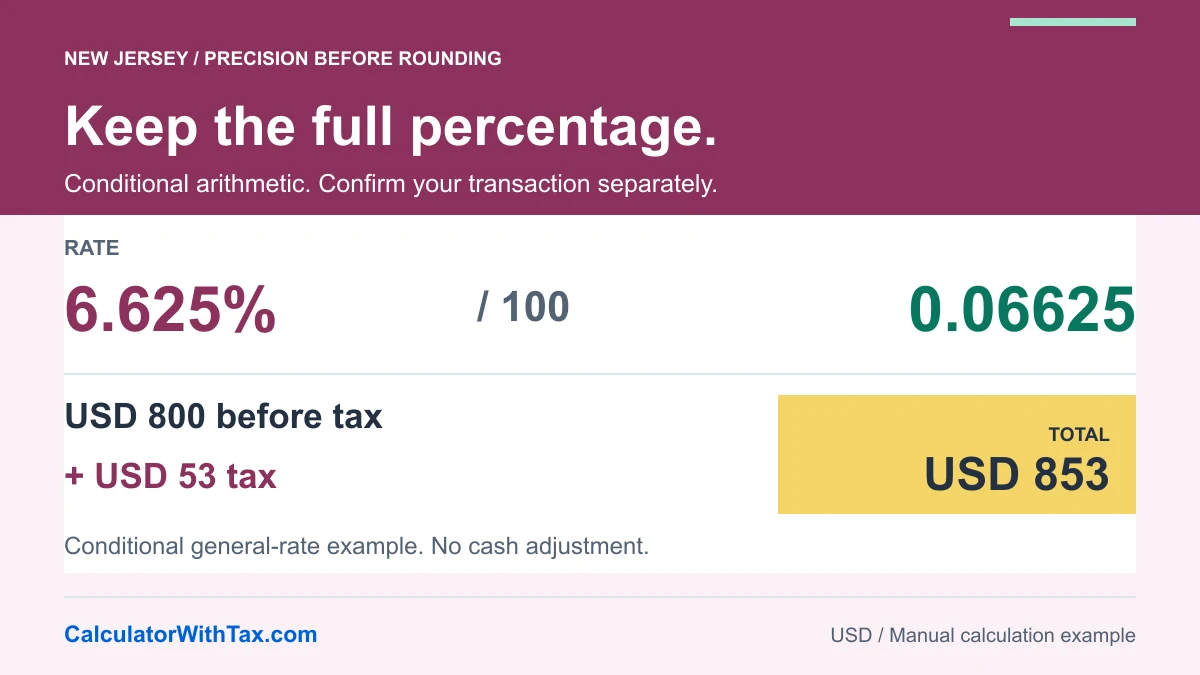
Use the full percentage, not a shortened approximation
A New Jersey sales tax calculator should preserve the percentage you intend to apply. 6.625%, 6.63% and 0.06625% are not interchangeable inputs. The first is a percentage, the second is a changed percentage, and the last mistakenly places the decimal multiplier in a percentage field.
The New Jersey Division of Taxation’s sales tax overview identifies the general 6.625% rate. Its rates and boundaries page records that rate from 1 January 2018. These official pages were checked on 19 October 2026. The general rate does not establish that a particular purchase is taxable.
Open the calculator with tax after confirming the taxable amount and applicable treatment. The tool uses the percentage you enter; choosing United States does not automatically apply New Jersey rules.
Separate the general rate from exceptions
Before multiplying, establish whether the sale belongs under the general rate, is exempt or requires a specialized treatment. New Jersey also publishes Urban Enterprise Zone guidance. A location or program name alone is not a reason to change the percentage in this tool without confirming the relevant eligibility conditions.
This guide deliberately does not decide exemption eligibility, qualified-merchant status, vehicle treatment, product classification, seller registration or return obligations. It explains calculations after the applicable inputs have been established.
For an older purchase, use the rate and rules relevant to that transaction date. A neat match to today’s arithmetic cannot prove that an old receipt used the correct historical treatment.
Calculate a before-tax amount at 6.625%
Assume USD 800 is one established taxable base and the general rate has been confirmed as applicable. Divide the percentage by 100 to obtain the decimal multiplier:
Decimal multiplier = 6.625 / 100 = 0.06625
Tax = 800 x 0.06625 = USD 53.00
Total = 800 + 53 = USD 853.00
Select Add tax, enter 800 as the amount and 6.625 as the percentage. The output separates the before-tax amount, tax and total. No address or customer information is needed for this arithmetic.
If you change the rate input to 6.63%, the same USD 800 base produces USD 53.04 tax. That extra USD 0.04 comes from changing the rate. It is not an unavoidable rounding difference in the original calculation.
Distinguish rate precision from monetary rounding
These examples assume one established taxable base and the stated percentage. They do not identify the rate for an address, product or sale date.
| Scenario | Input | Rate used | Before tax | Tax | Total |
|---|---|---|---|---|---|
| If the general 6.625% rate applies | $800.00 | 6.625% | $800.00 | $53.00 | $853.00 |
| Half-cent example under the manual convention | $100.00 | 6.625% | $100.00 | $6.63 | $106.63 |
| Same general-rate example, tax included | $853.00 | 6.625% | $800.00 | $53.00 | $853.00 |
On USD 100, the multiplication at 6.625% produces an unrounded USD 6.625 tax amount. Under this manual tool’s half-up convention, it displays USD 6.63 and a USD 106.63 total. The percentage is still 6.625%; only the monetary result has been rounded to cents.
The examples and chart use the existing decimal engine, which avoids treating binary floating-point output as payable cents. Their agreement verifies the website’s arithmetic implementation, not the tax treatment of a purchase or every statutory rounding method.
For a receipt mismatch, examine the seller’s taxable base and line or subtotal calculation before concluding that someone charged the wrong tax. Two calculations with different inputs or rounding scopes can differ while looking superficially similar.
Keep cash-payment rounding separate from sales tax
The Division’s cash-transaction rounding guidance explains an optional, disclosed cash-payment policy. It separates rounding the final cash total from calculating tax on the purchase price. Our calculator does not apply that cash adjustment.
For a mathematical illustration at 6.625%, USD 39.99 gives USD 2.65 tax and USD 42.64 total under the manual convention. A separate nearest-nickel adjustment would turn USD 42.64 into USD 42.65. It would not change the original USD 39.99 taxable base or justify recalculating tax on a rounded item price. Consult the official guidance before applying any cash policy.
Keeping these two stages separate makes a receipt easier to understand: the tax calculation explains the charge, while any separately applicable payment adjustment explains the cash settlement. Do not silently overwrite the displayed tax to force it to match an adjusted payment.
Extract tax from a confirmed inclusive total
If USD 853 already contains one tax at 6.625%, divide by 1.06625 to recover USD 800 before tax. The difference is USD 53 included tax. The exact unrounded included-tax fraction is 6.625 / 106.625, equivalent to 53/853.
Select Extract tax and enter the inclusive amount. Do not subtract 6.625% directly from USD 853; that uses the larger total as the percentage base. See the reverse sales tax explanation for the derivation, or how to calculate sales tax for the before-tax workflow.
The manual tool rounds the recovered base to cents and calculates included tax as the difference. It does not reconstruct a receipt containing unknown exempt amounts, special rates, additional fees or a separate cash adjustment.
Frequently asked questions
What rate should I enter in a New Jersey sales tax calculator?
Enter the applicable percentage after confirming the transaction's treatment. New Jersey's general rate is 6.625%; that is not a determination that every purchase is taxable at that rate.
How much is tax on USD 800 at 6.625%?
If that rate applies to the entire USD 800 taxable base, tax is USD 53 and the total is USD 853. The calculation does not establish eligibility for the general rate or an exemption.
Can I shorten 6.625% to 6.63% before calculating?
No. That changes the percentage. At USD 800, 6.625% gives USD 53 tax, while 6.63% gives USD 53.04. Preserve the rate and round the monetary result under the applicable method.
Does cash rounding change the taxable price?
New Jersey's cash guidance separates a disclosed optional cash-payment rounding policy from tax calculation. The tax remains based on the purchase price. Our manual tool does not implement nickel rounding of cash payments.
How do I recover the price before tax from USD 853?
For one tax confirmed at 6.625%, divide USD 853 by 1.06625 to recover USD 800. The included tax is USD 53. This does not work for an unknown mix of rates or charges.
Manual example
Illustrative arithmetic only. Not an official tax rate.
- Amount before tax
- Tax amount
- Total
800.00 + 53.00 = 853.00
Open the full calculator