
US · sales-tax
New York sales tax calculator: state vs NYC rates and totals
New York's 4% state component is not the complete rate for every sale. Establish the applicable combined percentage before calculating; NYC's general 8.875% rate is not a statewide default.
New York State and New York City are different inputs
A New York sales tax calculator needs more than the word “New York.” The state component, a city component and a combined rate describe different things. Entering one where the other is required can change a purchase total even when the multiplication itself is correct.
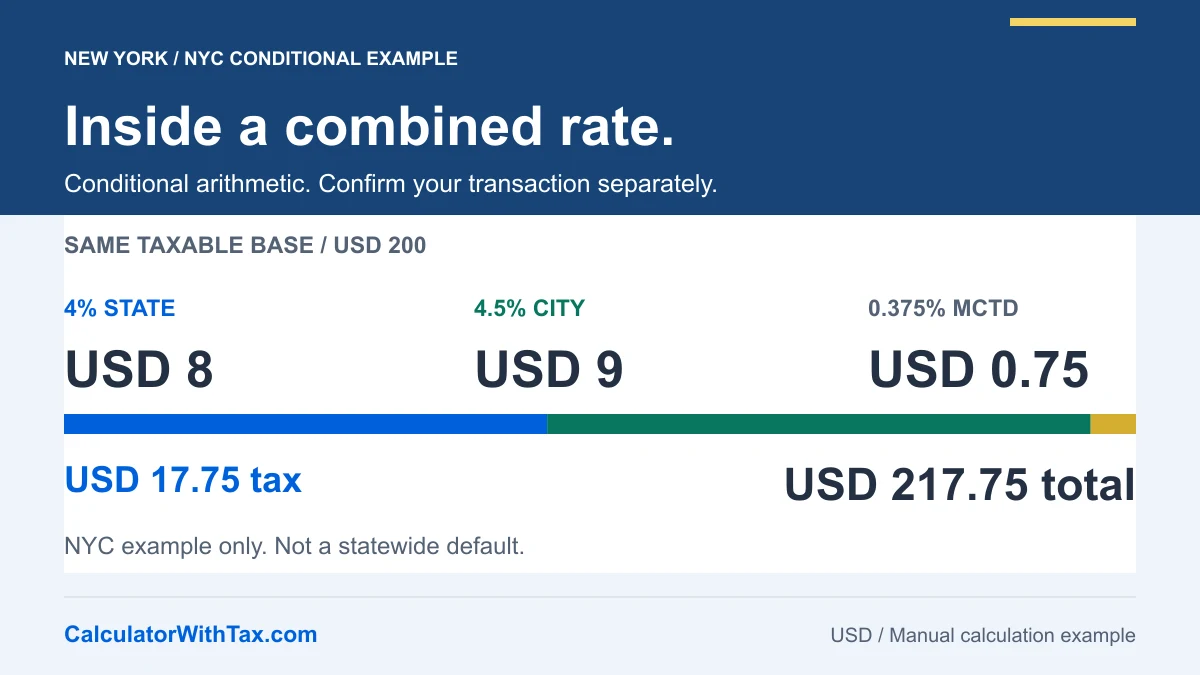
The New York Tax Department’s rate guidance identifies a 4% state component, local additions and an additional 0.375% MCTD component for taxable sales within that district. The NYC Department of Finance describes the city’s general combined rate as 8.875%: 4% state, 4.5% city and 0.375% MCTD. These official descriptions were checked on 19 October 2026; they do not determine the treatment of a particular item or transaction.
Use the calculator with tax once you have independently established your taxable amount and applicable percentage. It is a manual arithmetic tool, not an automatic New York rate or address lookup.
Confirm the jurisdiction and sale date first
The Tax Department’s rate page links to its official jurisdiction/rate lookup. Its rate-publications bulletin describes Publication 718 for combined general rates and Publication 718-A for present and past rates and effective dates. Read the lookup’s own limitations and use the publication appropriate to the transaction.
Do not treat a current rate result as proof of the rate on an older receipt. Likewise, do not assume that the NYC example below applies elsewhere in the state. Specialized transactions, exemptions and different tax treatments remain separate from this calculation.
Before entering a percentage, write down whether your source reports a combined rate or only a component. For an actual calculation, retain the source and relevant date privately. Our tool does not need your name, address or receipt image.
Add a confirmed combined rate to a taxable price
Assume USD 200 is entirely within one taxable base and the 8.875% general NYC combined rate has been established as applicable. The decimal multiplier for the tax is 0.08875:
Tax = 200 x (8.875 / 100) = USD 17.75
Total = 200 + 17.75 = USD 217.75
On that same base, 4% produces USD 8, 4.5% produces USD 9 and 0.375% produces USD 0.75. Their sum is USD 17.75. This component explanation works because all three percentages in the example apply to the same established base; it is not a taxability determination.
Select Add tax, enter 200 as the amount and 8.875 as the percentage. Preserve all three decimal places in the rate. Rounding the percentage before multiplying changes the input, rather than merely changing the presentation of the answer.
Read the comparison without confusing state tax and total tax
These examples assume one established taxable base and the stated percentage. They do not identify the rate for an address, product or sale date.
| Scenario | Input | Rate used | Before tax | Tax | Total |
|---|---|---|---|---|---|
| If the NYC general combined rate applies | $200.00 | 8.875% | $200.00 | $17.75 | $217.75 |
| State component only, not the combined total | $200.00 | 4% | $200.00 | $8.00 | $208.00 |
| Same combined-rate example, tax included | $217.75 | 8.875% | $200.00 | $17.75 | $217.75 |
The state-component row produces USD 8 tax and USD 208 when that component alone is added. It is included to explain the difference between a component and the combined calculation, not to recommend a state-only checkout rate.
If the confirmed combined input is already 8.875%, adding another 4 percentage points changes it to 12.875%. On USD 200, that would produce USD 25.75 tax instead of USD 17.75. The extra USD 8 comes from counting the state component twice.
The chart measures tax as a portion of the USD 217.75 total. That portion is smaller than 8.875% because the tax rate was applied to USD 200, not to the larger inclusive amount.
Reverse a total that already includes the tax
If USD 217.75 contains this one known tax, divide by 1.08875 to recover USD 200 before tax. Subtract the recovered base from the total to obtain USD 17.75 included tax. In the adjustable example, select Extract tax and enter the inclusive amount.
The exact unrounded tax fraction is 8.875 / 108.875, equivalent to 71/871. This fraction operates on the inclusive total. It is not a new rate to apply to a before-tax amount. The reverse sales tax guide explains the general relationship.
Reconcile the result and its limits
Check that the taxable base is complete and belongs under one confirmed treatment. A mixed receipt, fee or exempt item may make a single percentage on the entire payment inappropriate. This guide does not determine those classifications or a seller’s collection and filing obligations.
The manual engine rounds added tax to cents with half-up rounding. When extracting tax, it rounds the recovered base and uses the difference for tax. This is a disclosed tool convention, not certification of every New York collection or invoice-rounding rule. For the general before-tax workflow, see how to calculate sales tax.
Frequently asked questions
Is New York sales tax 4% or 8.875%?
4% is the state component. NYC's general combined rate is 8.875%, including city and MCTD components. Neither number alone determines the treatment of every New York transaction. Check the location, date and applicable tax rules.
How much is tax on USD 200 at 8.875%?
If that combined percentage applies to the entire USD 200 base, tax is USD 17.75 and the total is USD 217.75. This conditional example does not classify any product or address.
Should I add the state rate to a combined rate?
No. A combined percentage already includes its component rates. Adding the state component again would overstate the input. Verify what the official lookup result represents before calculating.
How do I remove 8.875% tax from an inclusive total?
Divide the one-rate inclusive total by 1.08875 to recover the unrounded base. For the USD 217.75 example, the base is USD 200 and included tax is USD 17.75. The exact unrounded tax fraction is 71/871 of the total.
Does this calculator look up New York tax by address?
No. It uses your manually entered percentage. The New York Tax Department provides its own jurisdiction/rate lookup and rate publications, which should be consulted separately.
Manual example
Illustrative arithmetic only. Not an official tax rate.
- Amount before tax
- Tax amount
- Total
200.00 + 17.75 = 217.75
Open the full calculator