
US · sales-tax
Sales tax by ZIP code: why the full address can matter
A postal ZIP code is not a guaranteed tax-jurisdiction boundary. Use the relevant state's official guidance to establish the location and applicable treatment, then calculate with the confirmed percentage.
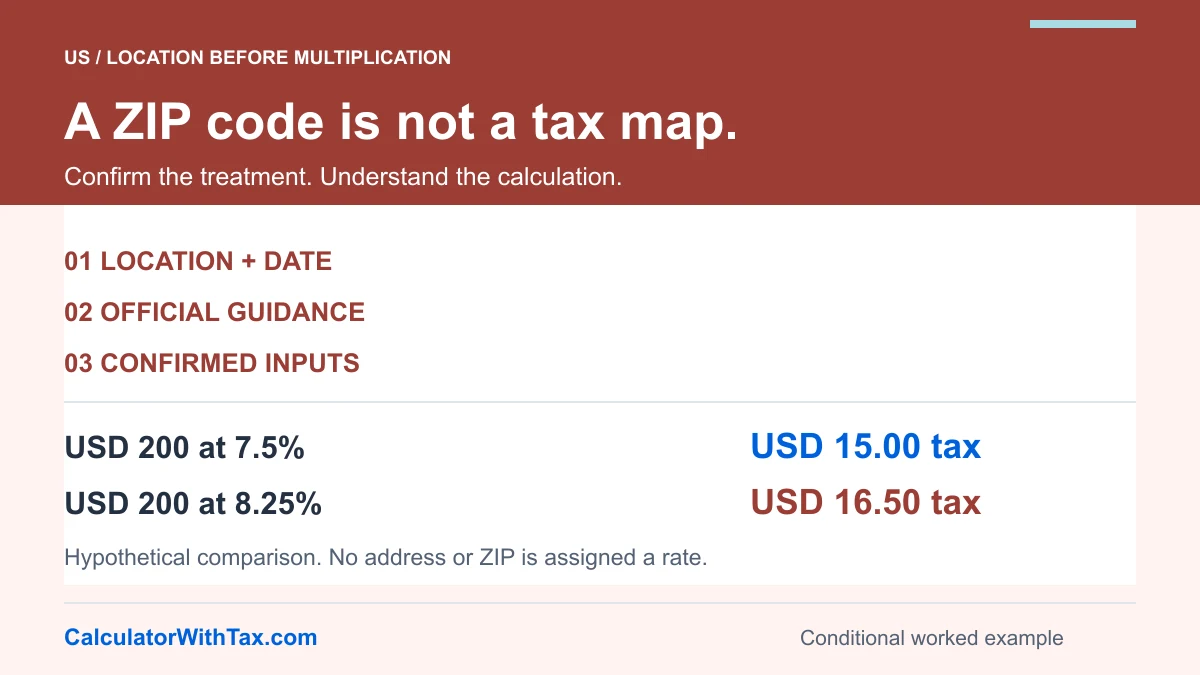
A ZIP code is a starting point, not a tax decision
Searching for sales tax by ZIP code often means you want a quick final price. The difficult part is not multiplying a percentage; it is establishing which percentage and taxable amount belong to the transaction.
The California Department of Tax and Fee Administration warns that a mailing address or ZIP code alone may not identify the correct rate. The Texas Comptroller’s local tax guide explains that local taxing boundaries do not follow postal ZIP boundaries. These official sources were checked on 19 October 2026. Their guidance concerns their own jurisdictions, not a single national sourcing rule.
The calculator with tax does not offer ZIP-to-rate matching. It calculates established inputs without requesting your address.
Follow a location-to-calculation workflow
- Identify the relevant state and transaction date. Do not use a current rate to explain an old sale without checking its effective period.
- Read the state’s location and sourcing guidance. Do not assume every transaction uses only the buyer’s home address or only the seller’s location.
- Use the official address or jurisdiction resource linked by that authority where appropriate. Review the result’s limitations.
- Establish the taxable base and whether the reported rate is combined or a single component.
- Enter that established amount and percentage into the calculator, keeping supporting details in your private records.
This sequence keeps jurisdiction research separate from arithmetic. It also prevents a precise-looking percentage from concealing an uncertain location or product classification.
Compare two hypothetical rates on the same amount
Assume USD 200 is taxable under one known treatment. To illustrate why rate selection matters, compare hypothetical inputs of 7.5% and 8.25%. These are not rates assigned to neighboring addresses, a named ZIP code or a real purchase.
Example A: 200 x 0.075 = USD 15.00 tax
Example B: 200 x 0.0825 = USD 16.50 tax
Difference: 16.50 - 15.00 = USD 1.50| Scenario | Input | Rate | Before tax | Tax | Total |
|---|---|---|---|---|---|
| Hypothetical rate A, not an address assignment | USD 200.00 | 7.5% | USD 200.00 | USD 15.00 | USD 215.00 |
| Hypothetical rate B on the same base | USD 200.00 | 8.25% | USD 200.00 | USD 16.50 | USD 216.50 |
| Rate A example, tax included | USD 215.00 | 7.5% | USD 200.00 | USD 15.00 | USD 215.00 |
The difference is 0.75 percentage points, not a claim that one location is 0.75% more expensive overall. With the same base, multiply USD 200 by 0.0075 to verify the USD 1.50 change. Rounding is not responsible for this example’s difference.
The chart separates the USD 200 base from tax. It is a proportional arithmetic diagram, not a map. It makes no claim about the geographic size of any taxing area.
A location lookup still does not classify the purchase
A rate associated with an address cannot by itself tell you whether an item is exempt, whether shipping belongs in the base or which sourcing rules govern an unusual sale. Those questions require the relevant official guidance and transaction facts.
For state-specific context, read the California calculation guide or Texas state and local comparison. Neither article turns the manual tool into an address-based compliance service.
Avoid substituting a neighboring city’s rate because it looks plausible. If official resources do not resolve a boundary or classification question, seek clarification before treating the result as a charge to collect.
Check a tax-included payment only after confirming its scope
For the hypothetical 7.5% case, USD 215 contains USD 200 before tax and USD 15 tax. The exact unrounded tax fraction is 7.5 / 107.5, equivalent to 3/43. Multiplying the inclusive payment directly by 7.5% would use the wrong base.
This reverse calculation assumes one rate on the entire taxable base and no unrelated fees or exempt amounts. A receipt with several treatments needs a breakdown before a meaningful comparison can be made.
Keep addresses private and evidence useful
Our manual calculator needs an amount and percentage only. Consult an official lookup separately rather than putting an address into an amount field or report. Record the source, date and assumptions privately so you can reproduce your calculation later.
The tool uses decimal arithmetic and a disclosed cents-rounding convention. Correct arithmetic can confirm that your inputs agree; it cannot certify that those inputs satisfy every state or local obligation.
Frequently asked questions
Can one ZIP code contain more than one sales tax jurisdiction?
Yes. Texas explicitly warns that taxing boundaries do not follow ZIP codes. California also cautions that a mailing address or ZIP code alone may not establish the correct rate. Consult the relevant state's guidance.
Does entering a ZIP code guarantee the correct sales tax?
No. A location result still needs the relevant date, sourcing rules and product or transaction treatment. A postal estimate is not a universal compliance determination.
Does CalculatorWithTax look up rates by ZIP code?
No. This guide links to official resources. The calculator performs manual arithmetic using the amount and percentage you provide.
How much can a small rate difference change a total?
On an illustrative USD 200 base, 7.5% gives USD 15 tax while 8.25% gives USD 16.50. The difference is USD 1.50. Neither percentage is assigned to an address or ZIP code here.
Should I send my address to use the calculator?
No. The manual calculator needs only an amount and rate. Use official address tools separately and avoid including private address details in an error report.
Manual example
Illustrative arithmetic only. Not an official tax rate.
- Amount before tax
- Tax amount
- Total
200.00 + 15.00 = 215.00
Open the full calculator