
GB · income-tax
How to Calculate a Daily Rate from Annual Salary: Choose the Basis
Divide annual gross salary by an explicitly chosen number of days. Different denominators produce different daily equivalents; none automatically establishes a contractual day rate or a contractor's take-home pay.
Published
Choose what you mean by a day before dividing
A daily equivalent is an annual amount allocated across a chosen number of days. The formula is simple; choosing the right denominator is the part that needs care. A calendar day, a hypothetical paid working day and a chargeable contractor day are not the same unit.
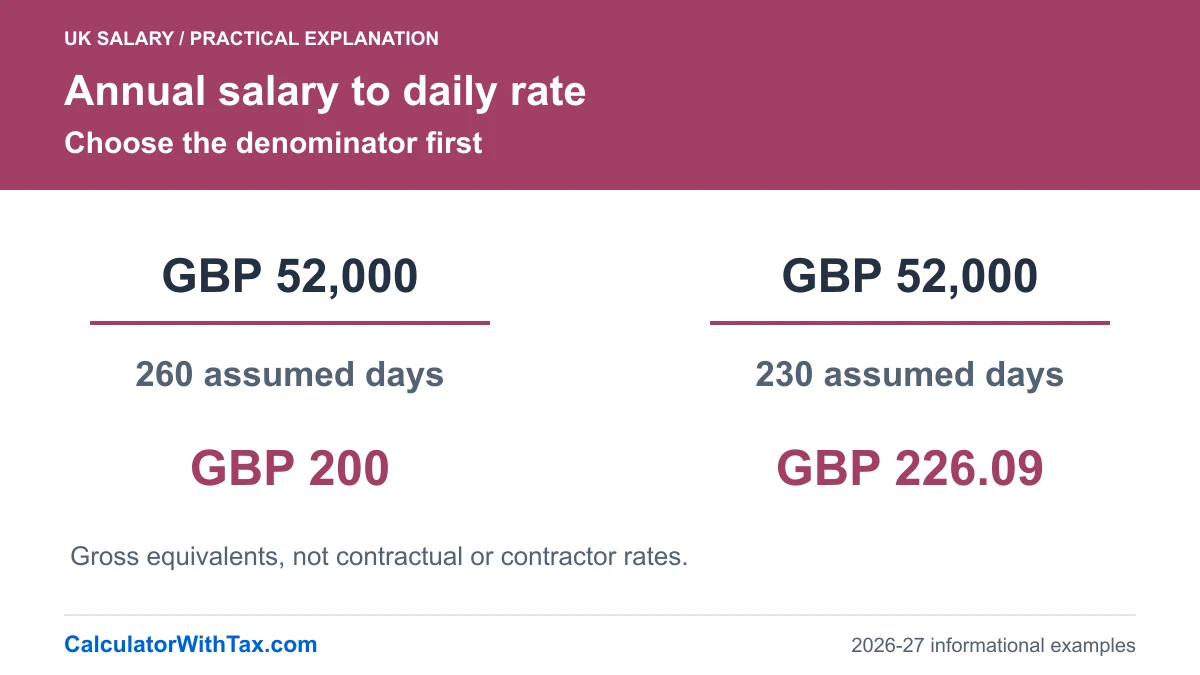
For £52,000 annual gross, dividing by 260 produces £200. Dividing by 230 produces approximately £226.09. Neither result contradicts the other because the denominator changed. Neither calculation, on its own, proves what an employer owes for a day’s absence or what a contractor should charge.
This is a mathematical comparison guide. It does not establish holiday pay, notice pay, a deduction for absence, a contractual daily rate or an employment-status decision.
Use a clearly labeled gross conversion
The basic relationship is:
Use annual gross salary as the numerator when the answer is intended to be gross. Do not divide an annual net estimate and label it a gross rate. Keep the chosen day count in the answer, for example “£200 gross per assumed day on a 260-day basis”, rather than presenting £200 as a universal rate.
In this article, 260 is five multiplied by 52, a simplified comparison basis. It is not a count of every person’s actual working days in a particular year. The 230 and 365 alternatives are also stated assumptions, not findings about a reader’s contract or holiday entitlement.
Compare three explicit denominators
The table uses the same annual gross in every row. Only the divisor changes, and results round to two decimal places using exact-decimal arithmetic.
| Explicit basis | Annual gross | Divisor | Gross equivalent |
|---|---|---|---|
| Assumed 260-day basis | £52,000.00 | 260 | £200.00 |
| Assumed 230-day basis | £52,000.00 | 230 | £226.09 |
| Assumed 365-calendar-day basis | £52,000.00 | 365 | £142.47 |
These are alternative denominators for the same annual amount, not interchangeable payment promises. The tax examples below still use the supported twelve-month employee model.
A smaller positive divisor produces a larger equivalent. That does not create additional annual earnings. Multiplying a rounded equivalent back by the divisor may leave a few pennies of rounding difference; it is not a payroll reconciliation or an instruction to alter contractual pay.
Avoid mixing calendar-day and working-day comparisons across offers. If one side uses 365 and the other 230, a larger daily number can be an artifact of the basis rather than a better annual offer. Compare annual gross first and explain the denominators separately.
A contractor day rate is a different question
A salaried employee’s annual gross and a contractor’s invoiced revenue are not interchangeable amounts. The contractor comparison can require costs, chargeable days, unpaid time and a separately established tax status. An ordinary salary division supplies none of those facts.
| Question | Inputs needed | What this article supplies |
|---|---|---|
| Gross mathematical equivalence | Annual gross and chosen divisor | Explicit illustrative arithmetic |
| Specific employment pay entitlement | Applicable terms, circumstances and rules | No entitlement decision |
| Contractor pricing or after-tax income | Revenue, costs, status and relevant tax model | No contractor or IR35 calculation |
Do not increase the employee result by an invented standard contractor premium and call the outcome verified. A useful pricing comparison needs its own evidence, not a percentage copied from an unrelated example.
Keep the annual employee tax illustration separate
If the starting £52,000 genuinely describes the supported full-year employment baseline, the UK take-home pay calculator can answer its narrower annual tax question. The following result uses regular monthly category A NI, not the 260-day or 230-day denominator.
Gross daily equivalence is separate from the linked employee annual tax estimate.
Synthetic 2026–27 examples: one full-year UK-resident employee, regular monthly category A NI, salary-only income and no pensions, loans or other excluded deductions. Independent professional tax review incomplete.
Take-home £40,717.96Income Tax £8,232.00Employee NI £3,050.04
| Scenario | Gross | Allowance | Income Tax | Employee NI | Annual net | Monthly average net |
|---|---|---|---|---|---|---|
| Employee annual baseline | £52,000.00 | £12,570.00 | £8,232.00 | £3,050.04 | £40,717.96 | £3,393.16 |
Reference checked 20 October 2026. NI is summed from twelve rounded monthly contributions. Average components are rounded before net is derived; direct annual-net division can differ by a penny.
The day count must not change the tax result in this illustration because it is not an input to the employee tax engine. The annual salary and monthly payment model remain fixed. This separation prevents gross conversion arithmetic from silently becoming an unsupported daily payroll calculation.
Pensions, loans, salary sacrifice, other income and partial-year employment remain excluded. An annual net amount allocated over days would still be an allocation, not the net payment due for a particular working day.
Write down the basis with the answer
Before using a daily figure, record the annual amount, whether it is gross or net, the divisor and the intended purpose. Check whether the task calls for a mathematical comparison or an actual pay entitlement. If it is the latter, consult the applicable terms and appropriate guidance rather than choosing whichever divisor gives the preferred result.
For a simpler annual-to-monthly comparison, use the related monthly guide. For a real payroll question, inspect correctly labeled payslip figures and seek an explanation through the appropriate private payroll or professional channel.
Frequently asked questions
What is the formula for a gross daily salary equivalent?
Annual gross salary divided by the explicitly chosen number of days. The divisor must match the purpose; the arithmetic alone does not choose a contractual or legally required method.
Is 260 days mandatory for every UK salary calculation?
No. This guide uses 260 as an illustrative five-times-52 basis, not a universal legal rule. A specific entitlement or payroll calculation needs its applicable contract and rules.
What is GBP 52,000 divided by 260?
It is GBP 200 gross per assumed day. A 230-day divisor gives about GBP 226.09. These are different denominators applied to the same gross amount, not different tax results.
Does the result tell me what contractor day rate to charge?
No. Contractor revenue, costs, unpaid time and tax status are a separate problem. The linked tax calculator is a restricted employee annual model, not a contractor or IR35 calculator.
Can I call annual net divided by 260 my daily payslip?
No. An average allocation is not a daily PAYE calculation or entitlement. This guide does not produce daily payroll deductions or after-tax contractor rates.
Explore the supported annual salary baseline
Compare annual Income Tax and projected monthly employee NI. Pensions, loans, tax-code adjustments and actual PAYE payslips are not calculated.
UK take-home pay calculator