
GB · income-tax
National Insurance Thresholds: Monthly Employee NI for 2026/27
Start an employee NI comparison with the earnings period and category. For the monthly category A baseline here, 8% and 2% apply to different slices; employer thresholds and the Income Tax allowance are separate.
Published
Start with employee, category and pay period
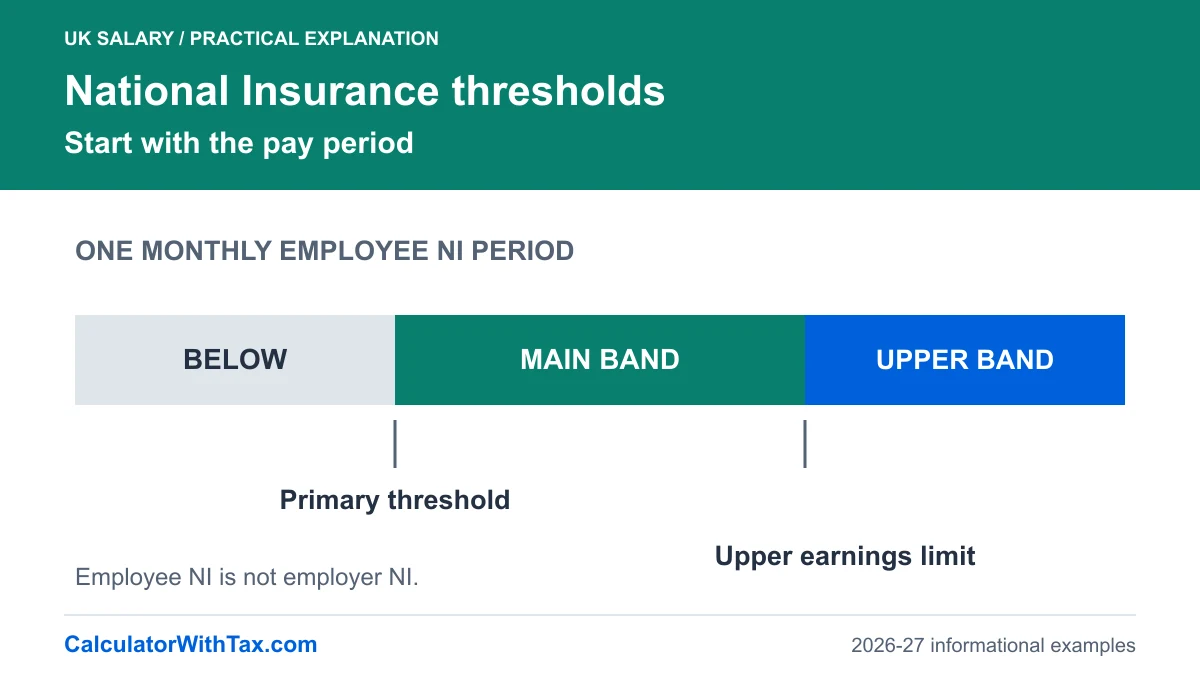
There is no single National Insurance threshold that can be dropped into every calculation. Identify whether the amount concerns employee or employer contributions, which category applies and the relevant earnings period. This guide concerns regular monthly category A employee NI for 2026–27 only.
HMRC’s employee rates page and employer tables give the current monthly boundaries. In this baseline, the primary threshold is £1,048 and the upper earnings limit is £4,189. The main employee slice uses 8%; the amount above the upper limit uses 2%.
Apply rates to the correct slices
An £1,100 gross month has £52 above the primary threshold. At 8%, that produces £4.16 employee NI for the month under the stated category and model. It is not 8% of the full £1,100.
For a £5,000 gross month, the main slice is £4,189 minus £1,048, or £3,141. Its contribution is £251.28. The upper slice is £5,000 minus £4,189, or £811; at 2% that adds £16.22. The month totals £267.50.
| Gross month | Main slice contribution | Upper slice contribution | Monthly employee NI |
|---|---|---|---|
| £1,100 | £52 × 8% = £4.16 | None | £4.16 |
| £5,000 | £3,141 × 8% = £251.28 | £811 × 2% = £16.22 | £267.50 |
These deliberately clean inputs avoid a midpoint in the example table. At a fractional-penny boundary, the engine applies the recorded monthly rounding convention after calculating the month’s contribution. The statutory provision treats an exact halfpenny as rounding down; this is not the annual Income Tax estimate’s half-up policy.
Reconcile the annual salary projections
£13,200 and £60,000 split into twelve regular gross payments of £1,100 and £5,000 respectively. Their projected NI sums therefore provide an independent check on the monthly arithmetic above. The annual Income Tax in the same table is a separate calculation.
Twelve regular category A monthly payments, not an annual-threshold NI calculation.
Synthetic 2026–27 examples: one full-year UK-resident employee, regular monthly category A NI, salary-only income and no pensions, loans or other excluded deductions. Independent professional tax review incomplete.
Take-home £13,024.08Income Tax £126.00Employee NI £49.92
Take-home £45,358.00Income Tax £11,432.00Employee NI £3,210.00
| Scenario | Gross | Allowance | Income Tax | Employee NI | Annual net | Monthly average net |
|---|---|---|---|---|---|---|
| GBP 1,100 gross each month | £13,200.00 | £12,570.00 | £126.00 | £49.92 | £13,024.08 | £1,085.34 |
| GBP 5,000 gross each month | £60,000.00 | £12,570.00 | £11,432.00 | £3,210.00 | £45,358.00 | £3,779.83 |
Second scenario minus first: gross £46,800.00, Income Tax £11,306.00, employee NI £3,160.08, annual net £32,333.92. A negative difference means a reduction, not a refund.
Reference checked 20 October 2026. NI is summed from twelve rounded monthly contributions. Average components are rounded before net is derived; direct annual-net division can differ by a penny.
The UK take-home pay calculator sums twelve rounded monthly employee contributions. It does not subtract one annual threshold and call that identical to the monthly result. If annual gross cannot be divided evenly into pence, it allocates the remainder pennies to the first projected months so the gross schedule still reconciles.
Why annual-threshold division can give a different result
The published annual primary threshold is £12,570. Dividing that by twelve gives £1,047.50, not the published £1,048 monthly boundary. That small difference is enough to change a contribution near a threshold and can accumulate across a year.
An annualized estimator and a monthly-period model can therefore disagree without one necessarily implementing the other’s method incorrectly. Before calling a discrepancy an error, compare period, category, threshold and rounding. Matching an annual gross input does not establish that two tools use the same NI model.
Do not confuse the official threshold labels
The lower earnings limit, primary threshold and secondary threshold serve different roles in the official tables. The lower earnings limit is not interchangeable with the starting point for this category A employee cash contribution. The secondary threshold relates to employer contributions, which are not deducted as employee NI in our salary model.
Nor is an Income Tax code an instruction to change these NI boundaries. Income Tax allowances, PAYE code history and NI contribution categories need to be identified separately. This guide does not assess an individual’s contribution record, benefits qualification or employer reliefs.
Keep the scope with the result
The examples do not cover directors, irregular earnings, other NI categories, deferral, multiple jobs or transitions around State Pension age. A matching annual salary does not make those circumstances equivalent to twelve regular category A payments.
Keep the year and period attached to the result. If a real payslip has an unexpected contribution, ask which earnings period, category and eligible pay were used. Do not replace a payroll explanation with a generic percentage of gross salary.
Frequently asked questions
What monthly thresholds does this category A example use?
For 2026/27 it uses a GBP 1,048 monthly primary threshold and GBP 4,189 monthly upper earnings limit. The rates are 8% on the main slice and 2% above the upper limit, not 8% on the whole payment.
Can I divide the annual primary threshold by twelve?
Not as a replacement for the published monthly threshold. GBP 12,570 divided by twelve is GBP 1,047.50, while the stated monthly NI threshold is GBP 1,048. The selected earnings period matters.
Is the lower earnings limit the point where this employee NI charge starts?
No. The lower earnings limit and primary threshold are distinct terms in the official tables. This guide's category A cash-contribution calculation uses the primary threshold. It does not assess contribution-record entitlement.
Does the tool calculate employer NI?
No. It estimates employee NI only. Employer contributions, categories and reliefs must not be substituted into the employee deduction.
Can I use this for directors or irregular pay?
No. Those cases, other NI categories and category changes require different inputs or methods and are outside this regular monthly category A baseline.
Explore the supported annual salary baseline
Compare annual Income Tax and projected monthly employee NI. Pensions, loans, tax-code adjustments and actual PAYE payslips are not calculated.
UK take-home pay calculator