
US · sales-tax
New York sales tax: store vs manufacturer coupons
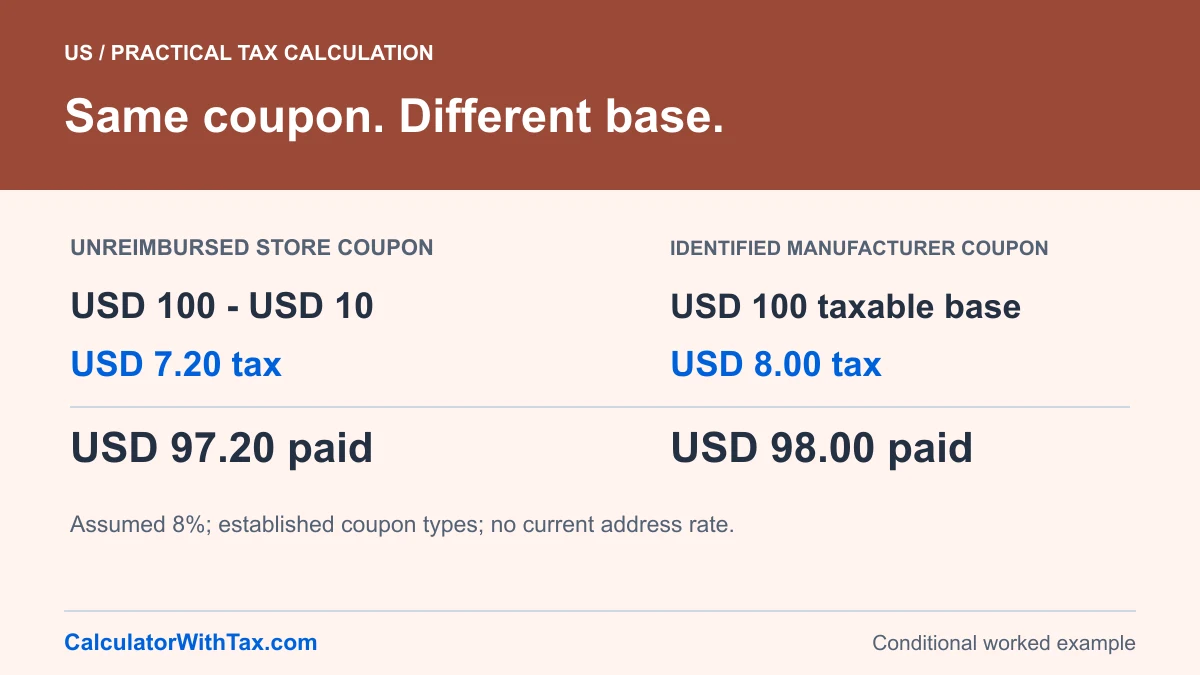
A coupon can reduce what you pay without reducing the taxable receipt by the same amount. At an illustrative 8% rate, a USD 10 store coupon on USD 100 produces USD 97.20 payable; an identified reimbursed manufacturer coupon produces USD 98.00.
Start with who funds the coupon
A New York sales tax coupon calculation has two questions: what amount is taxable, and how much does the customer still need to pay? Those amounts do not always move together. A coupon reimbursed by a manufacturer can function differently from a price reduction funded entirely by the shop.
The examples below concern an otherwise taxable purchase, a known selling price and the stated coupon type. Their 8% rate is illustrative, not a location lookup or a recommendation for any current New York address. Determine the address, date, item treatment and applicable combined rate before checking a real sale.
New York’s coupon bulletin TB-ST-140 distinguishes unreimbursed store coupons, identified manufacturer coupons and double coupons. It also describes exceptions. The bulletin was issued on 26 March 2010; its continuing presence on the official site does not eliminate the need to check subsequent law and the facts of a transaction.
Compare the same USD 10 discount two ways
Assume one USD 100 taxable item and an 8% example rate. With an ordinary unreimbursed USD 10 store coupon, the base becomes USD 90. Tax on USD 90 is USD 7.20, leaving USD 97.20 payable.
For an identified USD 10 manufacturer coupon reimbursed to the seller, the ordinary comparison keeps the USD 100 taxable base. Tax is USD 8.00. The full amount is USD 108.00, from which the customer satisfies USD 10 through the coupon, leaving USD 98.00 payable.
Both customers present a coupon with the same face value. The USD 0.80 payment difference comes from the USD 10 difference in taxable base multiplied by the assumed 8% rate. It is not a second charge on the coupon itself.
Compare established coupon treatments
New York coupon scenarios; assumed 8%, not a current address rate. Reimbursement and coupon classification must be established separately.
Sales tax = established taxable receipt x 8/100 (illustrative rate).
- Customer payment
- USD 97.20
Original price: USD 100.00; Taxable receipt: USD 90.00; Sales tax: USD 7.20; Customer payment: USD 97.20
| Starting assumptions | Tax in the stated amount | Scenario result |
|---|---|---|
| Unreimbursed store coupon: USD 1.00; 0.25 USD | USD 0.06 | Customer payment: USD 0.81 |
| Identified manufacturer coupon: USD 1.00; 0.25 USD | USD 0.08 | Customer payment: USD 0.83 |
| Matched store and manufacturer coupons: USD 2.00; 0.50 USD | USD 0.12 | Customer payment: USD 1.12 |
The adjustable comparison deliberately fixes the example rate. It is designed to isolate coupon treatment, not combine that issue with address matching, tax holidays, exemptions, shipping or product classification. Use the New York sales tax guide for the separate location and rate-verification workflow.
Reproduce the bulletin’s small examples
Small figures make the ordering easier to inspect. A USD 1 item with an unreimbursed USD 0.25 store coupon leaves a USD 0.75 taxable base. At the assumed 8%, tax is USD 0.06 and the customer pays USD 0.81.
With an identified reimbursed USD 0.25 manufacturer coupon, the same USD 1 item has USD 0.08 tax on its full price. USD 1.08 less the coupon leaves USD 0.83 payable. These ordinary distinctions from the official bulletin are reproduced in the example table above as source illustrations, not records of observed transactions.
Check the labels as well as the final number. A receipt showing USD 0.83 payable does not mean USD 0.83 was the taxable selling price. Working backward from that payment with a simple reverse-tax formula would ignore the coupon’s role in settling the bill.
Separate the two parts of a double coupon
Now assume a USD 2 item and a USD 0.50 identified manufacturer coupon that the shop doubles with another USD 0.50 of its own money. In this bounded case, the shop-funded portion reduces the taxable base to USD 1.50. At 8%, tax is USD 0.12. The resulting USD 1.62 is then reduced by the manufacturer’s USD 0.50 contribution, leaving USD 1.12 for the customer to pay.
Subtracting both portions before calculating tax would use USD 1 as the base and produce the wrong result for these assumptions. Ignoring the shop-funded portion would instead tax USD 2. The useful record is not merely “double coupon” but the value and funding of each part.
The interactive example assumes the extra store contribution equals the manufacturer coupon’s face value. A promotion with a cap, a different multiplier or restrictions needs its actual terms checked. It is not modeled by silently changing this example’s meaning.
Do not generalize the unmarked-coupon exception
The official bulletin also discusses coupons that are reimbursed but do not identify themselves as manufacturer coupons. Its collection and return-reporting treatment is not the same as simply choosing the ordinary manufacturer option above. That exception is outside this calculator example.
Likewise, an instant rebate, a later rebate and a shop price reduction need not share the same treatment. New York’s taxable-receipt guidance is an additional starting point for understanding what forms part of a receipt. A promotion’s marketing name is not a substitute for its reimbursement agreement and conditions.
For a real checkout discrepancy, obtain the coupon wording, the seller’s reimbursement information and the receipt before concluding that the arithmetic is incorrect. Do not change the rate to force a preferred payment; that would conceal the base issue.
Why reverse tax from the payment can fail
Reverse tax works when the amount being reversed is a tax-inclusive amount for a known base and rate. A payment after an identified manufacturer coupon is not necessarily that amount. In the USD 100 example, the customer pays USD 98, but the taxable transaction still includes the manufacturer’s contribution.
Reconstruct the full amount and coupon settlement first, then apply the appropriate calculation. The reverse sales tax guide explains why a known inclusive starting amount matters. It cannot infer coupon funding from a bank-card payment or a rounded receipt total.
Keep other non-taxable tender or adjustments separate too. A checkout total can contain several kinds of movement, while the tax base is a narrower accounting quantity. The illustration is a one-item comparison, not a general point-of-sale system.
A practical receipt-checking sequence
- Confirm that the item is taxable and identify the applicable jurisdiction and date.
- Read the coupon terms and establish which party funds each reduction.
- Determine the taxable receipt before multiplying by the verified rate.
- Add the calculated tax, then account for reimbursed coupon settlement where appropriate.
- Reconcile the displayed base, tax, coupon and customer payment separately.
For multiple items, retain the seller’s allocation and rounding approach. The examples round a single tax amount to cents; they do not establish a mandatory invoice-wide policy or allocate a coupon across differently treated items.
When this comparison is useful
Use it to explain an ordinary store-versus-manufacturer coupon difference, train a receipt review, or test an already classified example. Use the general sales tax calculation guide when the base has been established and the remaining question is multiplication.
Do not use it to determine filing liability, reimbursement rights, tax-exempt status or the treatment of an unmarked coupon. A clear answer sometimes means stopping at the missing fact: who actually funds the discount? Without that fact, a precise-looking total would still be based on an unresolved assumption.
Frequently asked questions
Do store coupons reduce New York sales tax?
An unreimbursed store coupon reduces the taxable receipt in the ordinary case described by New York's coupon bulletin. Establish who funds the discount before applying that treatment.
Why can an identified manufacturer coupon leave the tax unchanged?
Where the seller is reimbursed and the coupon is identified as a manufacturer coupon, the bulletin's ordinary example taxes the full selling price. The coupon then reduces the customer's payment rather than that taxable base.
Is 8% the current rate for every New York address?
No. It is the illustrative rate used here and in the cited coupon examples. Determine the applicable rate and transaction treatment separately.
How does a double coupon affect the base?
In the bounded example, only the store-funded extra portion reduces the base. Tax is added to that reduced base, then the reimbursed manufacturer portion reduces the customer's remaining payment.
Can the example handle an unmarked but reimbursed coupon?
No. New York's bulletin describes a separate collection and reporting treatment for that situation. It must not be treated automatically as either of the two ordinary cases in this example.
Check a separately established amount
Use one confirmed taxable amount and the applicable percentage. The manual calculator does not select a rate or classify the transaction.
Open the manual calculator